
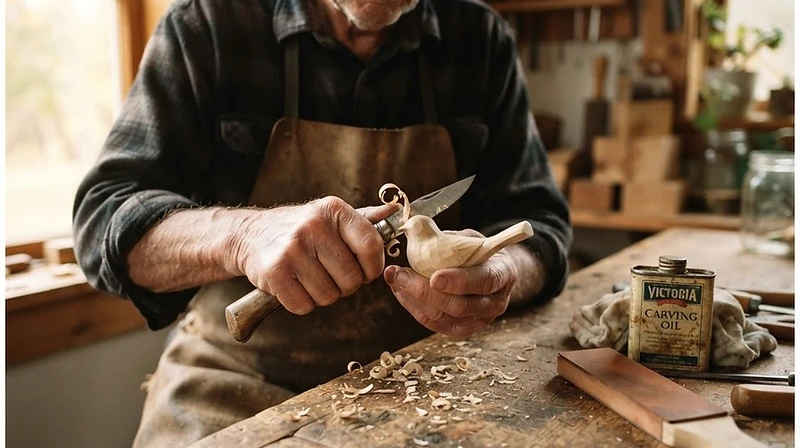
Whittling
A knife, a stick, a curl of wood — the quietest craft there is, where the blade is steady and the mind is steadier.
But first, a little context and history...
Whittling is the simplest of the woodcarving crafts. You need a knife and a piece of wood. You hold the knife in one hand and the wood in the other, and you cut away what does not belong. The shaving that falls is called a curl, and the skill of the craft is in making the curl — a clean, continuous ribbon of wood that means the blade is sharp, the angle is right, and the grain is being read correctly. A whittler who can produce a long, unbroken curl is a whittler who understands the wood.
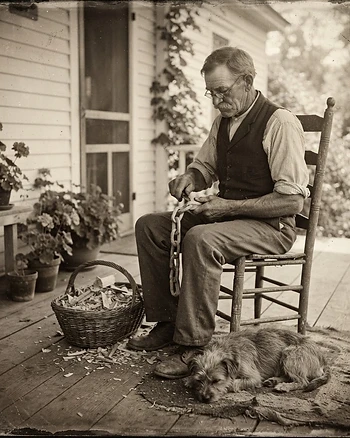
The craft is older than the name. Humans have been cutting shapes from wood since the Paleolithic, and every culture with access to wood has produced carved figures, utensils, and tools. But the word "whittling" — and the particular culture it names — is American, and it begins on the front porch. In the 19th and early 20th centuries, before radio and television, whittling was what a man did when he sat down. He pulled a pocketknife from his overalls, picked up a stick, and cut. The product was often nothing in particular — a point on a stick, a rough animal, a wooden chain carved from a single piece of wood, each link released from the next with nothing but a knife. The point was not the product. The point was the sitting, the cutting, and the thinking.
The craft entered the 20th century through the Boy Scouts. The first Boy Scout Handbook, published in 1911, included whittling and woodcarving among its merit badges, and the Scouts taught a generation of American boys to handle a knife safely and to read the grain of a piece of wood. The 1920s and 1930s were the golden age of the pocketknife as a tool — every boy carried one, and the first thing many of them carved was a tent stake or a spoon or a small animal. The craft was passed from father to son on the porch, in the workshop, and at the campsite.
The modern carving community is larger and more connected than any porch whittler could have imagined. The internet brought carvers together in forums and Facebook groups, YouTube made it possible to watch a master carver make a cut from any angle, and online guilds and carving schools — the Caricature Carvers of America, the National Wood Carvers Association, and dozens of regional clubs — now hold shows, teach classes, and publish patterns. The craft that was once solitary is now shared, but the act itself has not changed: one person, one knife, one piece of wood.
The equipment is minimal. A carving knife — a short, stout blade with a comfortable handle — is the first and often only tool. A hook knife, for carving concave shapes like spoons and bowls, is the second. A piece of basswood, butternut, or white pine — soft, straight-grained woods that cut cleanly and forgive mistakes — is the material. A carving glove, cut-resistant, protects the hand that holds the wood. A strop and compound keep the blade sharp, and a sharp blade is safer than a dull one, because a sharp blade goes where you aim it and a dull blade slips.
The craft rewards patience above all. The first session is a stick with a point. The tenth is a rough animal. The hundredth is a face, a spoon, a chain — something that could not have been made on the first day, because the hand had to learn what the eye already saw. The wood does not care how old you are. It only cares how sharp the blade is and how steady the hand. For the empty nester, whittling is a craft that can be learned in a month and practiced for a lifetime, and the only thing it asks is that you sit down, pick up a knife, and begin.
“The wood does not care how old you are. The cut you learn today is the warm-up for next year.”
What to gather
A graded list of gear — from the first honest kit to the tools of a life in the craft. The Novice kit is free; the deeper tiers open with membership.
Novice
The first kit — enough to begin honestly.
- BeaverCraft Wood Carving Knife Kit S15 Whittling Kit for BeginnersAmazon$39.99
- Beginner-Friendly Wood Carving Kit, 3pc Whittling Knife Set with Wood Carving Knives, Spoon Carving Knife, Basswood Blocks, & Fun Learning VideosAmazon$39.99
- Wood Carving Kit Whittling Kit: Deluxe Wood Carving Tools Knife Set with Leather CaseAmazon$29.99
- BeaverCraft Wood Carving Kit Comfort Bird DIY Kits for BeginnersAmazon$35.99
Expert
The equipment of a life in the craft.
Coming soon
From novice to proficient
A thirty-day passage. Each node is a day. The terracotta fill marks the ground you have already covered.
Understand the craft: the knife, the stick, the curl, the grain. Tour the gear and the wood. Today is orientation; the cut begins tomorrow.
YouTubeThe Craft and the Wood
Carving is FunReflect on the feeling of holding a carving knife for the first time. What specific aspect of the wood or the tool feels most intimidating or exciting to you?
Saved locally to your device


How the cohort practices today
The pulse is quiet — for now.
Be the first to document your Whittling journey with #EmptyNexxter.