
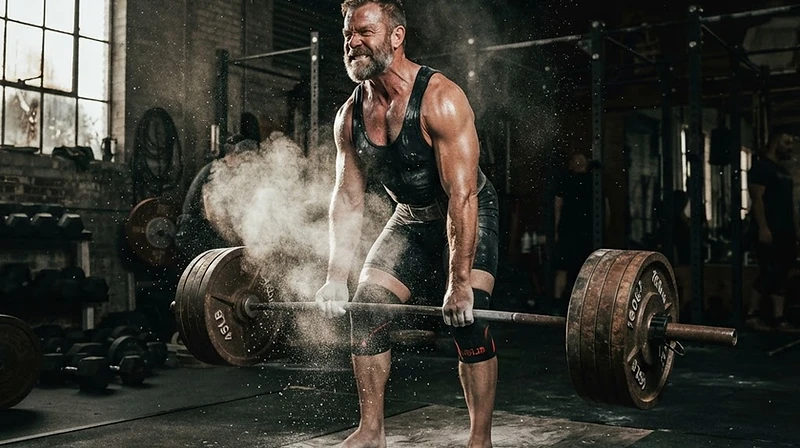
Weightlifting
The oldest argument against aging — pick up something heavy, put it down, and do it again — and the science that proved strength is the one thing you can rebuild at any age.
But first, a little context and history...
Weightlifting is the oldest argument against aging, and it is the discipline that taught the body to grow stronger on purpose. The idea is simple: lift something heavy, rest, lift something a little heavier, and repeat, and the body, forced to do more than it could do, builds itself to do it. The principle that makes it work is called progressive overload, and it is the one principle that every strength program in the world is built on.
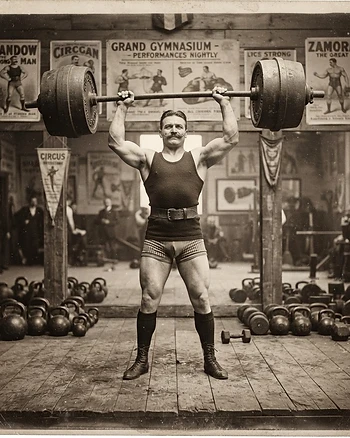
The sport is older than its equipment. The oldest evidence of strength training is a Greek stone found on the island of Thera, inscribed with the words 'Bybon son of Phola lifted me over his head with one hand,' and dated to around 1400 BCE. The stone weighs 143 kilograms. The ancient Greeks lifted stones as part of their athletic training and as a test of manhood, and the gymnasium — the word means 'naked place' — was the place where the body was built. The Roman army trained with heavy packs and weights, and the medieval and early modern strongmen — the men who lifted at fairs and in the circus — kept the art alive through the centuries when the gymnasium was forgotten. The strongman was the athlete of the nineteenth century, and the man who turned the strongman into the bodybuilder was a Prussian named Friedrich Wilhelm Müller, who took the stage name Eugene Sandow.
Sandow is the father of modern weightlifting, and the year that matters is 1893, when he performed at the World's Columbian Exposition in Chicago and became the first man to make a living from the display of his body. Sandow had trained under the strongman Ludwig Durlacher in Brussels and had developed a system of weight training that was aimed not at the stunt (the one-handed lift, the chain-breaking) but at the physique — the balanced, symmetrical, muscular body. Sandow's 1894 book, Sandow's System of Physical Training, and his 1898 magazine, Physical Culture, spread the idea that the body could be sculpted by weights, and his 'physical culture' schools, which opened across Europe and America, were the first gyms in the modern sense. Sandow organized the first major bodybuilding contest at the Royal Albert Hall in London in 1901, and the sport he founded — the sport of building the body with weights — has been growing ever since.
The equipment that made weightlifting a mass practice was the barbell, and the barbell that made it possible was the plate-loading barbell, invented by the German firm Kettler and popularized in America by Alan Calvert, who founded the Milo Barbell Company in 1902. Before the plate-loading barbell, barbells were fixed-weight — a globe at each end of a handle, loaded once at the foundry — and the lifter could not change the weight without changing the bar. The plate-loading barbell, with its collars and its stack of plates, let the lifter add or remove weight in small increments, and it is the tool that made progressive overload practical. The barbell that every gym in the world now uses — the Olympic barbell, a 20-kilogram steel shaft with rotating sleeves and 2-meter length — was standardized in 1920 by the International Weightlifting Federation, and the plates that load it — the bumper plates of rubber, the calibrated plates of iron — are the descendants of Calvert's first plates.
The science that turned weightlifting from a practice into a discipline was the work of one man, and his name was Thomas DeLorme. DeLorme was an army physician who, during the Second World War, rehabilitated wounded soldiers with a protocol of progressive resistance: three sets of ten repetitions, with the weight increased each session. He published his findings in 1945 and 1946, and the 'DeLorme method' — three sets of ten, progressive weight — became the standard prescription for strength and rehabilitation and remains the most common rep scheme in the world. The science that explained why it worked came later: the muscle grows in response to the tension and the damage of the work, and the growth (hypertrophy) is the body's adaptation to the demand that the work imposed. The tension is the load, the damage is the micro-tears in the muscle fibers, and the growth is the repair that overcompensates — that builds the fiber back a little stronger and a little larger than it was. The principle is the same at twenty and at seventy, and the muscle that is asked to lift more will grow more, at any age.
The two forms of weightlifting that the modern lifter chooses between are powerlifting and bodybuilding, and they are the two answers to the question 'why lift?'. Powerlifting is the sport of strength: the squat, the bench press, and the deadlift, and the winner is the lifter who lifts the most weight for one repetition. Bodybuilding is the sport of physique: the same lifts, done for more reps and more sets, and the winner is the lifter whose body is the most muscular and the most symmetrical. Powerlifting was formalized in the 1960s (the first world championship was in 1965) and bodybuilding was formalized by the Weider brothers, Joe and Ben, who founded the IFBB in 1946 and the Mr. Olympia contest in 1965. The two sports share the same equipment and the same principle, and the lifter who does either is the lifter who is building a body that the body would not build on its own.
For the empty nester, weightlifting is the sport that solves the one problem aging cannot be outrun. The loss of muscle that begins in the thirties and accelerates in the fifties — the condition called sarcopenia — is the loss that turns the independent person into the dependent one, and it is the loss that the walk, the bike, and the swim do not reverse. Weightlifting does. The muscle that is asked to lift, at any age, builds itself, and the bone that the muscle pulls on builds itself too, and the strength that the lifting builds is the strength that keeps a person standing, walking, and carrying. The gym does not care how old you are, and the bar that is too heavy today is the bar that is your warm-up next year. Weightlifting is the sport that keeps the body from being the thing that fails first, and it is the sport that teaches you, late in life, that strength is not a gift of youth but a choice of every week.
“The gym does not care how old you are, and the bar that is too heavy today is the bar that is your warm-up next year.”
What to gather
A graded list of gear — from the first honest kit to the tools of a life in the craft. The Novice kit is free; the deeper tiers open with membership.
Novice
The first kit — enough to begin honestly.
From novice to proficient
A thirty-day passage. Each node is a day. The terracotta fill marks the ground you have already covered.
Understand the one rule: to grow stronger, the work must increase. Today, learn the terms — rep, set, load, RPE — and the difference between training (practiced) and exercise (just tired).
YouTubeWhy We Lift — The Principle of Overload
Powerlifting TechniqueHow does understanding RPE change the way you view your daily effort compared to just 'feeling tired'?
Saved locally to your device


How the cohort practices today
The pulse is quiet — for now.
Be the first to document your Weightlifting journey with #EmptyNexxter.