
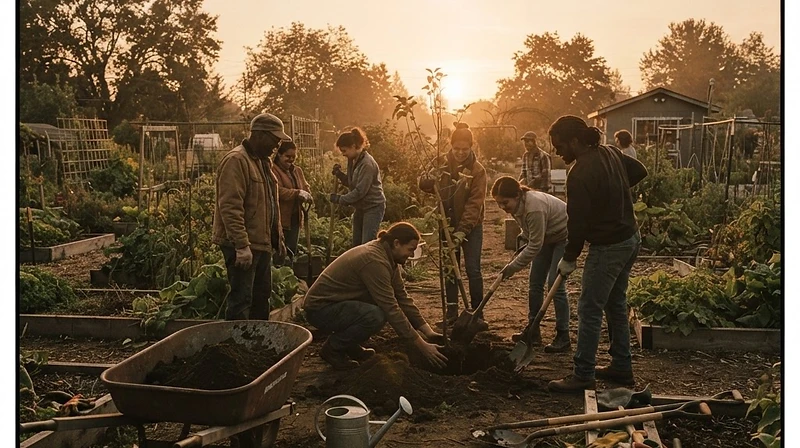
Volunteer in Your Community
The art of showing up — where borrowed hands build belonging.
But first, a little context and history...
Long before the word 'volunteer' entered the English lexicon in the 1750s — borrowed from the French 'volontaire,' meaning one who offers themselves freely — the practice itself was as old as the species. Archaeological evidence from early hominid sites reveals care for the injured and elderly that could only be explained by collective effort. To volunteer is to participate in humanity's most ancient contract.
The organized volunteer movement as we recognize it today traces its roots to the 19th century, when the Industrial Revolution upended traditional community structures. As people flooded into cities and extended families fragmented, mutual aid societies, settlement houses, and charitable organizations emerged to fill the gaps. The Young Men's Christian Association (YMCA), founded in 1844, became a template for volunteer-driven community organizations that would spread worldwide.
The 20th century transformed volunteering from a religious or class obligation into a civic virtue. The Peace Corps, established in 1961 by President Kennedy, asked Americans to serve not in their own communities but in communities across the globe — a radical reimagining of what it meant to show up. The Civil Rights Movement proved that volunteer labor — registering voters, organizing marches, staffing freedom schools — could reshape a nation's conscience.
Today, volunteering occupies a paradoxical place in American life. According to the Corporation for National and Community Service, roughly 30% of adults formally volunteer each year, contributing an estimated $200 billion in unpaid labor. Yet the volunteer rate has been declining since its peak in the early 2000s. The empty nest years — when time opens up and the question of legacy grows louder — are precisely when many people rediscover what their ancestors always knew: that belonging is built, not found, and the hands that give are the hands that receive.
“Belonging is not found. It is built — one borrowed hour at a time.”

What to gather
A graded list of gear — from the first honest kit to the tools of a life in the craft. The Novice kit is free; the deeper tiers open with membership.
Novice
The first kit — enough to begin honestly.
From novice to proficient
A thirty-day passage. Each node is a day. The terracotta fill marks the ground you have already covered.
Understanding the historical roots of mutual aid as humanity's oldest technology for survival.
YouTubeThe Philosophy of Mutual Aid
The Left LibraryHow does the concept of 'mutual aid' differ from traditional charity in your mind?
Saved locally to your device


How the cohort practices today
The pulse is quiet — for now.
Be the first to document your Volunteer in Your Community journey with #EmptyNexxter.