
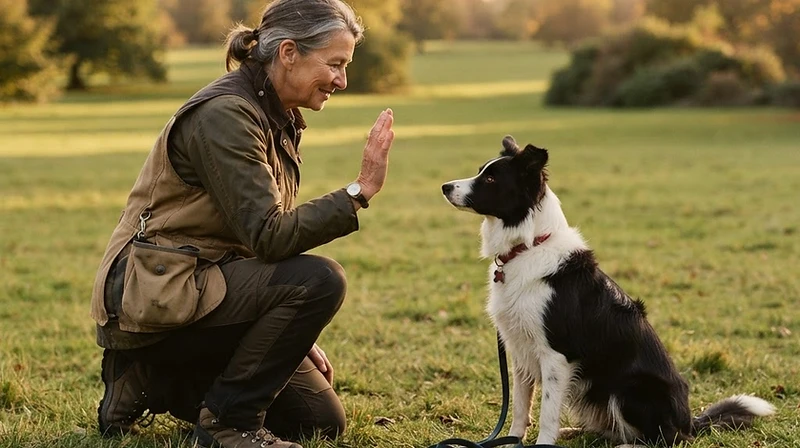
Train a Dog
Forge a language of silence and gestures with your most loyal companion.
But first, a little context and history...
At its core, dog training is the art of mutual translation. It relies on a simple, elegant sequence: the cue, the mark, and the reward. You provide a signal, the dog offers a response, and you bridge the gap between effort and understanding with a well-timed marker—often a click or a verbal 'yes'—followed by a high-value incentive. This practice transforms a chaotic household into a space of coordinated grace, grounding the dog in structure and the owner in a profound sense of purpose. For the Gen X empty nester, this hobby offers a unique reward: the reclamation of a quiet, intentional home life.
The genesis of this partnership resides in the transition from hunter-gatherer societies to settled communities. Roughly 10,000 years ago, wolves that showed reduced fear toward humans found a reliable source of food near fire pits. Those selective pressures favored individuals capable of reading human body language, effectively hardwiring obedience into the canine genetic code. By the time of the 19th-century sporting era, humans had refined these instincts into specialized labor. Breeders focused on specific traits, leading to the rise of the pointer, the retriever, and the setter. During this period, field trials emerged in Britain, establishing the first rigorous standards for canine performance based on hand signals and whistle commands.
The 1940s marked a pivotal shift toward modern, structured obedience training. As global conflicts necessitated the deployment of highly capable K-9 units, the military standardized methods for teaching dogs complex tasks like scouting, sentry work, and medical assistance. Following the war, these techniques trickled into civilian life through obedience schools, where veterans applied their experience to family pets. The focus shifted from utilitarian field work to harmonious house-living, turning the dog into a reliable companion for middle-class life.
In the 1980s, the field underwent a revolution spearheaded by practitioners like Karen Pryor, who popularized 'positive reinforcement'—a methodology based on B.F. Skinner’s work on operant conditioning. This approach abandoned the harsh, compulsion-based corrections of the past in favor of marker training. By using a clicker to precisely mark the moment of a correct choice, trainers could communicate with clarity rather than force. This modern era views the dog not as a subordinate, but as an active participant in a shared endeavor.
Today, you need very little to begin your journey: a sturdy six-foot leather or biothane leash, a pouch for treats, and a quiet, distraction-free environment. Consistency is your primary tool. You are not just teaching a dog to sit; you are establishing a legacy of patience. As a Gen X practitioner, you likely possess the requisite life experience to appreciate the slow burn of progress. You understand that authority is quiet and that the strongest bonds are built on consistent, reliable feedback.
This hobby is particularly suited for this stage of life because it requires presence. Unlike the frantic pace of raising children or the demands of a high-pressure career, training requires you to slow down and observe the world from a canine perspective. When you spend twenty minutes a day practicing a 'stay' or a 'heel,' you are engaging in a meditative act of focus. You move away from digital distractions and back to the tactile, immediate reality of a living creature who wants nothing more than to work alongside you.
Whether you are refining basic manners for a rescued senior dog or teaching complex rally obedience tricks to a new puppy, the practice remains a bridge between species. It honors the ancient pact made at the campfire while utilizing the most current behavioral insights. You are not merely a pet owner; you are the architect of a meaningful, lifelong partnership that demands your best self and rewards you with absolute loyalty.
“Training is not about command; it is about cultivating a common tongue between two different species.”

What to gather
A graded list of gear — from the first honest kit to the tools of a life in the craft. The Novice kit is free; the deeper tiers open with membership.
From novice to proficient
A thirty-day passage. Each node is a day. The terracotta fill marks the ground you have already covered.
Understand the craft: the dog, the cue, the reward, the bond. Tour the home, the yard, the leash. Today is orientation; the training begins tomorrow.
YouTubeThe Craft and the Dog
Zak George’s Dog Training RevolutionReflect on your home environment: what specific areas or distractions might impact your training sessions, and how can you prepare your space for success?
Saved locally to your device


How the cohort practices today
The pulse is quiet — for now.
Be the first to document your Train a Dog journey with #EmptyNexxter.