
Tie Dye
The resist that became a revolution — fold, bind, dye, and the surprise of color that no two hands ever make the same way twice.
But first, a little context and history...
Tie dye is the resist that became a revolution, and it is the craft that turned a technique of pattern into a symbol of freedom. The idea is simple: bind the fabric so the dye cannot reach it, dye the fabric, and the bound parts resist the dye and stay the color of the cloth. The pattern that emerges is the pattern of the binding, and the surprise is that no two pieces are ever the same — the dye finds its own way around the ties, and the hand that binds never binds twice the same way. The craft is the oldest of the resist techniques, and it is the craft that taught the dyer to work with the dye and the chance.
The history of tie dye begins in Asia, and the two traditions that defined it are the Indian bandhani and the Japanese shibori. Bandhani — the word comes from the Sanskrit bandh, 'to tie' — is the Indian resist technique in which the fabric is tied with thread at thousands of tiny points, dyed, and the ties removed to reveal a pattern of dots. The oldest evidence of bandhani is from the Indus Valley, around 5000 BCE, and the craft is still practiced in Gujarat and Rajasthan, where the bandhani saree is the wedding garment of the region. The tying is done by women, with a finger or a nail, and a single saree can have 75,000 ties, each one a dot in the final pattern. The craft is the work of weeks, and the pattern is the work of a hand that has tied a million dots. Shibori is the Japanese resist technique, and the word comes from the verb shiboru, 'to wring or squeeze.' Shibori is the resist that is made by folding, clamping, stitching, and binding the fabric, and the patterns — the arashi (storm) shibori, the itajime (board-clamped) shibori, the nui (stitched) shibori — are the patterns of the method. The oldest shibori in Japan is from the 8th century, and the craft was practiced by the farmer and the aristocrat alike, the farmer's indigo shibori on hemp and the aristocrat's silk shibori on the kimono. The two traditions — bandhani and shibori — are the two roots of the tie dye that the world knows, and the craft that the modern maker practices is the descendant of both.
The craft that came to the West is the craft that came through Africa, and the tradition that defined it is the adire of the Yoruba of Nigeria. Adire is the Yoruba resist technique, and the word means 'tie and dye.' The adire is made by tying, stitching, and painting the cassava paste resist on the indigo-dyed cotton, and the patterns — the oniko (tie), the alabere (stitch), the eleko (paste) — are the patterns of the method. The craft was practiced by the women of the Yoruba, and the adire cloth was the cloth of the market and the ceremony. The African tradition is the tradition that came to the Americas with the enslaved, and the tie dye of the American South — the indigo resist of the Sea Islands, the bandanna of the cowboy — is the descendant of the African craft. The craft that the world calls tie dye is the craft that came from three continents, and the technique that the modern maker uses is the technique that each of them refined.
The craft that became a symbol is the craft that became a symbol in the 1960s, and the moment that defined it was the counterculture of the American West. The tie dye of the 1960s was the tie dye of the hippie, and the hippie was the figure who rejected the mass-produced and the uniform and who embraced the handmade and the individual. The tie dye t-shirt — the spiral, the rainbow, the bright, the bold — was the garment of the counterculture, and the garment that said, in its every uneven line, that the person who wore it was not a number. The craft was practiced in the communes of California and Oregon, and the tie dye of the Grateful Dead and the Whole Earth Catalog was the tie dye that the world saw. The craft that had been the work of the Indian woman and the Japanese farmer and the Yoruba dyer became, in the 1960s, the work of the American maker, and the symbol of a generation that wanted to make its own clothes and its own color.
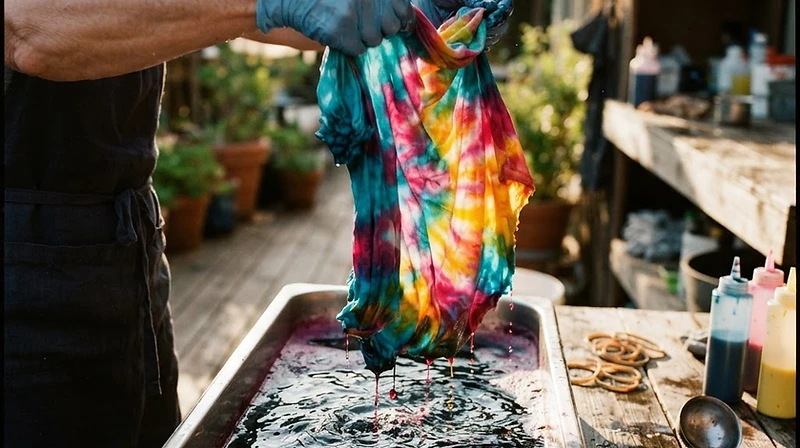
The technique that the modern tie dyer uses is the technique of the fiber-reactive dye, and the dye that made the modern craft possible is the Procion dye. Procion is the fiber-reactive dye that was developed by ICI in 1956, and the dye is the dye that bonds to the cellulose of the cotton at room temperature, without the mordant that the natural dyes require. The fiber-reactive dye is the dye that made the bright, permanent, wash-fast color of the modern tie dye possible, and the dye that the modern maker uses is the dye that the 1960s maker discovered. The technique is the technique of the squeeze bottle and the soda ash: the fabric is soaked in the soda ash (the fixative that activates the dye), the dye is mixed in the squeeze bottle, and the dye is applied to the bound fabric, and the dye bonds to the cotton in the hours that follow. The craft is the craft of the home, and the dyer is the maker who works in the backyard and the kitchen, and the color is the color that no factory can make.
For the empty nester, tie dye is the craft that rewards the playful hand and the open hour. The materials are few — dye, soda ash, squeeze bottles, and cotton — and the place is a backyard or a kitchen. The craft teaches the hand to bind and the eye to let go, and the surprise it gives is the surprise of the dye that finds its own way. The first piece is a spiral that runs, and the last piece is a shibori that holds, and the distance between them is the distance of a hundred pieces in the dye. The craft does not care how old you are, and the spiral that is too muddy today is the spiral that is your warm-up next year. Tie dye is the craft that keeps the hand and the eye bright, and it is the craft that gives you, at the end, something you can wear or give that no one else has.
“The craft does not care how old you are, and the spiral that is too muddy today is the spiral that is your warm-up next year.”
What to gather
A graded list of gear — from the first honest kit to the tools of a life in the craft. The Novice kit is free; the deeper tiers open with membership.
Novice
The first kit — enough to begin honestly.
From novice to proficient
A thirty-day passage. Each node is a day. The terracotta fill marks the ground you have already covered.
Understand the principle: bind the fabric so the dye cannot reach it. Tour the kit — dye, soda ash, squeeze bottles, cotton. Today is orientation; the dyeing begins tomorrow.
YouTubeThe Craft and the Resist
Create BasicsReflect on the tools you have gathered today. How does the concept of 'resist' change the way you look at a plain white t-shirt?
Saved locally to your device


How the cohort practices today
The pulse is quiet — for now.
Be the first to document your Tie Dye journey with #EmptyNexxter.