
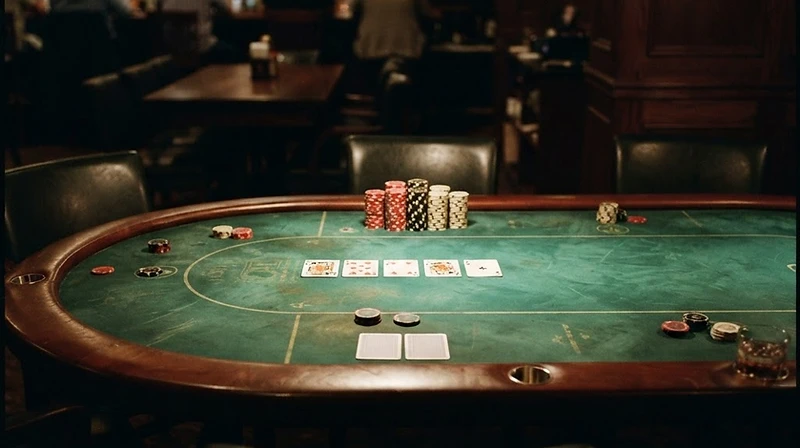
Texas Hold'em
The Cadillac of poker — two hole cards, five community cards, and a hundred years of bluffing from the Texas roadhouses to the World Series of Poker main event.
But first, a little context and history...
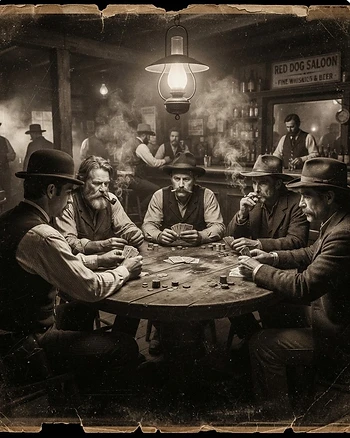
Texas Hold'em was born in the little South Texas town of Robstown, sometime in the first years of the twentieth century, and for decades nobody outside the Texas roadhouses knew it existed. The game was the invention of no one person — it grew out of the older stud and draw poker variants that the cowboys and the card sharps played on the cattle drives — but it was the Texans who fixed its shape: two hole cards dealt face down to each player, five community cards dealt face up in the middle, and four rounds of betting — pre-flop, on the flop, on the turn, and on the river. The genius of the game is that the players share five of their seven cards, so the hands are close in value and the decisions turn on what the other players are holding and what they are willing to do about it. It is a game of incomplete information, and that is what makes it a game of people rather than a game of cards.
The game left Texas in 1963, when a group of Texas gamblers — including the young Doyle Brunson, Amarillo Slim, and Sailor Roberts — brought it to Las Vegas and introduced it at the Golden Nugget. For a decade it was a back-room game, played by the rounders and the road gamblers, and it stayed there until 1970, when Benny Binion invited seven of the best players in the country to the first World Series of Poker at his Horseshoe Casino. The main event was no-limit Texas Hold'em, and it has been the main event every year since. The World Series made the game famous, but it was the hole-card camera — the little glass table that let television show the viewers the players' hidden cards — that made it a spectacle. When the camera arrived in the early 2000s, and when an amateur named Chris Moneymaker won the 2003 main event after qualifying for forty dollars on an online poker site, the game exploded. The Moneymaker effect — the idea that anyone could turn a small stake into millions — drew a generation to the felt, and Texas Hold'em became the most played poker variant in the world.
What makes Texas Hold'em endure is that it is a game of decisions made under uncertainty, and the empty nester finds in it the same thing the road gamblers found a hundred years ago: a game that is simple enough to learn in an afternoon and deep enough to study for a lifetime. The mathematics of the game — pot odds, implied odds, expected value, the combinatorics of the starting hands — are real and learnable, but they are never enough, because every decision is made against another person who is making decisions against you. The game teaches you to read a situation, to weigh the cost of a mistake against the cost of a fold, and to live with the variance — the bad beats and the lucky draws that even out over a thousand hands but never over a single night. It is the Cadillac of poker, as the old Texans called it, and it is still the game.
“It is a game of incomplete information, and that is what makes it a game of people rather than a game of cards.”
What to gather
A graded list of gear — from the first honest kit to the tools of a life in the craft. The Novice kit is free; the deeper tiers open with membership.
Novice
The first kit — enough to begin honestly.
Expert
The equipment of a life in the craft.
Coming soon
From novice to proficient
A thirty-day passage. Each node is a day. The terracotta fill marks the ground you have already covered.
Understanding the deal, the blinds, and the four betting streets.
YouTubeThe Anatomy of a Hand
Play-In GamesHow does the flow of the game change from pre-flop to the river?
Saved locally to your device


How the cohort practices today
The pulse is quiet — for now.
Be the first to document your Texas Hold'em journey with #EmptyNexxter.