

Texas 42
The state domino game of Texas — a trick-taking game played with tiles instead of cards, invented by two boys at a swimming hole and carried across the state for a hundred and thirty years.
But first, a little context and history...
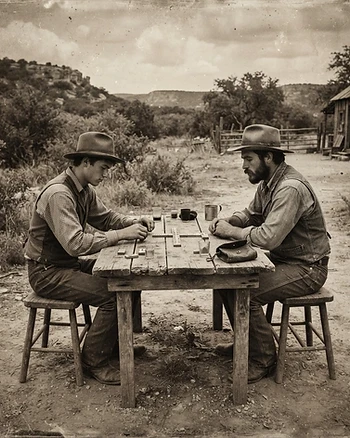
Texas 42 was born at a swimming hole. In 1887, two twelve-year-old boys — William Thomas and Walter Trapp — were sitting on the banks of the Frio River at Trappe Spring, in the Texas Hill Country, with nothing to do. They had a set of dominoes but no cards, and they wanted to play a trick-taking game like the ones their parents played. So they invented one. They assigned each domino a suit and a rank — the tiles became cards, the double-six became the highest trump, and the blank became the lowest — and they called the game 42, because that is the number of points available in each hand: one for each pip on the seven highest tiles. The game spread from the swimming hole to the ranches, from the ranches to the feed stores, and from the feed stores to every courthouse and fire station in Texas. By the 1930s, 42 was the state game in everything but name — and in 2011, the Texas legislature made it official, designating 42 the state domino game of Texas.
The game is played with a standard double-six domino set — twenty-eight tiles, from the double-blank to the double-six. Four players play in two partnerships, partners sitting across from each other. Each player draws seven tiles. The highest bidder names the trump suit — the suit of the tile whose higher half is the trump number — and leads the first trick. The tiles are played like cards: each player follows suit if they can, the highest trump wins, or if no trump is played, the highest tile of the suit led wins. The count tiles — the tiles whose pips total five or a multiple of five — are worth their pip count: the 5-5 is ten points, the 6-4 is ten, the 5-0 is five, and so on, for a total of forty-two points in the hand. The bidder must make their bid or go set — they lose the value of the bid. The game is to a hundred, or a hundred and twenty-one, or whatever the house rules say.
What makes 42 endure is that it is a trick-taking game played with tiles, and that combination is stranger and more satisfying than it sounds. The tiles have no hidden information — everyone can see what has been played — but the bidding and the partnership play make it a game of communication and inference, like bridge with dominoes. The empty nester finds in 42 what generations of Texans have found: a game that takes an hour to learn and a lifetime to play well, that is social in the way only a four-player partnership game can be, and that carries the whole history of the Texas Hill Country in its bones. The dominoes are the same twenty-eight tiles you played as a child, but in 42 they become a deck, and the deck becomes a conversation.
“The dominoes are the same twenty-eight tiles you played as a child, but in 42 they become a deck, and the deck becomes a conversation.”
What to gather
A graded list of gear — from the first honest kit to the tools of a life in the craft. The Novice kit is free; the deeper tiers open with membership.
Novice
The first kit — enough to begin honestly.
Expert
The equipment of a life in the craft.
Coming soon
From novice to proficient
A thirty-day passage. Each node is a day. The terracotta fill marks the ground you have already covered.
Understanding the history of 42 and the basic objective of the game.
YouTubeIntroduction to the National Game of Texas
Trompos y másWhy do you think 42 became a substitute for card games in 19th-century Texas?
Saved locally to your device


How the cohort practices today
The pulse is quiet — for now.
Be the first to document your Texas 42 journey with #EmptyNexxter.