
Tenkara Fishing
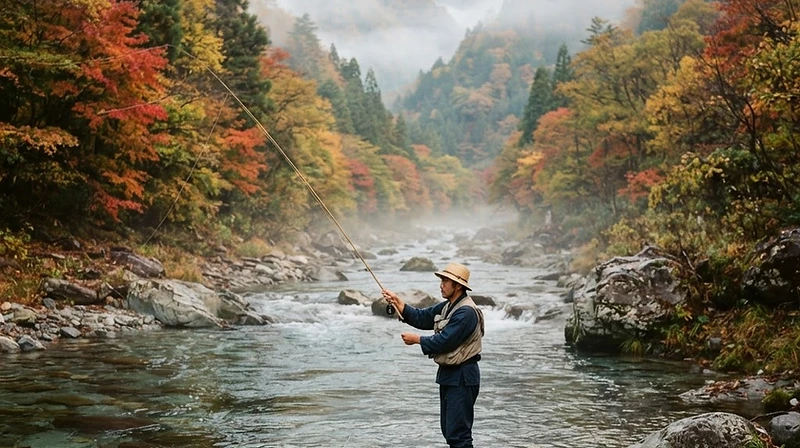
The fly rod with no reel — a Japanese mountain-stream tradition that strips angling to its essence: a rod, a line, and a fish.
But first, a little context and history...
Tenkara is fly fishing without a reel. A long, telescoping rod — typically eleven to fourteen feet — a fixed length of line tied to the tip, a short leader, and a single fly. You cast with the flex of the rod, the line unrolls, the fly lands on the water, and you fish. There is no reel, no line to manage, no false casting, and no equipment between you and the fish. Tenkara is the simplest form of fly fishing, and it is also the oldest.
The word tenkara means from heaven, or from the sky — a name that describes the way the fly appears to the fish: it drops from above, light as a leaf, and drifts on the current with no visible connection to the angler. The name is relatively modern — it was coined in the early 20th century by a Japanese researcher named Shigeru Soshu, who studied the mountain fishermen of the Kanto region — but the practice is centuries older. Tenkara was the fishing method of the Kofu and Gunma mountain fishermen who caught amago and iwana — two species of native Japanese trout — in the steep, fast mountain streams of central Japan. These were professional fishermen, not sportsmen: they fished for a living, selling their catch to the towns below, and the simplicity of tenkara was born of necessity. A rod, a line, and a fly were all they could carry into the mountains, and all they needed.
The rod is the heart of tenkara. Traditional tenkara rods were made of bamboo — split and glued into a long, telescoping blank that could collapse to two feet and extend to twelve. The modern rod is made of carbon fiber, and it telescopes from fifteen inches to twelve feet, with the same flex and sensitivity that the bamboo rods had. The length is the point: a long rod lets you keep the line off the water, which means the fly drifts drag-free — the holy grail of fly fishing — with no mending, no line control, and no false casting. You hold the rod high, the line hangs in the air, and only the fly touches the water. The fish sees a fly and nothing else.
The line is fixed. In tenkara, the line is tied to the tip of the rod — there is no reel to hold it — and the length is fixed by the angler. A typical tenkara line is the length of the rod plus a few feet, and the total length from rod tip to fly is about twenty to twenty-five feet. This is the limitation and the strength of tenkara: you fish at a fixed distance, and you fish close. You cannot cast thirty feet, and you do not try to. You walk to the fish, you get close, and you present the fly with a precision that a reel-and-line angler cannot match at any distance.
The fly is a kebari — a Japanese word meaning feathered hook. The traditional tenkara fly is a simple soft-hackle pattern: a hook with a body of silk thread and a collar of pheasant or hen feather. There is no wing, no tail, no complicated dressing — just a hook, a body, and a soft feather that breathes in the current. The philosophy of the tenkara fly is the philosophy of the sport: one pattern, fished well, is enough. The Japanese tenkara angler does not carry a box of a hundred patterns. They carry one pattern — the sakasa kebari, the reverse-hackle fly — and they fish it in every stream, in every condition, for every fish. The skill is in the presentation, not the pattern.
Tenkara came to the West in 2009, when Daniel Galhardo, a Japanese-speaking American angler, founded Tenkara USA and began importing rods and teaching the method. The sport found a ready audience among fly fishermen who were tired of the gear arms race of Western fly fishing — the multiple rods, the dozens of fly boxes, the sinking lines, the indicators, the split shot — and who were drawn to the simplicity of a rod, a line, and a fly. Tenkara is not a replacement for fly fishing; it is a different way of fishing, suited to small mountain streams and the pursuit of wild fish in close quarters. It is the purest form of the sport, and for many anglers, it is the most fun.
For the empty nester, tenkara is a water sport that travels light. A tenkara rod collapses to fifteen inches and weighs three ounces. It fits in a day pack. It fits in a suitcase. It fits in the trunk of a car with the rest of your life, and it is ready when you find a stream. The first day is learning to cast — which takes ten minutes, because there is no reel and no line to manage. The hundredth day is reading a mountain stream, walking to the fish, and presenting a fly with a precision that a thirty-foot cast cannot match — because you are standing five feet away, and the fish never sees you coming.
“One pattern, fished well, is enough. The skill is in the presentation, not the pattern.”
What to gather
A graded list of gear — from the first honest kit to the tools of a life in the craft. The Novice kit is free; the deeper tiers open with membership.
Novice
The first kit — enough to begin honestly.
From novice to proficient
A thirty-day passage. Each node is a day. The terracotta fill marks the ground you have already covered.
Understand the history of Tenkara as a minimalist Japanese mountain stream tradition.
YouTubeIntroduction to Tenkara Philosophy
DirksOutdoorsHow does the absence of a reel change your perspective on the connection between angler and fish?
Saved locally to your device


How the cohort practices today
The pulse is quiet — for now.
Be the first to document your Tenkara Fishing journey with #EmptyNexxter.