

Tai Chi
A moving meditation where breath follows body and body follows breath — the slow martial art that turns stillness into strength and a century of practice into a single continuous gesture.
But first, a little context and history...
The story the Chinese tell is that a Taoist monk named Zhang Sanfeng, watching a snake and a crane fight on Wudang Mountain, saw that the soft could defeat the hard — that yielding, not force, was the deeper martial truth. Whether he lived in the twelfth century or only in legend, the principle he embodied became tai chi chuan: the supreme ultimate fist.
The art we can trace began in the seventeenth century, in Chen Village, Henan, where a retired general named Chen Wangting wove together military combat, Taoist breathing, and the philosophy of yin and yang into a family style passed down in secret for generations. The Chen form was explosive — fast and slow alternating, low stances, sudden releases of power. In the nineteenth century, Yang Luchan learned the Chen style (some say by watching through a crack in the wall) and softened it into the flowing, extended form the world now recognizes as tai chi — a practice anyone could learn, regardless of age or strength.
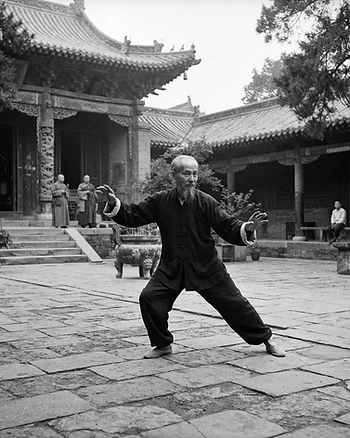
What makes tai chi singular is that it is a martial art practiced as health. The movements are combat applications — a block, a strike, a throw — performed so slowly that the body learns balance, alignment, and relaxation instead of speed and impact. Medical studies have measured what practitioners have always felt: tai chi improves balance in the elderly, lowers blood pressure, eases arthritis, and quiets the anxious mind. It is a fighting art that has found its highest use as a daily act of meditation — the body moving like water, the breath following the movement, the mind following the breath, until there is no separation between them.
“The river does not rush, yet it cuts the rock. The hand does not strike, yet it cannot be stopped. Tai chi is the art of winning by arriving last.”
What to gather
A graded list of gear — from the first honest kit to the tools of a life in the craft. The Novice kit is free; the deeper tiers open with membership.
Novice
The first kit — enough to begin honestly.
From novice to proficient
A thirty-day passage. Each node is a day. The terracotta fill marks the ground you have already covered.
Learning the fundamental Tai Chi stance and how to maintain a neutral, grounded spine.
YouTubeFoundations of Stance and Posture
BodyWisdomHow does your balance feel when you shift your weight from one leg to the other?
Saved locally to your device


How the cohort practices today
The pulse is quiet — for now.
Be the first to document your Tai Chi journey with #EmptyNexxter.