
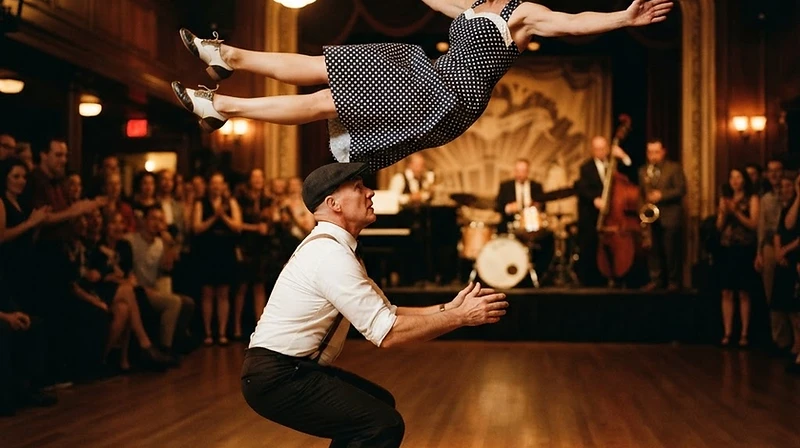
Swing Dancing
Find your rhythm in the Savoy’s shadow: where jazz meets movement in a timeless, energetic embrace.
But first, a little context and history...
Swing dancing is far more than a sequence of steps; it is a conversation conducted in rhythm, space, and momentum. Rooted in the 1920s jazz revolution, this art form prioritizes the 'swing'—a characteristic bounce that grounds the dancer while propelling them through complex, improvisational maneuvers. Unlike rigid ballroom styles, swing encourages individual expression within a partnered framework, making it a perfect pursuit for those entering their second prime who value both mental agility and physical connection. The history of the dance begins at the Savoy Ballroom in Harlem, a space that defied racial segregation to become the epicenter of cultural innovation. Dancers like George 'Shorty' Snowden and 'Mama' Lu Parks pioneered the Lindy Hop, a style named in honor of Charles Lindbergh’s flight across the Atlantic. By the 1930s, the Savoy’s legendary 'home of happy feet' served as a laboratory for big band music and athletic dance, where high-energy kicks and aerials pushed the limits of popular performance. This era transformed swing into a global phenomenon, bridging the gap between social recreation and high-level athleticism. The dance survived the waning popularity of big bands during the mid-century, finding a passionate resurgence in the 1990s through groups like the New York Swing Dance Society. Today, the global swing community acts as a living archive, preserving the original techniques while welcoming newcomers who seek an intellectual and physical challenge. For the Gen X empty nester, swing represents a unique opportunity to reclaim time once spent managing schedules and responsibilities. It is a hobby that offers a deep sense of community and a low barrier to entry. Beginners need only a pair of comfortable, leather-soled shoes to navigate the dance floor, and a willingness to embrace the learning curve of lead-and-follow dynamics. Because the dance relies on clear, non-verbal communication, it sharpens focus and coordination. Engaging with this medium allows you to step away from the digital noise of modern life and into the tactile, analog joy of a live band. Whether you are attending a workshop at a local social club or practicing the basic eight-count step in your kitchen, swing dancing offers a rhythmic escape that honors the past while keeping you firmly in the present.
“The dance floor is the only place where gravity is merely a suggestion and the music dictates the conversation.”

What to gather
A graded list of gear — from the first honest kit to the tools of a life in the craft. The Novice kit is free; the deeper tiers open with membership.
Novice
The first kit — enough to begin honestly.
From novice to proficient
A thirty-day passage. Each node is a day. The terracotta fill marks the ground you have already covered.
Understand the craft: the bounce, the swing, the air, the count. Tour the gear and the hall. Today is orientation; the dance begins tomorrow.
YouTubeThe Craft and the Groove
Nina GilkensonHow did it feel to move your body to the rhythm for the first time today? What aspect of the dance hall environment feels most exciting to you?
Saved locally to your device


How the cohort practices today
The pulse is quiet — for now.
Be the first to document your Swing Dancing journey with #EmptyNexxter.