
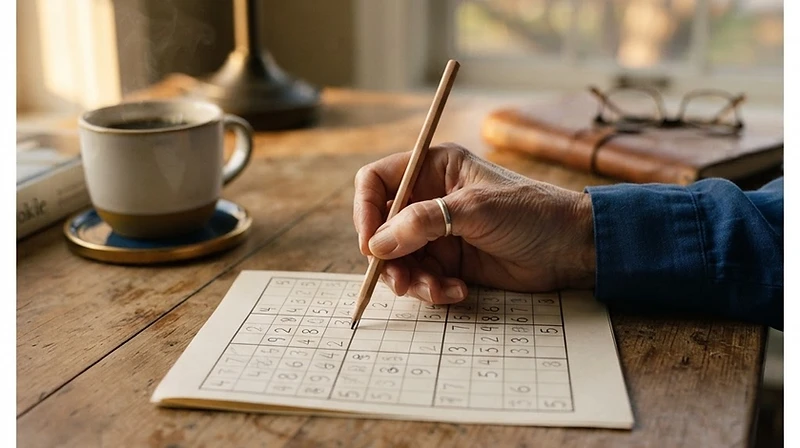
Sudoku
The quiet symphony of the grid: nine digits, infinite paths, and the elegant architecture of pure logic.
But first, a little context and history...
Sudoku is a logic-based, combinatorial number-placement puzzle that demands patience, pattern recognition, and an unwavering focus. The objective is simple: fill a nine-by-nine grid so that each column, row, and three-by-three sub-grid contains all digits from one to nine without repetition. Despite its deceptive simplicity, the puzzle requires rigorous deductive reasoning. It functions as a meditative exercise, stripping away the noise of the day to isolate the solver within a closed system of perfect order. For the Gen X empty nester, this represents a welcome shift from the chaos of household management to a domain where every action yields a predictable, satisfying result.
The lineage of Sudoku stretches back to the concept of Latin Squares, studied by mathematicians like Leonhard Euler in the 18th century. However, the modern iteration crystallized in 1979 when Howard Garns, a retired architect and puzzle enthusiast from Connersville, Indiana, published 'Number Place' in Dell Pencil Puzzles and Word Games. Garns designed his grid with a specific constraint—only a subset of cells provided starting clues, necessitating careful logical elimination to uncover the remainder. While it did not achieve instant fame in the United States, his design provided the essential skeletal framework for what was to follow.
The puzzle underwent a significant evolution after finding its way to Japan. In 1984, the publishing house Nikoli introduced the game to the Japanese market, renaming it 'Sudoku,' an abbreviation of the phrase 'Sūji wa dokushin ni kagiru,' which translates roughly to 'the numbers must occur only once.' Nikoli refined the aesthetics and standardized the difficulty levels, turning the abstract mathematical challenge into a daily cultural staple. This era saw the introduction of the elegant, symmetric grid designs that players recognize today, emphasizing a balance between the revealed clues and the empty spaces awaiting discovery.
Global adoption surged in 2004, largely due to the efforts of Wayne Gould, a retired Hong Kong judge. After discovering the game in Tokyo, Gould spent years developing a computer program to generate unique Sudoku grids. He successfully convinced The Times of London to feature the puzzle, sparking an international frenzy that transitioned from daily newspaper columns to mobile applications and competitive tournaments. The rise of digital interfaces allowed the hobby to reach a massive audience, providing an accessible gateway for enthusiasts to engage with the puzzle at their own pace, whether during a morning commute or a quiet evening at home.
Practicing Sudoku requires little more than a pencil, an eraser, and a printed grid, though digital tablets have become increasingly popular for their convenience and mistake-tracking features. The process begins with 'scanning'—a technique where the player identifies rows or columns that are nearly full to deduce missing placements. From there, the solver progresses to more advanced strategies like 'hidden pairs' or 'x-wings,' which require looking beyond the immediate cell to observe the grid as a whole. This steady escalation of difficulty provides a gratifying sense of cognitive growth that remains stimulating for years.
For those adjusting to a quieter home, Sudoku offers a specific type of mental sanctuary. It requires the solver to inhabit a state of 'flow,' where the outside world recedes behind the demands of the nine-by-nine structure. Unlike high-stakes professional obligations, the grid is a forgiving environment; mistakes are merely temporary obstacles to be erased and corrected rather than failures of consequence. It encourages a deliberate, methodical approach to problem-solving that is both intellectually taxing and profoundly relaxing.
Ultimately, the enduring appeal of Sudoku lies in its universality. It relies on the logic of numbers rather than linguistic dexterity or cultural knowledge, making it a truly global language. It is a hobby that respects the maturity of the player, favoring sustained concentration over youthful reflexes. By reclaiming the habit of quiet, focused analysis, the empty nester finds in the grid not just a pastime, but a refined tool for maintaining mental agility and finding peace in the precision of a completed square.
“A single grid offers a rare sanctuary; it is a battle of wits where the only opponent is the clarity of your own thought process.”

What to gather
A graded list of gear — from the first honest kit to the tools of a life in the craft. The Novice kit is free; the deeper tiers open with membership.
Novice
The first kit — enough to begin honestly.
From novice to proficient
A thirty-day passage. Each node is a day. The terracotta fill marks the ground you have already covered.
Understand the craft: the scan, the logic, the fill, the calm. Tour the grid and the pencil. Today is orientation; the solve begins tomorrow.
YouTubeThe Craft and the Grid
Sudoku.comReflect on the grid as a whole; how does the visual structure of the 9x9 board help you organize your thoughts before you even place a number?
Saved locally to your device


How the cohort practices today
The pulse is quiet — for now.
Be the first to document your Sudoku journey with #EmptyNexxter.