

Stone Polishing
The oldest craft in the archive — a slow meditation that turns a rough slab of agate or jasper into a piece of deep time you can hold in your hand.
But first, a little context and history...
Stone polishing is the oldest craft in this archive, and it is older than our species. The first polished stones we know of are the ochre plaques of Blombos Cave, on the southern coast of South Africa, which were ground flat and smooth seventy thousand years ago — thirty thousand years before the date historians used to call the dawn of art. The first drilled and polished beads are from the same site, made from the shells of ostrich eggs, and they are the earliest jewelry we have. The craft is older than agriculture, older than pottery, older than the wheel, and it may be older than language. The human hand learned to make a stone beautiful before it learned to make a pot.
The craft the ancients practiced was lapidary, from the Latin lapis, stone, and lapidarius, of stone. The Egyptians were the first to turn it into an industry. The earliest carved scarabs and the earliest cylinder seals are from the Nile, and the earliest lapidary workshop we have found is at the tomb of the pharaoh Djer at Abydos, circa 3000 BCE. The Egyptians polished carnelian, jasper, lapis lazuli, and turquoise into amulets and beads, and they invented the bow drill — a tool that drove a rotating bit with a back-and-forth bow — which was the lapidary's primary tool for three thousand years. The Greeks and Romans inherited the craft and added the cameo, a carved gem with a figure in relief, and the intaglio, a carved gem with a figure cut below the surface, which was used as a seal by pressing it into wax. The most famous lapidary object of the ancient world is the Portland Vase, a Roman cameo glass vessel from the reign of Augustus, which was carved from a single block of blue-and-white glass over a period of years and which Josiah Wedgwood spent four years trying to reproduce in ceramic in the 1780s.
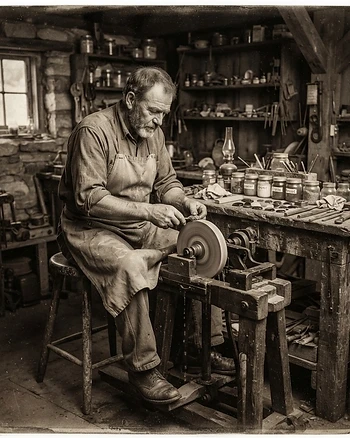
The craft that produced the Portland Vase was the craft of the hard-stone carver, and it was practiced with the same tools for two thousand years: a bow drill, a set of diamond-pointed tools, and a series of increasingly fine abrasives, from emery to pumice to putty. The modern craft of stone polishing, which is the craft the empty nester is likely to practice, is younger and simpler. It begins with the slab saw, which was invented in the 1930s and which uses a diamond blade to cut a rough stone into slices; the trim saw, which cuts the slices into shapes; the grinding wheels, which are silicon carbide or diamond and which progress from coarse (100 grit) to fine (600 grit); and the polishing wheels, which are felt or leather charged with cerium oxide or tin oxide, which produce the mirror finish that is the craft's signature. The cabochon — a stone with a flat back and a domed top, which is the shape most lapidaries cut — was named in the French cabochon, from the Latin caboche, head, and it has been the standard cut for opaque and patterned stones since the Middle Ages.
The stones the lapidary polishes are the agates, jaspers, and quartzes that are the common beauties of the mineral world. Agate is a banded chalcedony that forms in the voids of volcanic rock, and its bands are the record of the water that deposited the silica over millions of years; the agates of Idar-Oberstein, in Germany, have been cut and polished since the fifteenth century, and the town was the lapidary capital of Europe until the Brazilian agates of the nineteenth century undercut it. Jasper is an opaque chalcedony that comes in as many colors and patterns as there are deposits; the picture jaspers of Oregon and Madagascar show landscapes in their banding. Quartz is the most common mineral in the earth's crust, and it includes amethyst (purple), citrine (yellow), rose quartz (pink), smoky quartz (brown), and rock crystal (clear), all of which take a high polish. The rarer stones — the opals, the tourmalines, the beryls — are the domain of the faceter, who cuts flat faces at precise angles to bring out the stone's brilliance, and faceting is a separate craft that requires a faceting machine and a mastery of geometry that the cabochon cutter does not need.
For the empty nester, stone polishing is the rare hobby that is as much a meditation as a craft. The process is slow — a single cabochon can take six hours from slab to polish — and it is repetitive, which is the point. The sound of the wheel, the feel of the stone under the hand, and the slow reveal of the pattern as the grit gets finer are a form of attention that the empty nest, with its new quiet, is already teaching you. The stone you polish is a piece of deep time you can hold in your hand, and the polish you give it is the first human mark it has ever worn.
“The stone you polish is a piece of deep time you can hold in your hand, and the polish you give it is the first human mark it has ever worn.”
What to gather
A graded list of gear — from the first honest kit to the tools of a life in the craft. The Novice kit is free; the deeper tiers open with membership.
Novice
The first kit — enough to begin honestly.
Expert
The equipment of a life in the craft.
Coming soon
From novice to proficient
A thirty-day passage. Each node is a day. The terracotta fill marks the ground you have already covered.
Blombos Cave, the Egyptian bow drill, the Roman cameo, Idar-Oberstein, the 1930s slab saw. Know the lineage of the craft and the deep time in the stone.
YouTubeWhat Stone Polishing Is
Academy of Art UniversityReflect on the historical evolution of stone working mentioned in the lesson. How does knowing that humans have been shaping stone for millennia change your perspective on the craft?
Saved locally to your device


How the cohort practices today
The pulse is quiet — for now.
Be the first to document your Stone Polishing journey with #EmptyNexxter.