
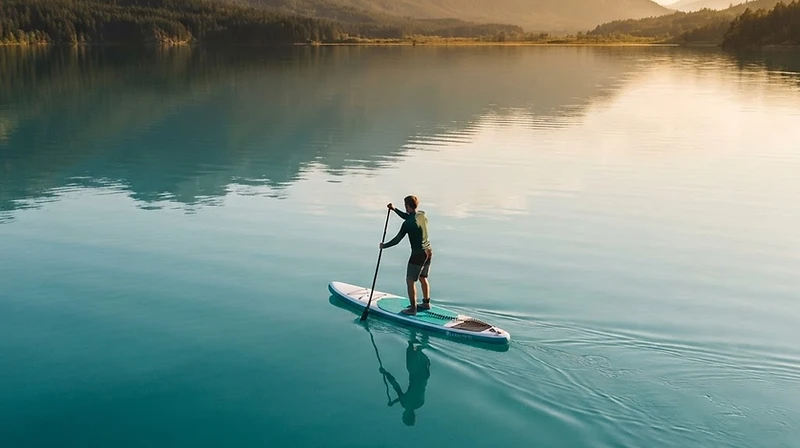
Stand Up Paddleboarding
A standing view of the water — part paddle, part balance, part meditation — born on Hawaiian waves and now on every lake and bay.
But first, a little context and history...
Stand up paddleboarding — SUP — is the act of standing on a large, buoyant board and propelling yourself with a single-bladed paddle. It looks like surfing with a paddle, and that is exactly what it was before it became its own sport. The board is wider and longer than a surfboard, the paddle is longer than a canoe paddle, and the water does not need to be moving. You can paddleboard on a wave, on a lake, on a river, or on a glassy bay at sunrise, and the experience is the same: a standing view of the water that no other craft gives you.
The roots of stand-up paddling are ancient. Peruvian fishermen stood on reed boats called caballitos de totora and paddled them with a bamboo shaft — a practice that predates the Incas. But the modern sport was born in Hawaii, and it was born as a teaching tool. In the 1940s, Waikiki beach boys — the Hawaiian surf instructors who taught tourists to surf — would stand on their longboards with outrigger paddles to photograph their students and to keep an eye on them in the surf. They called it beach boy surfing, and it was a practical solution to a practical problem: standing up let you see the whole line-up, and a paddle let you catch waves that a prone surfer could not.
The sport as we know it was created by one man: Laird Hamilton. In the late 1990s, Hamilton — already a legendary big-wave surfer — began standing on modified longboards with a canoe paddle as a cross-training exercise. He and a small group of Maui surfers used SUP to stay in shape when the waves were flat, and they discovered that paddling into waves standing up was a completely different experience from prone surfing: you could see the wave earlier, catch it earlier, and ride it with a perspective that felt more like sailing than surfing. Hamilton and his collaborators — including Brian Keaulana and Archie Kalepa — began making custom boards and paddles, and by the early 2000s, SUP was a recognized discipline.
The sport exploded in the 2010s because it solved a problem that surfing never could: you did not need waves. A stand-up paddleboard could be used on flat water — on lakes, rivers, bays, and harbors — and the barrier to entry was lower than any board sport before it. You did not need to paddle out through surf, you did not need to duck-dive, and you did not need to time a wave. You stood on a board that was stable enough for a beginner to balance on within minutes, and you paddled. The fitness industry discovered SUP as a core workout — the balance and the paddling engage the legs, the core, the back, and the shoulders — and yoga instructors discovered that a board on flat water was the most challenging yoga mat in the world.
The equipment is simple. A beginner board is typically 10 to 12 feet long, 32 inches wide, and 4 to 6 inches thick — wide and thick enough to be stable, long enough to track straight. The paddle is 6 to 8 inches taller than the paddler, with an adjustable shaft and a blade angled forward for efficiency. A leash connects the paddler to the board so it does not drift away on a fall. A personal flotation device is required in most jurisdictions. The inflatable SUP — a board that rolls up to the size of a sleeping bag and inflates in ten minutes with a hand pump — transformed the sport by making it possible to carry a board in the trunk of a sedan and check it on an airplane.
For the empty nester, SUP is a water sport that does not require the ocean, the waves, or the youth of surfing. It is a full-body workout that feels like a walk on the water. The first day is wobbly — the board moves under your feet, and the paddle feels awkward in your hands. The hundredth day is a glide across a glassy lake at dawn, the paddle a metronome, the water a mirror, and the standing view a perspective you cannot get any other way.
“A standing view of the water that no other craft gives you.”
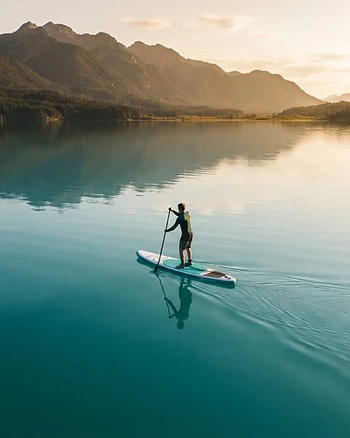
What to gather
A graded list of gear — from the first honest kit to the tools of a life in the craft. The Novice kit is free; the deeper tiers open with membership.
Novice
The first kit — enough to begin honestly.
From novice to proficient
A thirty-day passage. Each node is a day. The terracotta fill marks the ground you have already covered.
Learn the essential equipment including board selection, paddle sizing, and the importance of PFDs and leashes.
YouTubeIntroduction to SUP Gear and Safety
Sport al CentroWhat safety gear are you prioritizing for your first session?
Saved locally to your device


How the cohort practices today
The pulse is quiet — for now.
Be the first to document your Stand Up Paddleboarding journey with #EmptyNexxter.