
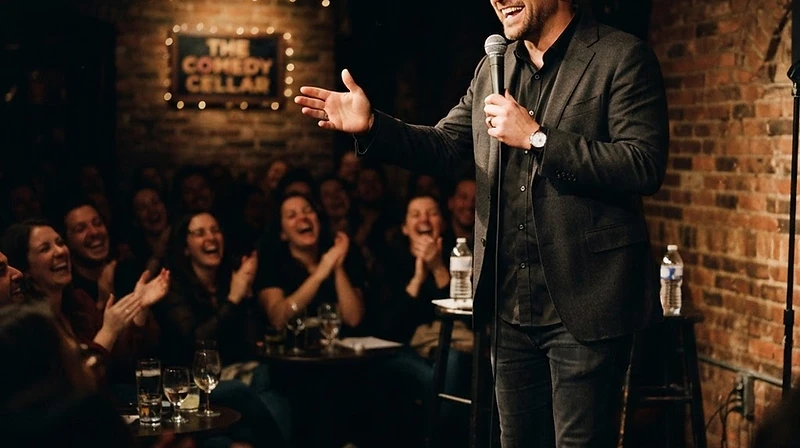
Stand-Up Comedy
The art of standing alone in front of strangers and making them laugh — one true thing at a time.
But first, a little context and history...
Stand-up comedy is the only art form in which the audience is the instrument. A solo performer steps onto a stage with nothing but a microphone and a point of view, and the room either laughs or it does not — there is no director, no editor, no second take, and no hiding behind a character or a script. The comedian who bombs is alone in a way that no other performer ever is, and the comedian who kills is holding the room in the palm of their hand. That brutal simplicity is the whole art.
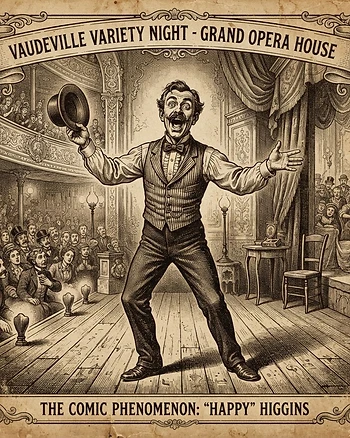
The roots of stand-up run through the ancient Greek and Roman comic traditions, the medieval court jester, and the British music hall, but the form as we know it was born on the American vaudeville circuit of the 1880s. Vaudeville shows mixed acrobats, singers, animal acts, and comedians on a single bill, and the comedians who survived learned to win over rooms that had come for anything but them. The great vaudevillians — W.C. Fields, the Marx Brothers, Will Rogers — developed the skill that defines stand-up to this day: the ability to read a room in the first ten seconds and adjust everything about your performance before the audience knows they have been read.
The Borscht Belt — the Catskills resort circuit where Jewish comedians performed for vacationing families in the 1940s and 1950s — was where stand-up found its modern voice. Sid Caesar, Lenny Bruce, Joan Rivers, and a generation of comics learned to turn personal observation into universal truth, working five sets a night, seven nights a week, in front of audiences who had heard every joke and demanded new ones. Lenny Bruce broke the form open by refusing to tell jokes at all, instead standing on stage and talking about religion, politics, and the language you were not allowed to say on television — and getting arrested for it. Bruce established the principle that stand-up could be more than laughter: it could be truth-telling, and the laughter was the proof that the truth had landed.
The comedy club era of the 1970s and 1980s — the Comedy Store in Los Angeles, the Improv in New York — gave the form its modern infrastructure. Every comedian who matters today learned their craft at an open mic, five minutes at a time, in front of audiences who owed them nothing. The open mic is the gym of stand-up: you go up, you fail, you figure out why, you go up again. The only way to learn whether a joke works is to tell it to strangers, and the only way to get good at it is to tell ten thousand jokes that do not.
Modern stand-up is a writer's medium disguised as a speaker's art. The best comedians — Richard Pryor, George Carlin, Dave Chappelle, Maria Bamford, John Mulaney — spend their days writing and their nights testing, refining a five-minute bit over months of stage time until every word earns its place. The reward is a form of communication that no other medium can replicate: a single person, alone on a stage, saying exactly what they believe is true, and hearing a room full of strangers agree.
“You do not write jokes. You write the truth, and then you cut every word that is not funny.”
What to gather
A graded list of gear — from the first honest kit to the tools of a life in the craft. The Novice kit is free; the deeper tiers open with membership.
Novice
The first kit — enough to begin honestly.
From novice to proficient
A thirty-day passage. Each node is a day. The terracotta fill marks the ground you have already covered.
Identifying and articulating your unique comedic perspective.
Voice Calibration: Defining Your Persona
Which aspects of your personality felt most authentic when expressed through the persona exercises?
Saved locally to your device


How the cohort practices today
The pulse is quiet — for now.
Be the first to document your Stand-Up Comedy journey with #EmptyNexxter.