
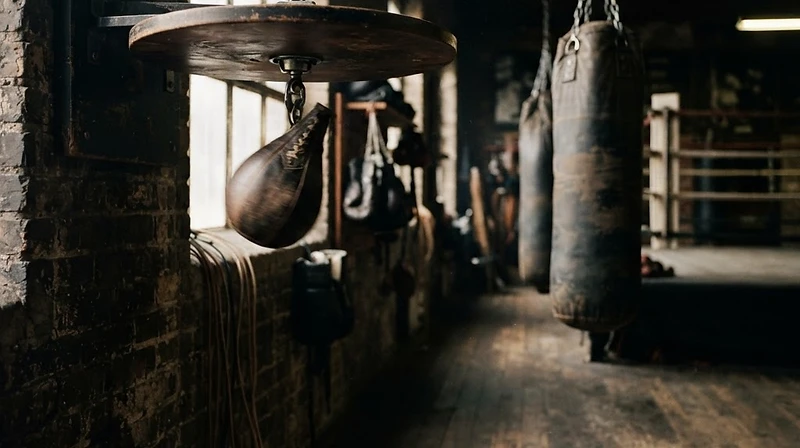
Speed Bag
Rhythm before power — the smallest bag in the gym teaches timing, hand speed, and shoulder endurance, and humbles nearly everyone in the first week.
But first, a little context and history...
When gloved boxing replaced the bare-knuckle prize ring in the last decades of the nineteenth century, the sport moved indoors and became something that could be practiced rather than merely endured. Gymnasiums needed equipment that could absorb thousands of repetitions without breaking a fighter or a building, and the punching bag answered that need. But a heavy bag can only teach power. It cannot teach the thing that actually separates a trained hand from an untrained one: whether the hand comes back to the right place at the right time. The speed bag — a small teardrop of leather hung from a swivel beneath a rebound platform — was the answer to that question, and no single inventor is credited with it. It emerged from the gym the way most good equipment does: somebody built one, somebody else copied it, and the ones that worked survived.
What makes the bag interesting is that it is a physical instrument with a fixed tempo. Inflated properly and hung from a clean swivel, it rebounds off the platform at a rate set by its size, its pressure, and the friction in the swivel — roughly two bounces for every one you throw, which is why the basic pattern is heard as a triplet rather than a beat. Front, back, front. The bag is not a target you hit; it is a metronome you negotiate with. Change the pressure by a pound and the song changes.
Which is why almost every beginner fails the same way. Fists arrive where the bag used to be, not where it is, and the instinct is to hit harder to make it behave. Harder is always wrong. The correction is counterintuitive and entirely learnable: relax the shoulder, keep the elbow quiet, watch the bag rather than your hand, and let the platform do the returning. The bag teaches hand speed, hand-eye timing, shoulder endurance, and the habit of staying loose under fatigue — none of which the heavy bag can give you. It gives no power at all, and anyone using it to show off has misread the instrument.
For most of the twentieth century the speed bag lived almost exclusively in boxing gyms, appearing in the background of every training montage from the 1930s onward and fixed in the popular imagination by a certain 1976 film silhouette. The 2010s boutique-boxing boom carried it back out to general fitness, sometimes well and sometimes as decoration. Meanwhile drummers discovered it independently — the triplet rhythm, the rebound, and the wrist action are close cousins of rudiments played on a snare. It is one of the few pieces of gym equipment that is genuinely musical.
The practical course for a beginner in their second prime is refreshingly cheap: a wall-mounted platform, a medium bag at 10 by 7 inches, a decent ball-bearing swivel, and hand wraps. Hang the bag so its fattest point sits at your chin. Wrap your hands. Work in three-minute rounds with a minute of rest, exactly as a fighter would, and spend the first week on nothing but a single controlled rebound — one strike, let it come back, catch it, reset. Rhythm is built before speed, and speed is built before combinations. Thirty days of honest practice will take you from flailing to a clean, continuous triplet with both hands, which is what proficiency actually looks like here. The advanced vocabulary — double-time patterns, elbow strikes, the around-the-world — arrives later, and takes far longer, which is precisely the pleasure of it.
“The bag does not care how hard you hit it. It cares only whether your hand is exactly where you left it, on time.”
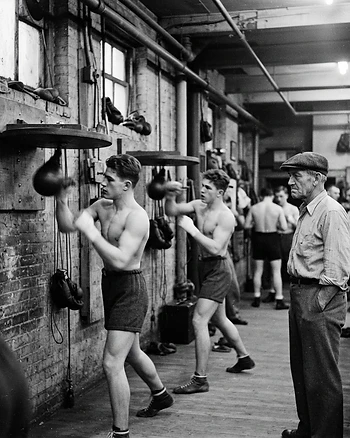
What to gather
A graded list of gear — from the first honest kit to the tools of a life in the craft. The Novice kit is free; the deeper tiers open with membership.
Novice
The first kit — enough to begin honestly.
Advanced
The serious tools of a committed hand.
Coming soon
Expert
The equipment of a life in the craft.
Coming soon
From novice to proficient
A thirty-day passage. Each node is a day. The terracotta fill marks the ground you have already covered.
Learn to adjust the platform to chin height and adopt a square, balanced stance.
YouTubeSetting Up Your Stance and Height
Precision StrikingHow does your shoulder tension feel when your hands are held at chin level?
Saved locally to your device


How the cohort practices today
The pulse is quiet — for now.
Be the first to document your Speed Bag journey with #EmptyNexxter.