
Snowboarding
The winter sport that arrived last and youngest — sideways on the snow, the surfer's stance brought to the mountain, and the counterculture that became an Olympic event.
But first, a little context and history...
Snowboarding is the youngest of the winter sports, and it is the one that arrived sideways. The sport began not on the mountain but in the backyard, and the first snowboard was not a board at all but a toy. In 1965, an engineer in Muskegon, Michigan, named Sherman Poppen tied two skis together and put a rope at the nose for his daughters to hold, and he called the contraption the Snurfer — a portmanteau of snow and surfer. The Snurfer was a toy: no bindings, no metal edge, no way to turn except by leaning and hoping. Poppen licensed it to Brunswick, and by the late 1970s more than a million Snurfers had been sold, and a generation of children had learned that you could stand sideways on the snow and slide down a hill on a single board. The Snurfer was the seed, and every snowboard that came after it grew from that seed.
The men who turned the toy into a sport were the men who gave it bindings and an edge, and the most important of them was Jake Burton Carpenter. Burton, a New Yorker who had grown up surfing and Snurfing, moved to Vermont in 1977 and began making snowboards in a barn, and the thing he made that the Snurfer lacked was a binding — a strap that held the front foot, and later both feet, to the board so the rider could steer and stop and jump. Burton was not alone: Dimitrije Milovich, a surfer from the East Coast, founded Winterstick in 1972 to make snowboards inspired by surfboards, and Tom Sims, a skateboarder from California, began making snowboards in the late 1970s and would be Burton's great rival for the rest of the decade. The early boards were wide, heavy, and finless, with no metal edge, and they were banned at almost every ski resort in America — the riders were seen as reckless, uninsured, and uncontrolled, and the ski patrol did not want them on the hill. For the first ten years of the sport, snowboarders hiked the backcountry, rode the small hills that tolerated them, and fought, year by year, for the right to ride the chairlift.
The technology that made snowboarding a real sport was the metal edge and the highback binding, and both arrived in the 1980s. The metal edge — borrowed from the ski — gave the board the ability to hold on hard snow and to carve a turn rather than only to slide. The highback binding, invented by Burton in 1983, put a support behind the rider's calf so the rider could lever the board onto its heel edge, and it is the binding that every rear-foot strap binding on the mountain still uses. The twin-tip board, which arrived in the late 1980s and which is shaped the same at the nose and the tail, let the rider ride switch — backward — and it is the board that made freestyle possible. By the end of the 1980s, the board had bindings, an edge, and a shape, and the sport had the tools it needed to become what it became.
The resort that opened the door for snowboarding was Stratton Mountain in Vermont, which allowed Burton's boards in 1983 and hosted the first national snowboard championships in 1985, and the decade that followed was the decade the resorts opened, one by one, until by the mid-1990s almost every resort in America allowed snowboards. The culture of the sport was the culture of skateboarding and surfing — baggy clothes, a disregard for the formality of the ski school, and a vocabulary of tricks borrowed from the halfpipe and the skatepark — and the culture was the reason the ski world resisted the sport for so long and the reason the sport grew so fast once it was let in. The first World Cup was held in 1994, the first world championships in 1983 (organized by Paul Graves at Suicide Six in Vermont), and the sport was added to the Winter Olympics in 1998 at Nagano, where the giant slalom and the halfpipe were the first events. The Olympic arrival was the moment the outlaw sport became an international discipline, and the riders who had been banned from the lifts a decade earlier were now riding for medals.
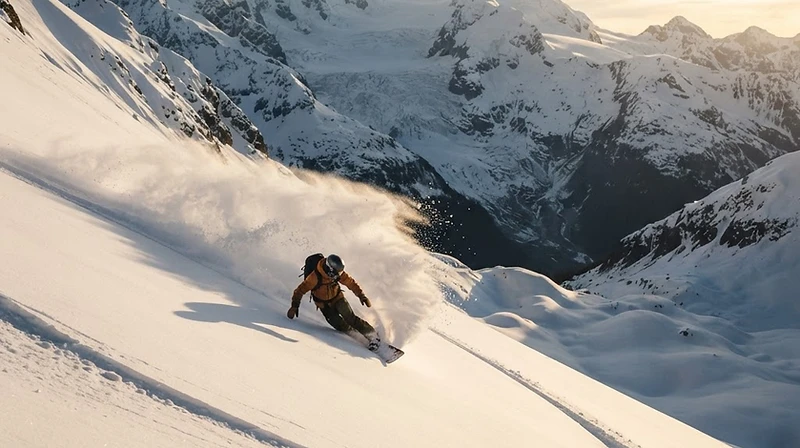
The discipline that defines snowboarding is freestyle, and freestyle is the sport's gift to the mountain. The halfpipe — a U-shaped channel of snow carved into the hillside, in which the rider rides up one wall, launches, and lands in the other — was borrowed from skateboarding, and the tricks done in the pipe (the spin, the grab, the flip) are the sport's signature. The slopestyle course — a run of rails, boxes, and jumps — is the discipline that brought the skatepark to the mountain, and the big-air event is the discipline that asks only how high and how far a rider can fly. The other half of the sport is freeride and alpine: freeride is the descent of ungroomed snow — powder, trees, cliffs — and it is the discipline closest to the sport's surfing roots, and alpine is the carved turn on hard snow, raced on stiff boards with hard boots, and it is the discipline closest to the sport's skiing cousins. The rider who can ride all of these is the rider who has the whole mountain.
For the empty nester, snowboarding is the sport that rewards the beginner's willingness to fall. The first days on a snowboard are spent falling — on the backside, on the frontside, on the knees, on the wrists — and the learning curve is steeper at the start than skiing but gentler in the middle: the snowboarder who survives the first three days can link turns, and the snowboarder who can link turns can ride the whole mountain. The stance is the surfer's stance — sideways, with the feet across the board and the body facing the side of the hill — and the turn is made by rotating the body and driving the edge, not by the long, forward-facing arc of the skier. The sport is harder on the body in the first week and easier on the body in the tenth year, and the rider who learns it late learns a sport that is as much a game as a discipline — a sport of style and flow rather than of speed and line — and a sport that keeps the winter young.
“The first days on a snowboard are spent falling, and the rider who survives the first three days can ride the whole mountain.”

What to gather
A graded list of gear — from the first honest kit to the tools of a life in the craft. The Novice kit is free; the deeper tiers open with membership.
Novice
The first kit — enough to begin honestly.
From novice to proficient
A thirty-day passage. Each node is a day. The terracotta fill marks the ground you have already covered.
Stand on the board sideways — feet across the board, knees soft, weight centered, looking over your lead shoulder. The stance is the surfer's stance, and it is the foundation of every turn.
YouTubeThe Stance
SnowboardProCampHow did it feel to find your center of gravity while standing sideways on the board? What adjustments did you make to your knees to feel more stable?
Saved locally to your device


How the cohort practices today
The pulse is quiet — for now.
Be the first to document your Snowboarding journey with #EmptyNexxter.