
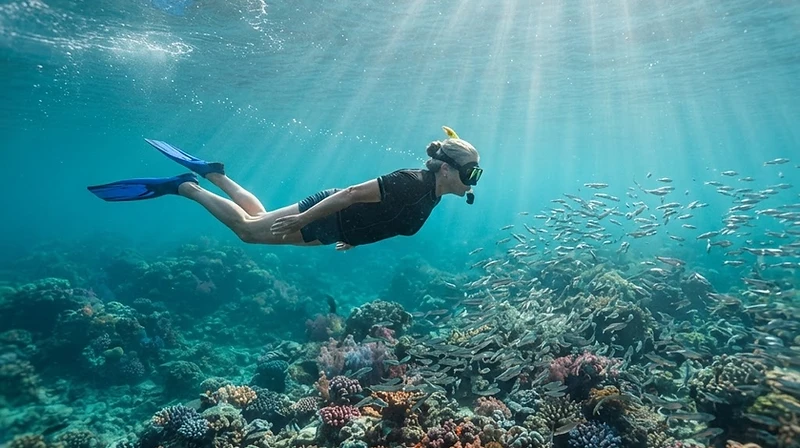
Snorkeling
Suspend the weight of the world at the surface, drifting in silent communion with the pulse of the tide.
But first, a little context and history...
Snorkeling offers a rare invitation to witness the unseen architecture of the ocean, stripping away the noise of terrestrial life to favor a meditative connection with the marine world. It remains a uniquely accessible discipline, requiring only a mask for vision, a snorkel for respiration, and fins for locomotion. For the Gen X empty nester, this hobby provides a perfect intersection of physical fitness and intellectual curiosity. It demands no intense training, yet it rewards the practitioner with an ever-changing gallery of biological marvels beneath the waves. As we step into a quieter chapter of life, the ability to hover effortlessly over a vibrant coral reef provides a restorative perspective that few other pastimes can match. The discipline of breath control and the steady, rhythmic movement required to navigate currents cultivate a sense of inner peace that mirrors the stillness of the water itself. Historically, the pursuit traces its lineage to the 1300s, when Persian and Arabian pearl divers mastered the art of prolonged submersion. These early adventurers utilized carved tortoiseshell goggles, fitted with clear, polished stone or glass, to scan the seabed for precious oysters. They developed remarkable physiological discipline, holding their breath for extended durations to reach the ocean floor. This ancient reliance on human endurance and simple optics formed the foundational philosophy of skin diving. Their ingenuity ensured that, despite limited technology, humans could meaningfully observe the aquatic environment without the encumbrance of bulky, early-era pressurized systems. By the 19th century, industrial innovation transitioned the craft into the realm of modern equipment. Inventors began experimenting with rubber materials, leading to the creation of the first flexible breathing tubes. Manuel Rodriguez, a pivotal figure in this era, helped refine the mechanics of the snorkel, transforming it from a rudimentary reed into a functional, comfortable tool that allowed swimmers to keep their faces submerged for hours. These advancements bridged the gap between professional extraction work and the burgeoning interest in recreational exploration. The 1930s marked a pivotal shift in cultural reception, largely due to the influence of Guy Gilpatric on the French Riviera. A journalist and spearfisher, Gilpatric popularized the use of refined, watertight masks and rubber fins, turning what was once a dangerous industrial necessity into a glamorous leisure activity. His writings documented the vivid beauty of Mediterranean marine life, inspiring a generation to treat the ocean as a landscape rather than merely a resource. This shift moved the practice from the sphere of laborers into the lifestyle of curious explorers. Today, equipment design focuses on ergonomics and safety, utilizing silicone seals and dry-top mechanisms to ensure a seamless experience. Modern masks provide panoramic visibility, while lightweight composite fins allow for fluid, energy-efficient propulsion through the water column. The simplicity of the gear ensures that travel is effortless, whether exploring a local coastal cove or embarking on an expedition to tropical archipelagoes. For those of us transitioning into an era of newfound time, snorkeling serves as a bridge to wonder. It demands focus, which quiets the mind, and movement, which invigorates the body. Each drift across a shallow reef feels like an intimate visit to a hidden wilderness. Because the ocean remains in constant flux, no two sessions are ever identical, ensuring that the hobby remains a lifelong pursuit of discovery rather than a static routine. It is a humble, majestic way to re-engage with the natural rhythms of our planet, offering a profound sense of scale and serenity that resonates deeply in our later years.
“To snorkel is to trade the clamor of the shore for the profound, rhythmic clarity of the deep.”

What to gather
A graded list of gear — from the first honest kit to the tools of a life in the craft. The Novice kit is free; the deeper tiers open with membership.
Novice
The first kit — enough to begin honestly.
- Scuba Prime Pano 3 Window Adult Snorkeling GearAmazon$29.99
- PIYAZI Snorkeling Gear for AdultsAmazon$17.99
- Cressi Adult Snorkel Set (Mask, Dry Snorkel, Adjustable Fins)Amazon$69.95
- EXP VISION Dry SnorkelAmazon$8.99
- Cressi Traveler Set - Adult Snorkel Set Wide View Mask, Dry Top Snorkel and FinsAmazon$116.91
- Amazon Basics Snorkel Mask with Dry-Top TubeAmazon$31.48
Expert
The equipment of a life in the craft.
Coming soon
From novice to proficient
A thirty-day passage. Each node is a day. The terracotta fill marks the ground you have already covered.
Understand the craft: the mask, the breath, the fin, the drift. Tour the gear and the sea. Today is orientation; the snorkel begins tomorrow.
YouTubeThe Craft and the Sea
STINAPA BonaireReflect on the gear you saw today; which piece of equipment do you feel most curious about, and why does it seem essential for your comfort in the water?
Saved locally to your device


How the cohort practices today
The pulse is quiet — for now.
Be the first to document your Snorkeling journey with #EmptyNexxter.