
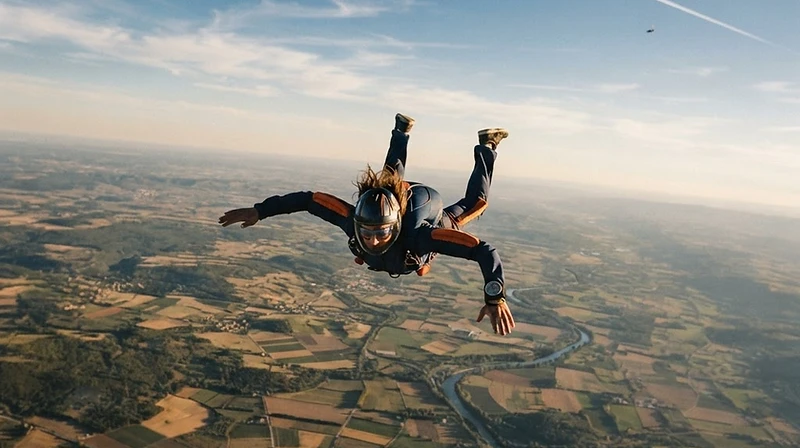
Skydiving
Exchange the weight of middle life for the weightless clarity of the troposphere.
But first, a little context and history...
Skydiving is the art of controlled descent, a symphony of aerodynamics played out in the thin air miles above the earth. While we often associate the experience with modern adrenaline, its roots are etched in the Enlightenment-era ambition of André-Jacques Garnerin. In 1797, Garnerin cut his silk canopy loose from a hydrogen balloon above Paris, proving that a calculated fall could be tempered into a graceful landing. This early demonstration stripped away the fear of the unknown, replacing it with the mechanics of drag and atmospheric resistance. For the modern enthusiast, this history serves as a reminder that every jump is a dialogue with physics.
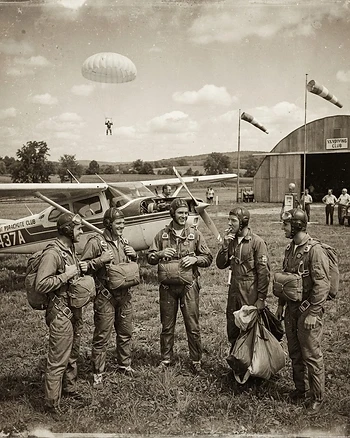
The evolution of the sport accelerated sharply during the 20th century. Military strategists recognized the utility of the parachute, refining its geometry and reliability during the brutal exigencies of World War I and II. Round canopies and static-line deployments became the standard for airborne divisions, transforming an experimental novelty into a tactical imperative. These decades forged the discipline, standardization, and rigorous safety protocols that define modern drop zones. By the post-war era, veterans began applying these lessons to civilian recreation, forming clubs that turned a survival tool into a weekend passion.
Technological breakthroughs in the 1980s fundamentally altered the landscape of the sport. The introduction of the ram-air, rectangular canopy replaced the unpredictable round parachutes of the past, granting pilots true maneuverability and soft, pinpoint landings. Today, jumpers utilize high-tech altimeters, automatic activation devices that deploy in emergencies, and sophisticated navigation techniques to navigate the sky. Modern gear is an ergonomic marvel, designed for comfort and ease of use, ensuring that the focus remains entirely on the visceral experience of flight rather than the machinery of survival.
For the Gen X empty nester, skydiving offers a unique intersection of solitude and community. After years of managing households, careers, and the complex needs of growing children, the sudden quiet of the home can feel jarring. Stepping into the slipstream of a plane offers a profound, forced meditation. At twelve thousand feet, the stressors of the terrestrial world vanish, leaving only the sound of the wind and the immediacy of the present moment. It is a hobby that demands complete, undivided attention, which serves as a powerful antidote to the distracted nature of contemporary life.
Getting started is remarkably approachable through the Accelerated Freefall (AFF) program. Unlike the historical methods of static-line training, AFF pairs students with certified instructors who guide them through the basics of body flight, canopy control, and safety procedures from day one. You do not need to be a professional athlete to succeed; you only need a steady temperament and a willingness to trust the training. The drop zone culture is welcoming and egalitarian, focused more on the shared accomplishment of the jump than on individual ego.
Learning to skydive is a pursuit that matures along with the practitioner. While the adrenaline is undeniable, the true reward is the development of a lifelong skill set that rewards patience and precise technique. Each jump is an opportunity to refine your approach, master new wind patterns, and understand the nuanced relationship between your body and the atmosphere. By stepping out of the cabin, you are not just escaping the nest; you are reclaiming your sense of personal agency, discovering that the horizon is far wider than you previously imagined.
“Gravity is merely a suggestion once you realize that the wind is your only true partner in the sky.”
What to gather
A graded list of gear — from the first honest kit to the tools of a life in the craft. The Novice kit is free; the deeper tiers open with membership.
Novice
The first kit — enough to begin honestly.
From novice to proficient
A thirty-day passage. Each node is a day. The terracotta fill marks the ground you have already covered.
Understand the sport: the plane, the canopy, the freefall, the landing. Tour the drop zone, the hangar, the packing area. Today is orientation; the skydive begins tomorrow.
YouTubeThe Sport and the Drop Zone
Skydive VibesWhat aspects of the drop zone environment felt most intimidating or welcoming to you today? Reflect on how understanding the facility layout contributes to your overall safety.
Saved locally to your device


How the cohort practices today
The pulse is quiet — for now.
Be the first to document your Skydiving journey with #EmptyNexxter.