
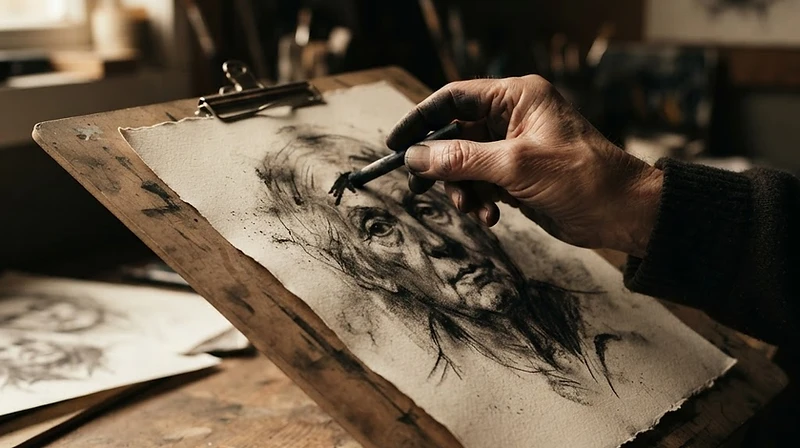
Sketching with Charcoal
The art of the burnt stick: transforming simple shadow into profound light through the ancient dance of charcoal.
But first, a little context and history...
Sketching with charcoal represents one of the most intimate connections an artist can forge with the past. At its core, the medium is remarkably simple: charred wood, typically willow or vine, applied to a textured surface. Unlike the precise, indelible nature of graphite, charcoal offers a forgiving, atmospheric quality. It encourages the artist to think in terms of mass, volume, and light rather than just outlines. For the Gen X empty nester, this medium provides a meditative reprieve, allowing one to manipulate shadows with fingertips or chamois cloths until a sense of depth emerges from the flat plane of the paper.
Our collective journey with charcoal began deep within the limestone caverns of Europe. In sites like Lascaux and Altamira, prehistoric ancestors utilized the remains of their hearth fires to depict the bison, horses, and deer that defined their survival. These early sketches demonstrate a sophisticated understanding of muscle structure and movement. Artists used the irregular contours of the cave walls to provide natural volume to their figures, proving that the synergy between the medium and the surface is an ancient discovery. This primal connection to the earth remains present every time you sharpen a stick of vine charcoal over a sketchpad.
During the Italian Renaissance, charcoal transitioned from primitive wall markings to a cornerstone of academic rigor. Masters like Leonardo da Vinci and Michelangelo utilized charcoal not only for final works but for 'cartoons'—full-scale preliminary studies for frescoes and paintings. The medium allowed them to experiment with light and shadow, mapping out the muscular tension of a figure before committing to permanent pigment. In these bustling studios, charcoal became the primary language of anatomy, serving as a bridge between a fleeting mental image and a monumental artistic realization.
By the 19th century, the charcoal sketch became the standard for atelier instruction across Europe. Students spent months rendering plaster casts of classical statues, learning to identify the subtle transition between highlight, midtone, and deep shadow. This repetitive, focused practice instilled a discipline of seeing. It taught artists to look past the surface of an object and identify the structural skeleton underneath. Today, that same academic tradition offers a structured yet liberating pathway for the modern enthusiast to cultivate professional observational skills from the comfort of a home studio.
Practicing this craft requires minimal investment: a few sticks of willow charcoal, a kneaded eraser, and a pad of toothy, acid-free paper. The kneaded eraser is particularly important, as it functions like a brush, allowing you to lift charcoal away to create highlights and delicate texture. This subtractive process—pulling light out of the darkness—provides a unique psychological reward. It mimics the act of revealing hidden truths, a task that resonates deeply during the life transition of the empty nest. It demands your full attention, effectively quieting the distractions of the modern world.
Why does this activity resonate so strongly for those in their second prime? At this stage in life, many of us seek hobbies that offer both intellectual rigor and tangible tactile satisfaction. Charcoal does not require the toxic fumes of oil paints or the expensive space of a sculpture studio; it is clean, portable, and immediate. It invites you to embrace imperfections, as the smudge of a finger or a stray mark can often be incorporated into the composition rather than erased. It is a medium of evolution, where the drawing grows and shifts alongside the artist’s changing perspective.
As you begin your practice, remember that every master was once a beginner struggling with the messiness of carbon dust. Start by sketching simple household objects—an apple, a coffee mug, or the intricate folds of a linen cloth. Pay attention to where the light source hits and how the shadow dissipates across the floor. By focusing on these relationships of value, you are participating in a tradition that spans three millennia. You are not just making a picture; you are refining the way you perceive the world around you, one smudge at a time.
“Charcoal is not merely a tool for drawing; it is a conversation between the hand and the history of human sight.”

What to gather
A graded list of gear — from the first honest kit to the tools of a life in the craft. The Novice kit is free; the deeper tiers open with membership.
Novice
The first kit — enough to begin honestly.
Expert
The equipment of a life in the craft.
Coming soon
From novice to proficient
A thirty-day passage. Each node is a day. The terracotta fill marks the ground you have already covered.
Understand the medium: the vine and the compressed, the paper and the tooth, the eraser and the stump. Tour the studio, the easel, the board. Today is orientation; the charcoal begins tomorrow.
YouTubeThe Medium and the Table
Fine Art TutorialsReflect on your workspace setup: does your current environment allow you to move freely, and how does the physical arrangement of your tools impact your comfort?
Saved locally to your device


How the cohort practices today
The pulse is quiet — for now.
Be the first to document your Sketching with Charcoal journey with #EmptyNexxter.