
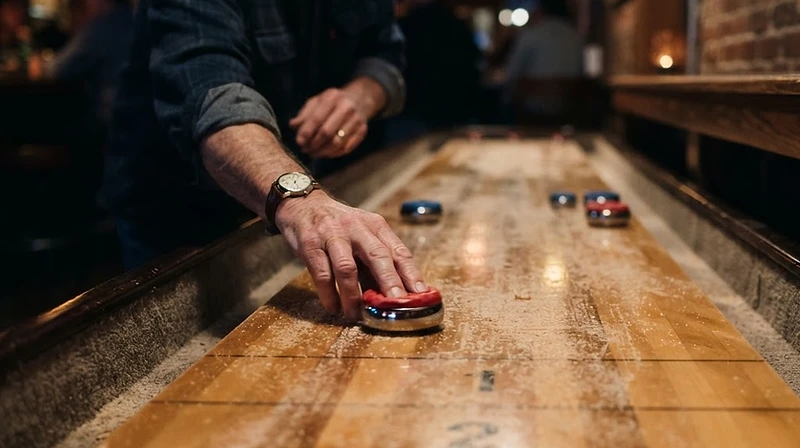
Shuffleboard
Precision in motion: where the silent glide of the puck meets the quiet focus of the seasoned hand.
But first, a little context and history...
Shuffleboard centers on the elegant application of momentum across a friction-sensitive surface. Players slide weighted metal pucks, known as weights, along a long, wax-coated maple table. The objective is to navigate these weights into high-scoring zones at the opposing end, while simultaneously knocking an opponent's pieces into the gutters. It remains a rare hobby that balances intense strategic focus with a relaxed, social rhythm, making it a perfect anchor for an evening in a home game room or a local club. The roots of the game trace back to 16th-century England, where it was known as shovel-groat or shovel-board. During this era, patrons in local taverns would slide silver coins, such as the groat, across polished wooden surfaces. King Henry VIII reportedly enjoyed the sport, even recording gambling debts related to his matches. As the centuries passed, the game evolved alongside maritime culture. Sailors on long voyages adapted the concept to the open decks of ships, creating a larger, floor-based version that utilized cues to push weighted discs toward painted scoring diagrams. By the mid-20th century, the game found a new identity in the retirement communities of Florida. During the 1950s and 1960s, the deck version became a staple of communal life, prized for its accessibility and low physical strain. This era solidified shuffleboard as a quintessential retirement activity, favored by those seeking a competitive outlet that remained gentle on the body. It offered a sophisticated way to socialize while maintaining a sharp competitive edge, transforming neighborhood clubhouses into hubs of local rivalry. Modern shuffleboard enthusiasts typically favor the indoor table version, which requires a refined touch rather than the brute force of the outdoor court. Success depends on the quality of the table surface and the application of silicone beads, which act as a lubricant to allow the pucks to glide with minimal friction. A standard table measures between 12 and 22 feet, demanding a steady stance and a smooth release. Because the wax wears down and requires consistent re-application, the maintenance of the board becomes as much a part of the ritual as the game itself. For the Gen X empty nester, shuffleboard offers a compelling blend of tactile satisfaction and low-stakes strategy. As the household grows quieter, this hobby provides a meditative quality; the act of lining up a shot requires a level of mindfulness that encourages a temporary detachment from daily pressures. It is not an activity that demands peak physical athleticism, yet it rewards the kind of quiet, accumulated wisdom that only comes with age. You do not need to be a professional to derive satisfaction from a perfectly executed slide that kisses the edge of a scoring line. Getting started requires only a basic set of weights and a table. Most newcomers find that their skills improve quickly through repetition, as the brain begins to calibrate the precise amount of force needed for different distances. Because the game is easy to learn but difficult to master, it remains perpetually engaging. Whether played in a competitive league or as a way to unwind after a long day, shuffleboard serves as a reminder that the best hobbies are those that allow us to focus entirely on the present moment.
“Shuffleboard rewards the patient hand; it is a game where the most profound movements are often the ones you barely feel.”
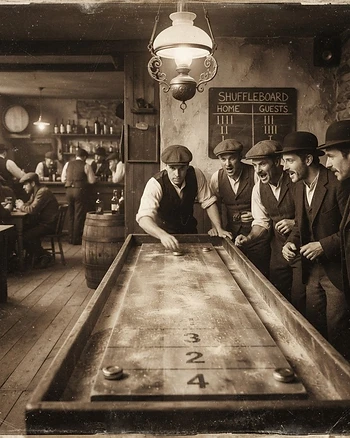
What to gather
A graded list of gear — from the first honest kit to the tools of a life in the craft. The Novice kit is free; the deeper tiers open with membership.
Novice
The first kit — enough to begin honestly.
From novice to proficient
A thirty-day passage. Each node is a day. The terracotta fill marks the ground you have already covered.
Understand the game: the table, the weights, the wax, the scoring triangle. Tour the table, the pucks, the silicone, the scoreboard. Today is orientation; the slide begins tomorrow.
YouTubeThe Game and the Table
Allerlei von NicolaiReflect on the layout of the table and the scoring zones. How does the physical length of the board influence your initial strategy?
Saved locally to your device


How the cohort practices today
The pulse is quiet — for now.
Be the first to document your Shuffleboard journey with #EmptyNexxter.