
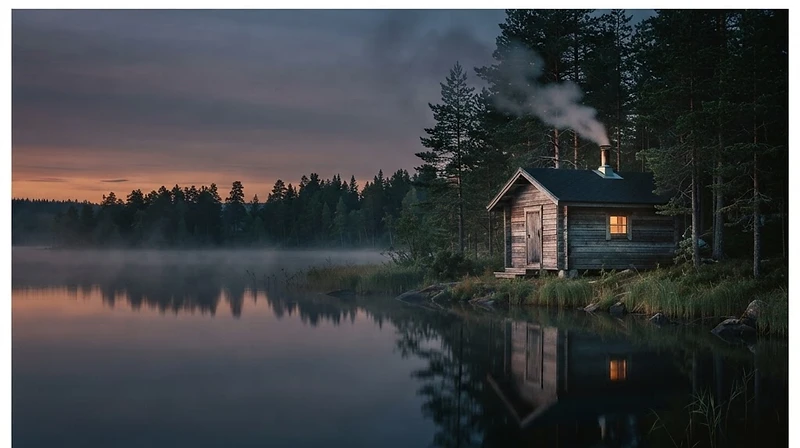
Sauna
Heat, cold and silence: an ancient Finnish room where the body resets and the mind finally stops talking.
But first, a little context and history...
The sauna is older than Finland itself. Archaeologists date the earliest Finnish sauna sites to roughly 7000 BCE: a pit scraped into a slope, a fire, a pile of stones, and a covering of hides to hold the heat. It was not a luxury. It was where bodies were washed, the sick were nursed, babies were born, and the dead were prepared — the one room in a hard climate that was reliably warm, clean and safe.
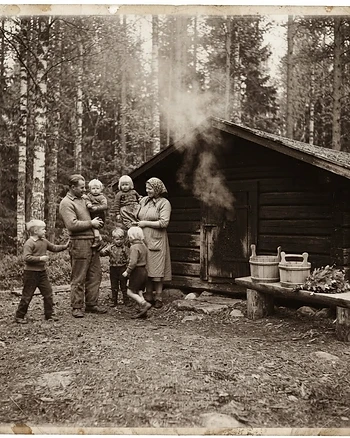
Over millennia the pit became a cabin. The smoke sauna, savusauna, is the classic form: a windowless log building with a stone stove and no chimney, fired for hours until the walls themselves hold the heat, then cleared of smoke before anyone enters. It is slow, sooty and difficult, and many Finns still consider it the only true sauna. The chimneyed wood stove and, later, the electric heater made the room ordinary — every apartment block, every summer cottage, every lakeside cabin could have one.
The word löyly is untranslatable and essential. It means the steam that rises when water meets hot stone, and also the spirit of the room, and also the feeling in your chest when it arrives. A sauna is measured in löyly, not degrees. Alongside it sits the vihta or vasta: a bundle of fresh birch twigs used to beat the skin, moving blood and releasing the sharp green smell of summer into a room built for winter.
Finnish immigrants carried the sauna to North America in the late nineteenth century, settling in Michigan's Upper Peninsula, northern Minnesota and Ontario, where it became a community institution rather than a private one. For most of the twentieth century the rest of the world ignored it. Then came the research: large Finnish cohort studies linking frequent sauna bathing with lower cardiovascular and all-cause mortality, followed by a global wellness boom that turned a working-class bathing house into a spa amenity. Purists will tell you the boom got the temperature wrong and the silence wrong. Both things are true at once.
What survives is the ritual itself, and it is remarkably simple: heat the room, sit in it longer than is comfortable and shorter than is reckless, cool down hard, repeat, then rest. Everything else — the whisk, the cold plunge, the rye bread and beer afterward — is ornament on a structure that has not changed in seven thousand years.
“The heat is only the invitation. The stillness is the practice.”
What to gather
A graded list of gear — from the first honest kit to the tools of a life in the craft. The Novice kit is free; the deeper tiers open with membership.
Novice
The first kit — enough to begin honestly.
From novice to proficient
A thirty-day passage. Each node is a day. The terracotta fill marks the ground you have already covered.
Understanding the history and cultural significance of the sauna as a space for mental reset.
YouTubeIntroduction to the Finnish Sauna
Finlandia DiariesWhat does the concept of 'silence' mean to you in a modern, noisy world?
Saved locally to your device


How the cohort practices today
The pulse is quiet — for now.
Be the first to document your Sauna journey with #EmptyNexxter.