
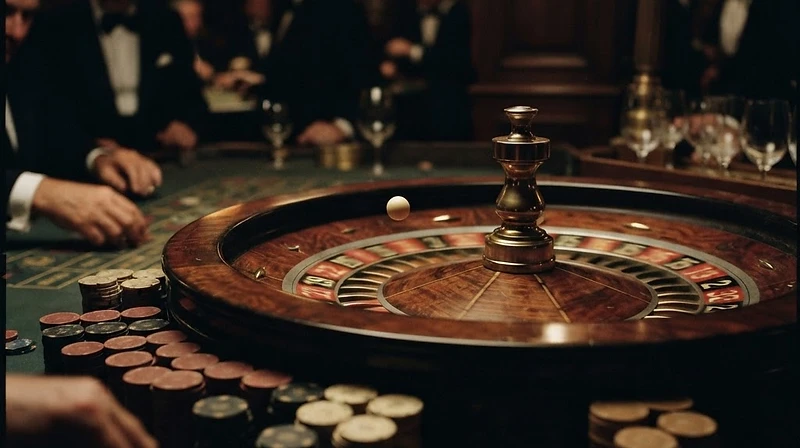
Roulette
The most democratic table in the casino — and the only one where arithmetic measurably improves your terms.
But first, a little context and history...
Roulette is French for "little wheel," and that is nearly all the name promises. The game as we recognize it took shape in Paris in the 1790s, when a spinning wheel with numbered pockets appeared among the gaming tables of the Palais-Royal. A persistent legend credits Blaise Pascal with the device, on the theory that a seventeenth-century mathematician chasing perpetual motion stumbled into a wheel of thirty-six numbers. There is no contemporary evidence for it, and the story is best told as the kind of origin myth casinos prefer: mathematics, accident, and a hint of the occult.
What is documented is the wheel's commercial evolution. Early Parisian roulette carried extra pockets beyond the zero, making the house's advantage obvious and the players' resentment permanent. In 1843 the brothers Francois and Louis Blanc took a different approach at their Bad Homburg casino: they removed the double zero, cut the house's hold on even-money bets almost in half, and let the traffic follow. It did. Single-zero roulette travelled to Monte Carlo, became the standard of the European and French tables, and remains the most player-favourable version of the game ever set down in a casino.
The American wheel went the other way. Nineteenth-century operators added a double zero, producing thirty-eight pockets and a 5.26 percent edge, then compounded the injury with the five-number basket on 0, 00, 1, 2 and 3, which carries the worst price on any standard table at 7.89 percent. Same game, same felt, nearly double the cost of playing it.
The rest of roulette's history is the history of people trying to read the wheel rather than the odds. In the 1960s the physician Richard Jarecki systematically profited from wheels with mechanical bias, worn bearings and tilted rotors that made certain pockets slightly more likely than others. In the 1970s a group of physicists known as the Eudaemonic Pie timed the ball and the rotor with shoe-mounted computers. Modern casinos now monitor wheels for exactly these tendencies, which is why the physical edge has largely been engineered out of the modern game.
What has not changed is the arithmetic. Betting systems are not edges: every progression, from Martingale to Fibonacci to Paroli, rearranges the shape of the ride without moving its destination. The expected loss per spin is identical whether you bet flat, double after losses, or scatter chips across the layout. What genuinely changes your terms is duller and more useful: play a single-zero wheel, look for tables offering la partage or en prison (which return half of an even-money bet when zero appears, halving the edge to 1.35 percent), avoid the American five-number basket, and measure your session in hours rather than in spins.
This lab teaches the arithmetic first and the systems second, including an honest accounting of what each one can and cannot do. Roulette is a game of small, measurable certainties: a single-zero wheel returns about 97.3 cents on the dollar, a double-zero wheel about 94.7. Learn to see those two numbers clearly and you will play with your eyes open, which is the only advantage the table ever truly offers.
“No progression changes the expectation of a single spin. What you can change is the wheel you play on, the bets you avoid, and the size of the bankroll you are willing to lose.”
- Wizard of Odds — Roulette Basics· Reference
- Wizard of Odds — Sector Bets (Voisins, Tiers, Orphelins)· Reference
- Call Bets and the Racetrack, Explained· Guide
- Wikipedia — Roulette· History
- Wikipedia — Martingale (betting system)· Reference
- Wikipedia — Gambler's Ruin· Reference
- The Science of the Casino: Why the House Always Wins· Essay
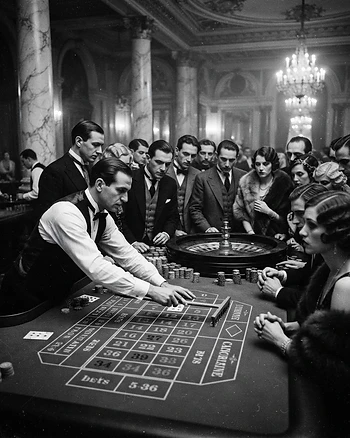
What to gather
A graded list of gear — from the first honest kit to the tools of a life in the craft. The Novice kit is free; the deeper tiers open with membership.
Novice
The first kit — enough to begin honestly.
From novice to proficient
A thirty-day passage. Each node is a day. The terracotta fill marks the ground you have already covered.
A first look at the wheel, the ball, and the numbered layout before any strategy enters the room.
YouTubeThe Table in Four Minutes
The Ultimate ExplainerWhich part of the layout did you find hardest to read at first glance, and why?
Saved locally to your device


How the cohort practices today
The pulse is quiet — for now.
Be the first to document your Roulette journey with #EmptyNexxter.