
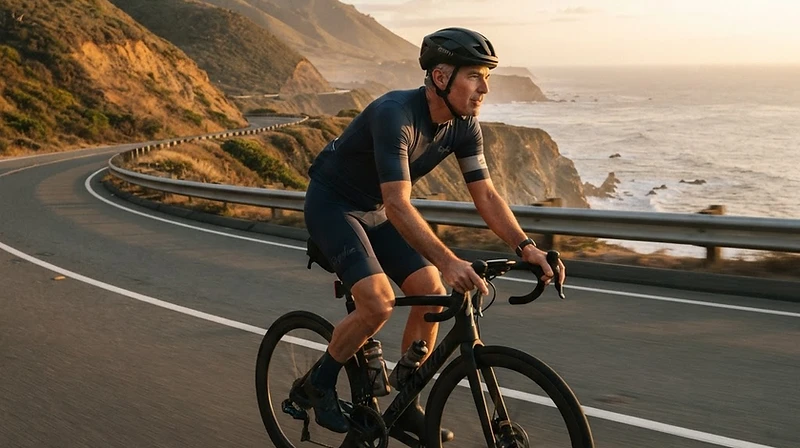
Road Biking
The sport that began with a walking machine — a road that goes for miles, a pedal stroke that is a rhythm, and a way to see the country at the speed of a human being.
But first, a little context and history...
Road biking is the sport that began with a walking machine and became the thing that taught the world to move. The first bicycle was the Draisine, invented by Karl Drais, a German forest official, in 1817, as a response to the failure of the previous year's harvest: the horses had died or been eaten, and Drais, who needed to inspect the forests, built a wooden frame with two in-line wheels and no pedals, which the rider pushed along with his feet. It was called the hobby horse, the dandy horse, and the velocipede, and it was a fad in the summer of 1819 before it was banned from the sidewalks of London, Paris, and New York for being a nuisance to pedestrians. The Draisine is the ancestor of every bicycle that followed, and it is the reason the word 'bicycle' exists.
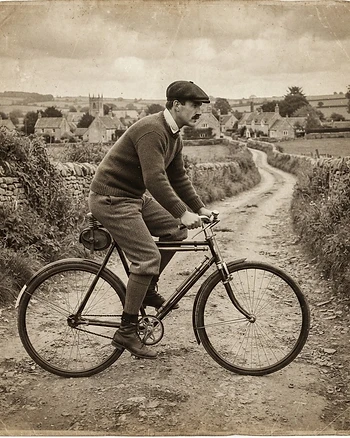
The bicycle that became the road bike was the Rover safety bicycle, designed by John Kemp Starley in 1885 in Coventry, England. Before the Rover, the bicycle was the ordinary, or the penny-farthing — the high-wheel bicycle with a five-foot front wheel and a small rear wheel, which was fast but which pitched the rider over the handlebars in a 'header' at the slightest obstacle. Starley's Rover had two wheels of equal size, a chain drive to the rear wheel, and a frame that the rider sat behind rather than above, which made it safe — hence the name. The Rover is the bicycle that every road bike descends from, and it is the machine that made cycling a sport, a transport, and a freedom for women, who could not ride the penny-farthing in the skirts the era required and who could ride the Rover. The Rover safety was the bicycle Susan B. Anthony said had 'done more to emancipate women than anything else in the world.'
The sport that the Rover made possible was road racing, and the first race was Paris-Roubaix, first run in 1896 over the cobbled farm roads of northern France, which is still the most famous one-day race in the world and which is called the Hell of the North because of the cobbles and the weather. The Tour de France, the race that made the road bike a global sport, was first run in 1903 as a circulation stunt by the newspaper L'Auto, and it was won by Maurice Garin, a former chimney sweep, who covered 2,428 kilometers in nineteen days at an average speed of 25.3 kilometers per hour. The Giro d'Italia began in 1909, the Vuelta a España in 1935, and the three are the Grand Tours, which are the three-week stage races that are the highest expression of the sport. The first world championship was in 1921, the first Olympic road race in 1896. The sport's modern era began with the introduction of the derailleur, which allowed the rider to change gears without stopping, in the 1930s; the first Tour won with a derailleur was 1937.
The technology of the road bike evolved in the service of speed, which is the sport's only goal. The steel frame of the Rover era was replaced by the aluminum frame in the 1970s, which was lighter, and the aluminum was replaced by the carbon fiber frame in the 1990s, which was lighter still and which could be shaped to be aerodynamic. The steel fork was replaced by the carbon fork, the wire-spoked wheel by the deep-section aero wheel, and the tubular tire, which was glued to the rim, by the clincher, which is held on by the rim's edge. The number of gears grew from two in the 1930s to eleven by the 2000s, and the drivetrain that is now the standard is the eleven-speed electronic groupset, which shifts with the push of a button and which was introduced by Shimano in 2009. The drop handlebar, which has been the road bar since the 1880s, is the bar that gives the rider multiple hand positions for the long ride and the aerodynamic position for the sprint.
For the empty nester, road biking is the rare sport that is as much a meditation as an exercise. The road goes for miles, the pedal stroke is a rhythm, and the distance is a way to see the country at the speed of a human being, which is the speed the world was meant to be seen at. The bike that was a walking machine in 1817 is now a machine of extraordinary refinement, and the road that was a farm track is now a network that covers the continent. The lesson the empty nest is teaching you — that the next chapter is the one you ride — is the lesson the road bike has been teaching for two hundred years.
“The road goes for miles, the pedal stroke is a rhythm, and the distance is a way to see the country at the speed of a human being.”
What to gather
A graded list of gear — from the first honest kit to the tools of a life in the craft. The Novice kit is free; the deeper tiers open with membership.
Novice
The first kit — enough to begin honestly.
Advanced
The serious tools of a committed hand.
Coming soon
Expert
The equipment of a life in the craft.
Coming soon
From novice to proficient
A thirty-day passage. Each node is a day. The terracotta fill marks the ground you have already covered.
The Draisine, the Rover safety, Paris-Roubaix, the Tour, the derailleur, the carbon frame. Know the lineage of the bike under you and the road that made it.
YouTubeWhat Road Biking Is
BCRHow does understanding the evolution of the bicycle from the draisine to modern carbon frames change your appreciation for the machine you ride today?
Saved locally to your device


How the cohort practices today
The pulse is quiet — for now.
Be the first to document your Road Biking journey with #EmptyNexxter.