
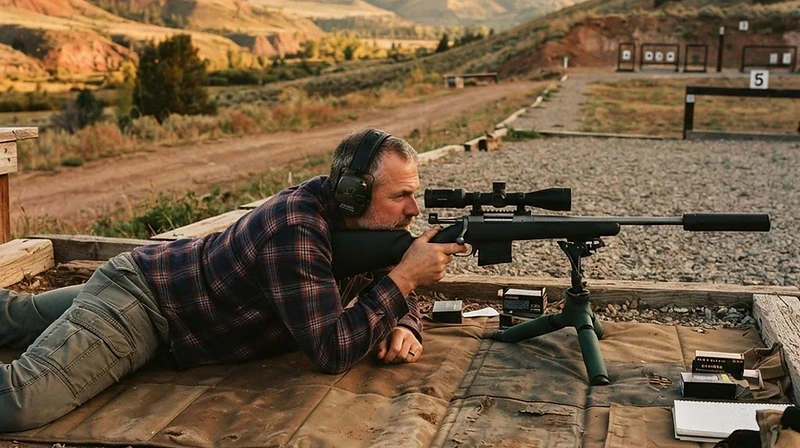
Rifle
The art of putting one small hole next to another, at a distance most people cannot see.
But first, a little context and history...
The rifle begins with the gunpowder revolution of medieval China and Europe, but its defining feature — the spiral grooves cut inside the barrel that spin a bullet straight — is a Renaissance invention. By the 15th century, German and Austrian gunsmiths were rifling the bores of hunting and target arms, giving the lead ball a gyroscopic spin that let it fly true at distances a smoothbore could not reach. The word itself comes from the German riffeln, to groove.
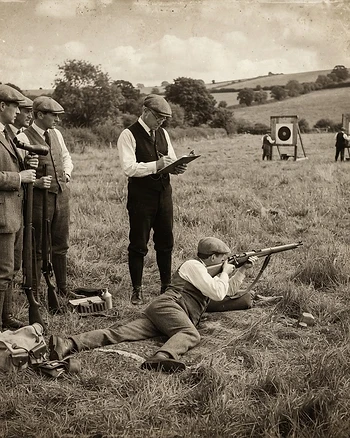
For three centuries the rifle was a slow, fiddly weapon. The patched ball had to be hammered down the grooves from the muzzle, making a rifleman's rate of fire perhaps a third of a musketeer's. What the rifle gave up in speed it returned in accuracy: American frontiersmen in the 18th century — the Pennsylvania longrifle makers like the Herschells and the Hawkens — turned the grooved barrel into a tool of settlement, hunting, and war. The Kentucky longrifle carried by Morgan's riflemen at Saratoga in 1777 could hit a man-sized target at 200 yards when a smoothbore musket was guesswork past 80.
The 19th century mechanized the rifle. The percussion cap replaced flint, the breechloader replaced the muzzle-loader, and the brass cartridge replaced the paper patch. By the American Civil War, repeaters like the Spencer and Henry could fire seven shots without reloading. By the 1890s, smokeless powder and the jacketed spitzer bullet — the sharp-pointed round we still use today — pushed effective range past 1,000 yards. The bolt-action magazine rifle of the Boer War and the First World War — the Mauser 98, the Lee-Enfield, the Springfield 1903 — is, mechanically, the same rifle a modern hunter or target shooter still carries.
The sport of rifle marksmanship grew alongside the weapon. The National Rifle Association was chartered in New York in 1871 specifically to improve American marksmanship after the poor shooting of Civil War volunteers; the first Creedmoor matches in 1873 drew 6,000 spectators. Olympic rifle shooting has been part of every modern Games since 1896. For the empty nester, the rifle is a study in stillness: the slow, patient pursuit of putting one small hole next to another at a distance most people cannot see clearly.
“The rifle does not reward strength. It rewards the absence of movement.”
What to gather
A graded list of gear — from the first honest kit to the tools of a life in the craft. The Novice kit is free; the deeper tiers open with membership.
Novice
The first kit — enough to begin honestly.
Advanced
The serious tools of a committed hand.
Coming soon
Expert
The equipment of a life in the craft.
Coming soon
From novice to proficient
A thirty-day passage. Each node is a day. The terracotta fill marks the ground you have already covered.
The action, the barrel, the stock, the trigger, the scope — learn the anatomy of the bolt-action rifle before you fire it.
YouTubeAnatomy of the Bolt-Action Rifle
MeatEaterIdentify the bolt handle and safety mechanism on your specific rifle. How do these components interact to ensure the rifle is safe or ready to fire?
Saved locally to your device


How the cohort practices today
The pulse is quiet — for now.
Be the first to document your Rifle journey with #EmptyNexxter.