
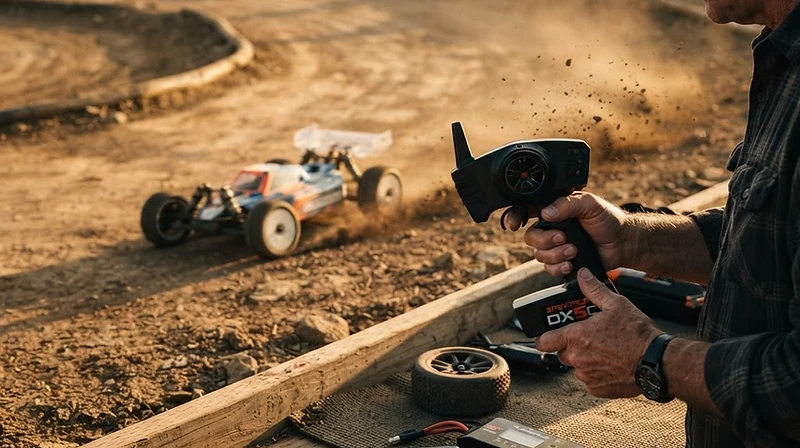
RC Cars
Master the throttle and master the machine: the precision of RC racing offers a second life on the track.
But first, a little context and history...
Radio-controlled (RC) car racing is a blend of mechanical engineering and reflexive athletics. It transforms a quiet driveway or a local dirt track into a theater of speed. At its heart, the hobby requires a chassis, a sophisticated transmitter, and a motor—either electric or nitro-powered—to propel the vehicle across diverse terrains. For the empty nester, this hobby offers a unique intellectual challenge. It provides the satisfaction of building something tangible with one's own hands, paired with the competitive thrill of piloting a machine through tight corners and over jumps at high velocity.
The lineage of these miniature speedsters traces back to the tether cars of the 1930s and 1940s. These early models were powered by tiny internal combustion engines and attached to a central post via a steel cable, forcing them to run in a continuous circle. While these cars reached incredible speeds, they lacked true pilot input. By the late 1960s, the advent of affordable, proportional radio technology allowed enthusiasts to finally steer and throttle their creations wirelessly, liberating the hobby from the tethered circle.
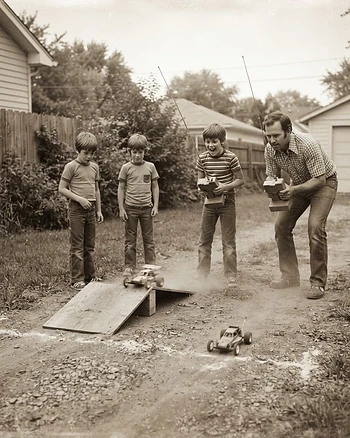
The 1970s and 1980s served as the golden age of innovation, transitioning the hobby from niche curiosity to mainstream obsession. Italian manufacturers pioneered the 1/8 scale off-road buggy, proving that small cars could survive jumps and rough terrain. Simultaneously, the Japanese market, led by giants like Tamiya, introduced the 1/10 scale plastic kit. These models were accessible, detailed, and highly customizable. This era saw the introduction of robust suspension systems and sophisticated tires, allowing owners to move from flat parking lots into the unpredictable environment of backyard dirt tracks.
Today, the hobby is practiced through a wide spectrum of disciplines, ranging from relaxed 'bashing'—driving for fun in off-road settings—to high-stakes competitive circuit racing. A modern enthusiast might choose a brushless electric motor for instant, quiet torque, or a nitro engine for the visceral experience of smell and sound. Building these machines requires precision tools, a soldering iron, and a workspace where one can focus on the nuances of gear ratios, shock damping, and tire compounds. It is a hobby that rewards the inquisitive mind and the disciplined hand.
Modern technology has further refined the experience, with telemetry sensors providing real-time data on battery voltage and motor temperature directly to the controller. The community surrounding RC racing is vibrant and welcoming, with local hobby shops and clubs hosting weekly events that cater to every skill level. Whether you are tuning a crawler for technical rock-climbing or prepping a touring car for indoor carpet racing, the camaraderie of the paddock is an essential part of the experience. It is a shared language spoken through chassis adjustments and lap times.
For the Gen X empty nester, RC racing provides a perfect remedy for the quiet house. It encourages a return to tactile creation, where the act of assembling a differential or calibrating a servo takes precedence over digital consumption. You are not merely observing; you are actively engaging with physics and engineering in real-time. The hobby bridges the gap between childhood wonder and adult technical competence.
The barrier to entry remains intentionally low, yet the ceiling for mastery is infinite. You can purchase a ready-to-run kit to start immediately, or spend weeks meticulously assembling a competition-grade chassis from thousands of individual parts. Ultimately, the hobby is about the connection between the driver's intention and the machine's reaction. When you pull that trigger, the outside world fades, leaving only the sound of rubber on pavement and the singular goal of hitting the next apex perfectly.
“A car is not just a model; it is a mechanical puzzle that demands patience, precision, and a steady thumb on the trigger.”
What to gather
A graded list of gear — from the first honest kit to the tools of a life in the craft. The Novice kit is free; the deeper tiers open with membership.
Novice
The first kit — enough to begin honestly.
From novice to proficient
A thirty-day passage. Each node is a day. The terracotta fill marks the ground you have already covered.
Understand the hobby: the chassis, the power system, the radio, the drive. Tour the transmitter, the receiver, the servo, the battery. Today is orientation; the build and the drive begin tomorrow.
YouTubeThe Hobby and the Car
Get Into RCReflect on the different categories of RC cars discussed. Which type of chassis appeals most to your personal interests and why?
Saved locally to your device


How the cohort practices today
The pulse is quiet — for now.
Be the first to document your RC Cars journey with #EmptyNexxter.