
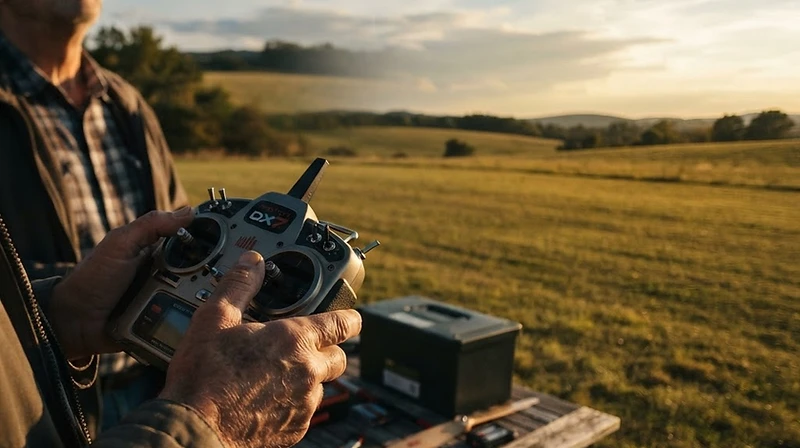
RC Airplanes
Master the horizon with the elegant marriage of balsa wood, precision electronics, and the boundless sky.
But first, a little context and history...
Radio-controlled aviation represents a timeless intersection of mechanical engineering and aerial artistry. While the origins of model flight trace back to early aeronautical pioneers, the hobby found its stride in the 1930s when enthusiasts began pairing lightweight balsa airframes with rudimentary radio systems. These early practitioners were not merely hobbyists; they were amateur engineers navigating the complex challenges of aerodynamics, gravity, and signal reliability. For a generation now entering the empty nest, this pursuit offers a profound opportunity to reconnect with the tactile satisfaction of a physical build while sharpening the mind against the complexities of modern flight dynamics. The transition from the workbench to the flight line demands a rare combination of focus and steady hands that few other leisure activities provide. Following the era of free-flight models, which relied entirely on pre-set control surfaces and wind conditions, the introduction of radio control fundamentally altered the landscape. During the 1940s and 1950s, the development of vacuum tube transmitters allowed pilots to gain remote command over a craft for the first time. The evolution continued through the mid-20th century, as bulky equipment gave way to streamlined, multi-channel radios and eventually the sophisticated 2.4GHz digital systems we use today. This technological progression mirrored the growth of the Academy of Model Aeronautics, founded in 1936, which established safety standards and fostered a community that continues to support pilots across the globe. Mastery of an RC aircraft is a multi-disciplinary endeavor. It begins in the workshop, where you interpret blueprints and shape lightweight woods like balsa and spruce, covering them in heat-shrink films that mimic the skin of historic warbirds or modern aerobatic planes. You must learn the nuances of propulsion, whether your preference lies in the visceral roar of a nitro glow engine or the silent, efficient precision of modern brushless electric motors. Once on the flight field, the hobby shifts from stationary construction to dynamic performance. Each flight is a lesson in air currents, depth perception, and spatial awareness, demanding total presence of mind. Unlike the fleeting digital distractions of contemporary life, RC flying forces you to exist entirely within the moment of the flight. For the empty nester, this hobby serves as an ideal second act. It provides a community of fellow enthusiasts who value historical authenticity and technical rigor. There is a distinct, meditative quality to sanding a wing rib to perfection or diagnosing a minor mechanical issue before a flight. You are not simply operating a device; you are participating in a tradition that spans nearly a century of innovation. Whether you choose to fly classic scale replicas that honor the golden age of aviation or sleek, high-performance gliders that dance on thermal updrafts, you are reclaiming the sky for your own enjoyment. The persistence required to build a kit from scratch creates a sense of accomplishment that is increasingly rare. In an era dominated by disposable technology, the act of repairing a craft you built with your own hands offers a deep, lasting satisfaction. By engaging with this craft, you join a legacy of pilots who recognize that the greatest rewards come to those willing to spend time at the workbench, learning the secrets of the air one flight at a time.
“Aviation is an unforgiving tutor, yet a single perfect landing repays a thousand hours of steady work at the workbench.”

What to gather
A graded list of gear — from the first honest kit to the tools of a life in the craft. The Novice kit is free; the deeper tiers open with membership.
Novice
The first kit — enough to begin honestly.
Coming soon
From novice to proficient
A thirty-day passage. Each node is a day. The terracotta fill marks the ground you have already covered.
Understand the hobby: the airframe, the power system, the radio, the flight. Tour the transmitter, the receiver, the servo, the battery. Today is orientation; the build and the flight begin tomorrow.
YouTubeThe Hobby and the Model
VoroRCReflect on the different components of an RC airplane mentioned in the video. Which part of the system (airframe, radio, or power) do you feel most curious to learn more about?
Saved locally to your device


How the cohort practices today
The pulse is quiet — for now.
Be the first to document your RC Airplanes journey with #EmptyNexxter.