

Quilting
Stitching time into legacy: the enduring craft of turning remnants into heirloom warmth.
But first, a little context and history...
At its technical core, quilting is the art of securing three distinct layers—a decorative top, a insulating batting, and a backing—via continuous running stitches. Derived from the Latin term 'culcita,' meaning a stuffed sack, the craft transcends its functional origins. It represents a meditative bridge between historical utility and modern artistic expression, making it a perfect pursuit for the seasoned hand and the reflective mind. By transforming disparate scraps of fabric into a cohesive narrative, the maker preserves memories that often fade from memory before they fade from thread.
The lineage of the quilt begins on the medieval battlefield. Before the decorative bedcovers of the 18th century, the 'gambeson' provided essential defense for soldiers. This quilted garment, stuffed with wool or cotton, offered a crucial layer of impact resistance beneath chainmail. The earliest known surviving specimen, the Tristan Quilt, dates to approximately 1360 in Sicily. This ornate masterpiece illustrates the tragic romance of Tristan and Isolde through intricate appliqué and quilting, proving that even in its infancy, the craft served as a vessel for complex visual storytelling.
As settlers migrated to the American colonies, the quilt became a pillar of domestic life. Faced with harsh winters and limited textile resources, women turned to 'scrap quilting.' Every fragment of worn clothing, from faded linen shirts to wool coats, was salvaged and repurposed into a functional masterpiece. This era birthed the iconic patterns still revered today, such as the Ohio Star and the Double Wedding Ring. The 'Log Cabin' design, featuring a central square representing the hearth, remains a poignant symbol of the American frontier, where light and dark fabrics delineated the warmth of home against the shadows of the wilderness.
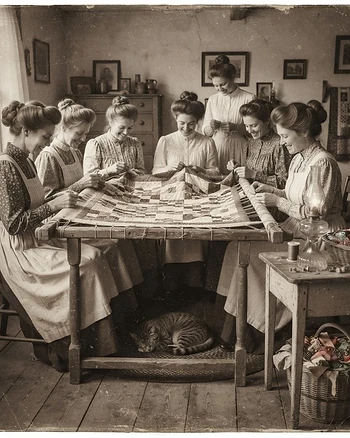
The quilting bee represents a vital cultural milestone in the craft’s history. These gatherings allowed women to assemble full-sized quilts that were too expansive for one person to maneuver alone. Beyond the physical output, these meetings functioned as essential social hubs, facilitating the exchange of news, support, and collective wisdom. These hives of activity turned a solitary domestic chore into a vibrant communal ritual, embedding the quilt deeply into the social fabric of American history.
In the 20th century, the legacy of the craft was immortalized by the women of Gee’s Bend, Alabama. Their unique, improvisational style transformed quilting from a traditional task into a recognized form of abstract art, celebrated in museums globally. Their work demonstrated that the quilt is a living document, capable of reflecting contemporary struggles, joy, and individual creative agency. Their influence ensures that quilting remains a dynamic, evolving discipline rather than a static relic of the past.
Today, the hobby offers Gen X empty nesters an unparalleled opportunity for focus and creative restoration. It requires minimal initial investment—a rotary cutter, an acrylic ruler, a reliable sewing machine, and high-quality thread are the primary tools. The process demands a departure from the frantic pace of modern connectivity, forcing a return to tactile, slower rhythms. Whether you are following a rigorous geometric pattern or embracing the free-form style of improvisational piecing, the craft rewards consistency and patience.
For those entering this new stage of life, quilting provides both a productive outlet and a sense of legacy. You are not simply sewing cloth; you are creating tactile histories that will outlast the current moment. Each finished project serves as a physical archive of your time, attention, and aesthetic evolution. It is a quiet, deliberate rebellion against the disposable nature of modern consumerism, grounding the maker in the tangible reality of a beautiful, finished whole.
“A quilt is not merely fabric; it is a map of the maker's patience and the quiet narrative of a life pieced together, one stitch at a time.”
What to gather
A graded list of gear — from the first honest kit to the tools of a life in the craft. The Novice kit is free; the deeper tiers open with membership.
Novice
The first kit — enough to begin honestly.
From novice to proficient
A thirty-day passage. Each node is a day. The terracotta fill marks the ground you have already covered.
Understand the quilt: top, batting, back, and the stitching through. Tour the kit — fabric, thread, needle, hoop. Today is orientation; the stitching begins tomorrow.
YouTubeThe Craft and the Three Layers
Jordan FabricsReflect on the three layers of a quilt. How does the relationship between the top, batting, and backing change your perception of a finished project?
Saved locally to your device


How the cohort practices today
The pulse is quiet — for now.
Be the first to document your Quilting journey with #EmptyNexxter.