
Jigsaw Puzzles
Piece by piece, restore the world to its proper order.
But first, a little context and history...
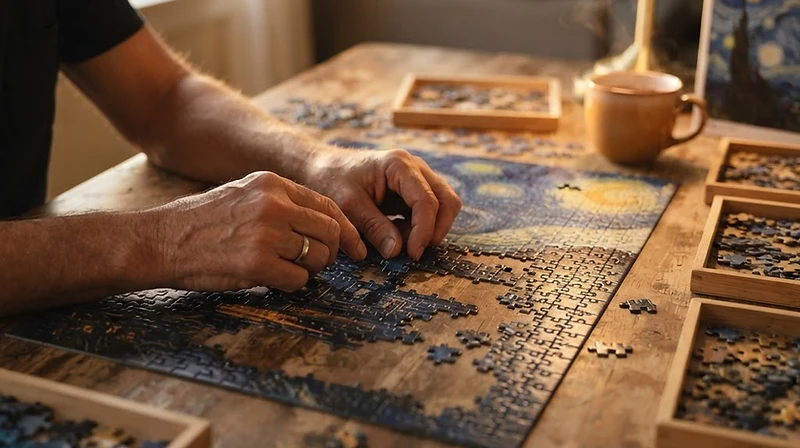
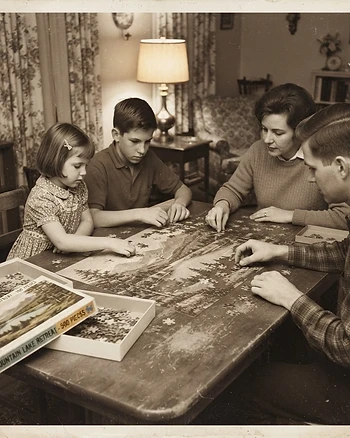
Puzzling is an exercise in intentionality, a practice of turning scattered disorder into a coherent whole. At its core, it is a pursuit that demands nothing more than a steady hand, a sharp eye, and the willingness to lose track of the hour. For those of us navigating the quietude of an empty nest, this activity offers a rare sanctuary. It rewards the patience cultivated over decades, providing a tactile meditative space that screens and digital devices simply cannot replicate. You are not just building an image; you are rebuilding your own capacity for deep, sustained focus. The heritage of this craft traces back to 1767, when London cartographer and engraver John Spilsbury produced the first 'dissected map.' He mounted a map of Europe onto a piece of cedar, using a fine-bladed marquetry saw to trace the political borders of each country. Designed as an educational aid for students, his maps required them to assemble geographical regions correctly. This marriage of instruction and entertainment bridged a gap in 18th-century pedagogy. Soon, these mahogany puzzles became popular pastimes among the aristocracy, slowly evolving from strictly geographical lessons into decorative scenes of history and myth. During the Victorian era, the invention of the treadle saw allowed for more intricate, irregular cutting patterns, shifting the challenge from simple border recognition to complex, interlocking artistry. The true democratization of the hobby arrived in the early 20th century, as advancements in die-cutting and high-quality cardboard production made puzzles affordable for the middle class. The Great Depression sparked a national obsession, as inexpensive puzzles offered an accessible, repeatable form of domestic relief during lean times. Today, the puzzle has matured into a sophisticated craft ranging from challenging, high-piece-count landscapes to artisanal wooden puzzles featuring 'whimsy pieces'—custom shapes that add layers of surprise to the assembly process. To begin, you require only a sturdy table with optimal lighting and a dedicated space where your work can remain undisturbed. Investing in a sorting tray or a felt roll-up mat helps maintain order during the process. The beauty of the modern era is the variety; whether you prefer the classic challenge of monochromatic art, the geometric precision of mechanical puzzles, or the intricate laser-cut wooden variety, the entry point remains universally inviting. For the Gen X enthusiast, this hobby serves as a profound reset button. In a life that has often been defined by the noise of raising children and the frantic pace of a mid-career climb, the stillness of the puzzle table provides a deliberate boundary. It is an invitation to inhabit the present moment completely. The process of sorting edges, grouping by color, and finally securing the fit of a singular piece mimics the way we choose to organize our own experiences. It is a slow, rhythmic, and deeply rewarding way to reclaim your time, proving that the most complex pictures are often the ones we piece together on our own terms.
“A puzzle is not merely a picture reclaimed; it is a quiet dialogue between the analytical mind and the chaos of the scattered fragment.”
What to gather
A graded list of gear — from the first honest kit to the tools of a life in the craft. The Novice kit is free; the deeper tiers open with membership.
Novice
The first kit — enough to begin honestly.
From novice to proficient
A thirty-day passage. Each node is a day. The terracotta fill marks the ground you have already covered.
Understanding piece shapes, knobs, and blanks to identify how they interlock.
YouTubeThe Anatomy of a Puzzle
Engineering WorldHow do the different shapes of pieces influence your initial sorting strategy?
Saved locally to your device


How the cohort practices today
The pulse is quiet — for now.
Be the first to document your Jigsaw Puzzles journey with #EmptyNexxter.