
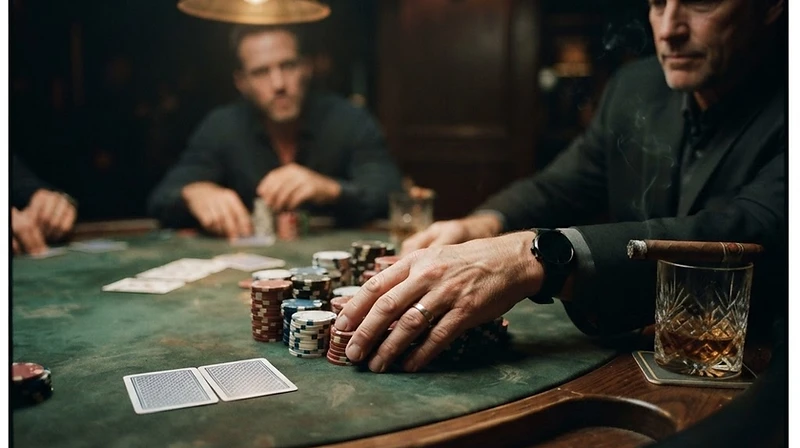
Poker
Master the art of the calculated risk in a contest of logic, patience, and nerves.
But first, a little context and history...
Poker is a sophisticated dance of probability and human psychology, demanding a precise blend of mathematical rigor and emotional discipline. At its core, the game challenges players to make optimal decisions with incomplete information, utilizing a standard deck of 52 cards to navigate shifting rounds of wagering. While popular culture often frames it as a game of luck, the longevity of elite players proves that consistency, observation, and patience eventually eclipse the variance of the deal. For the Gen X professional entering their second prime, poker offers a perfect intellectual playground—a high-stakes environment that rewards the years of experience you have already gained in reading people and managing risk.
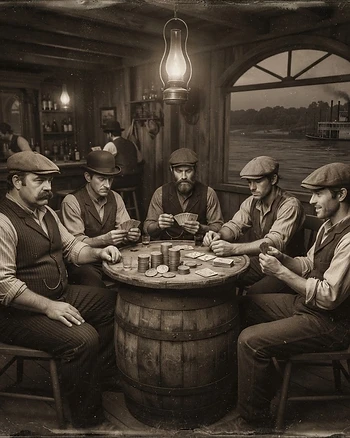
The historical roots of the game are deeply embedded in the American landscape of the early 1800s. While historians debate exact lineages, the consensus points to a convergence of French 'Poque' and German 'Pochen' played by settlers traveling along the Mississippi River. These early versions were often played with a truncated 20-card deck, but the transition to the full 52-card French suit allowed for deeper strategic complexity, eventually introducing the concept of the flush and the straight. By the time the game moved from riverboats to the untamed saloons of the Wild West, it had become the standard pastime for prospectors, traders, and legends alike, earning its reputation as a rugged test of mettle.
Following the Civil War, poker evolved from a frontier curiosity into a formalized discipline. The introduction of community cards, specifically in variants like Texas Hold 'em, revolutionized the game by creating shared information that players must interpret simultaneously. However, the game remained largely a clandestine pursuit until 1970, when Benny Binion invited the greatest players of the era to his Horseshoe Casino in Las Vegas for the inaugural World Series of Poker. This singular event transformed poker from a backroom gamble into a spectator sport, establishing a professional hierarchy that remains the industry gold standard today.
The 21st century ushered in a digital renaissance, democratizing access to high-level play. The 2003 'Moneymaker Effect,' triggered by an amateur winning the World Series of Poker main event after qualifying online, ignited a global craze that refined the game’s theory. Modern players now have access to powerful software, known as Game Theory Optimal (GTO) solvers, which calculate the mathematically perfect line for any given scenario. While these tools have raised the ceiling for competition, they have also underscored the human element; at the table, the ability to exploit weaknesses remains the ultimate competitive advantage.
To begin your journey as a student of the game, the barrier to entry is delightfully low. You require only a high-quality deck of cards, a set of clay chips, and a small group of curious companions. Beyond the physical tools, the most significant investment is time spent analyzing your own decision-making process. Learning to fold a hand that holds potential but lacks mathematical justification is a skill that translates surprisingly well into other areas of professional and personal life. It is a hobby that respects your time and your intelligence.
For the empty nester, poker provides more than just a pastime; it offers a social structure and an unending intellectual challenge. As your domestic responsibilities shift, the poker table becomes a place of camaraderie where you can compete against peers on equal footing. Whether you enjoy the relaxed atmosphere of a home game or the disciplined intensity of a casino tournament, poker remains a lifelong pursuit. It is a game that never truly stops teaching, provided you remain a willing student of the cards and your own temperament.
“In poker, you do not play the cards; you play the person across from you.”
What to gather
A graded list of gear — from the first honest kit to the tools of a life in the craft. The Novice kit is free; the deeper tiers open with membership.
Novice
The first kit — enough to begin honestly.
From novice to proficient
A thirty-day passage. Each node is a day. The terracotta fill marks the ground you have already covered.
Understand the game: the deck, the chips, the position, the bet, the hand. Tour the table, the blinds, the button, the pot. Today is orientation; the poker begins tomorrow.
YouTubeThe Game and the Table
Cash In PokerReflect on the structure of the table and the flow of a hand. How does the position of the dealer button change the way you view your potential actions?
Saved locally to your device


How the cohort practices today
The pulse is quiet — for now.
Be the first to document your Poker journey with #EmptyNexxter.