
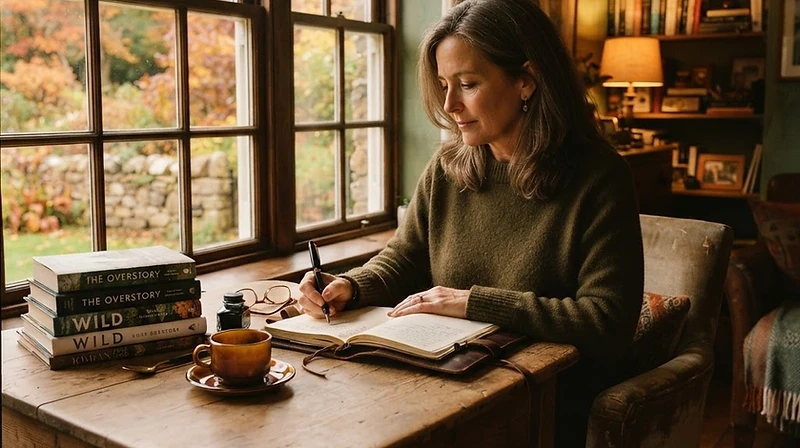
Poetry
The oldest art and the one that costs nothing — a pen, a page, and the willingness to pay attention.
But first, a little context and history...
Poetry is the oldest art, and it is older than writing. The earliest poem we know is the Epic of Gilgamesh, composed in Sumerian around 3000 BCE on clay tablets in the cuneiform script that is the first writing we have; the poem is a story of a king and his friend and the death that comes for both, and it is still a good poem. The Iliad and the Odyssey, composed by someone we call Homer around 750 BCE, were spoken and sung before they were written, and the rhythm of their dactylic hexameter was a memory aid as much as an art — the meter let the bard hold thousands of lines in the mouth. The Psalms, composed in Hebrew between the tenth and fourth centuries BCE, are the poems that built the Western idea of the inner life: the cry to God that is also a song, and the complaint that is also a praise.
The forms that poets still use are older than most nations. The sonnet was invented by Giacomo da Lentini at the court of Frederick II in Sicily around 1230, fixed at fourteen lines and a turn, and carried to England by Wyatt and Surrey in the sixteenth century; Shakespeare's 154 sonnets, published in 1609, are the ones every English speaker knows. The haiku was fixed by Matsuo Bashō in Japan in the seventeenth century — five syllables, seven, five, and a season — and his Narrow Road to the Interior, written in 1689, is the travel poem that every haiku since answers. The ghazal was perfected by Rumi and Hafez in Persia in the thirteenth and fourteenth centuries, a string of couplets with a refrain, and it is still the form of the Urdu and Persian poet. The villanelle, the sestina, the pantoum — the forms that look like puzzles and sound like music — were all fixed before 1600.
The American poetry that an empty nester inherits is younger than the country. Walt Whitman's Leaves of Grass, published in 1855, invented free verse in English and the idea that a poem could be as long as a man's breath and as wide as a continent; Emily Dickinson, writing in her bedroom in Amherst in the 1860s, invented the compressed lyric that is the other half of American poetry, the poem that is a grenade with the pin pulled. The modernists — Ezra Pound, T. S. Eliot, H. D. — broke the line and the form in the 1910s and 1920s and made the poem a collage; the Confessionals — Robert Lowell, Elizabeth Bishop, Sylvia Plath, Anne Sexton — put the self back in the poem in the 1950s and 1960s and made the poem a testimony. The poetry slam, invented by Marc Smith at the Green Mill in Chicago in 1986, put the poem back in the mouth and made it a performance again, as it had been at the beginning.
For the empty nester, poetry is the art that costs nothing and asks everything. It requires a pen, a page, and the willingness to pay attention to the world and to the language at the same time, which is the hardest thing a human being can do and the one that is most worth doing. The poem you write today is the poem no one else can write, and the first line you put down is the first line of a practice that can last the rest of your life.
“A poem is a grenade with the pin pulled. The first line you put down is the first line of a practice that can last the rest of your life.”

What to gather
A graded list of gear — from the first honest kit to the tools of a life in the craft. The Novice kit is free; the deeper tiers open with membership.
Novice
The first kit — enough to begin honestly.
From novice to proficient
A thirty-day passage. Each node is a day. The terracotta fill marks the ground you have already covered.
Gilgamesh, Homer, the Psalms, Bashō, Shakespeare, Whitman, Dickinson — the lineage of the art you are entering. Know the conversation you are joining before you speak.
YouTubeWhat Poetry Is
Study.comReflect on the lineage of poets you admire; how does understanding the history of the craft change the way you view your own potential contributions?
Saved locally to your device


How the cohort practices today
The pulse is quiet — for now.
Be the first to document your Poetry journey with #EmptyNexxter.