

Pickleball
A rhythmic dance of paddles and plastic; the backyard invention that conquered the American court.
But first, a little context and history...
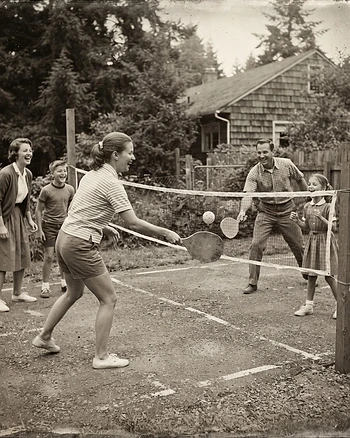
Pickleball occupies a unique space in the American sporting landscape, balancing high-speed tactical engagement with an accessible physical footprint. The game takes place on a court measuring 20 by 44 feet, the same dimensions as a doubles badminton court. Players wield solid composite paddles to strike a lightweight, perforated plastic ball over a net set to a height of 34 inches at the center. This specific configuration minimizes the court coverage required, making it an ideal discipline for those seeking vigorous exercise without the joint-stress inherent in traditional tennis. The allure lies in the 'kitchen'—the non-volley zone—which forces players to rely on patience, touch, and finesse rather than raw power. For the Gen X empty nester, this shift in focus provides a refreshing mental challenge that prioritizes court intelligence over sheer aerobic capacity. The history of the sport traces back to a quiet summer afternoon in 1965. Joel Pritchard, a congressman, and his friend Bill Bell returned home to find their children listless. Their attempt to organize a badminton match stalled due to a lack of proper equipment. Improvising, they fashioned paddles from spare plywood in a garage and utilized a Wiffle ball they had on hand. Barney McCallum joined them shortly thereafter, and the trio refined the rules over subsequent weekends to ensure a balanced, competitive experience. The name remains a subject of nostalgic debate; while some credit the Pritchard family dog, Pickles, who frequently disrupted play by chasing the ball, others point to the rowing term 'pickle boat,' signifying a crew comprised of leftover oarsmen—a nod to the repurposed gear used to launch the sport. By 1967, the first permanent pickleball court was constructed in the backyard of Bob O'Brien, a neighbor, cementing the transition from a casual pastime to a structured local hobby. The 1970s marked the sport's professionalization, culminating in the first organized tournament held in 1976 at the South Center Athletic Club in Tukwila, Washington. During the 1980s, the sport found its permanent home within the Sun Belt retirement communities of Arizona, Florida, and California. These active adult enclaves embraced the game for its low barrier to entry and high social quotient. Because doubles play is the standard, the game naturally fosters community, turning matches into collaborative social events rather than solitary athletic endeavors. Today, pickleball stands as the fastest-growing recreational activity in the United States. Modern advancements have transformed the equipment, shifting from the original crude plywood to lightweight carbon fiber paddles and high-visibility polymer balls. Despite these technical upgrades, the spirit of the game remains rooted in the mid-century suburban backyard. For the modern enthusiast, the game offers a perfect second act, providing a low-impact, high-reward environment where strategy and social connection serve as the primary currency. It is a rare sport that permits mastery at any stage of life, allowing players to refine their drop shots and lobs with the wisdom of experience, proving that the most vibrant chapter often begins once the house grows quiet.
“Pickleball isn't just a game; it is a tactical conversation played out in soft volleys and strategic placement.”
What to gather
A graded list of gear — from the first honest kit to the tools of a life in the craft. The Novice kit is free; the deeper tiers open with membership.
Novice
The first kit — enough to begin honestly.
Intermediate
The upgrades that change how it feels.
Coming soon
Expert
The equipment of a life in the craft.
Coming soon
From novice to proficient
A thirty-day passage. Each node is a day. The terracotta fill marks the ground you have already covered.
The creator has disabled playback on external sites, or the video has been removed. Watch it directly on YouTube.
Watch on YouTubeUnderstand the court: the 44x20 ft rectangle, the kitchen (non-volley zone), the net at 34 inches. Tour the paddle, the ball, the shoes. Today is orientation; the play begins tomorrow.
The Game and the Court
The P.E. PlaybookReflect on the court layout and equipment; what part of the court setup seems most unique compared to other racket sports you have seen?
Saved locally to your device


How the cohort practices today
The pulse is quiet — for now.
Be the first to document your Pickleball journey with #EmptyNexxter.