

Piano
The instrument that taught the world to practice — ten notes at once and a literature that fills a lifetime.
But first, a little context and history...
The piano is the instrument that taught the world to practice. Its name is short for pianoforte — soft-loud in Italian — and the name is the invention: before the piano, the harpsichord plucked its strings and could not vary its volume no matter how hard the player pressed. Around 1700, in the workshop of the Medici court in Florence, the instrument maker Bartolomeo Cristofori replaced the pluck with a hammer that struck the string and fell back, so the player could, for the first time, make a note loud or soft by touch alone. Three of Cristofori's pianos survive; the oldest, built in 1720, is in the Metropolitan Museum of Art in New York, and it still plays.
The piano was slow to catch on. The harpsichord had two centuries of repertoire behind it, and the organ had the church. The German maker Silbermann built pianos in the 1730s and showed one to Johann Sebastian Bach, who is said to have complained that the high notes were too weak and the action too stiff; a later Silbermann instrument, in the 1740s, won Bach's approval. The piano's rise began in earnest with the piano sonatas of Haydn, Mozart, and Clementi in the late eighteenth century, and it was Beethoven who forced the instrument to grow. Beethoven demanded more keys, a heavier action, and a louder sound than any piano of his day could give him, and the makers of Vienna and London rebuilt the instrument to meet him; by the time of the Hammerklavier sonata in 1818, the piano had the eighty-eight keys and the iron frame it still has today.
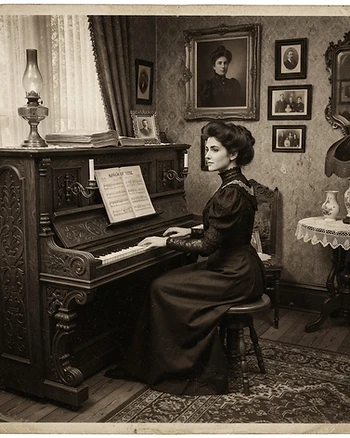
The piano that conquered the American home was the upright, invented in London by John Isaac Hawkins in 1800 and refined in Vienna by Matthias Müller, which stood the strings on end and put a piano in a room that had no wall for a grand. The square piano — a small rectangular box on legs — was the parlor instrument of the early Republic; the upright replaced it after the Civil War. By 1900, the United States was manufacturing over 350,000 pianos a year, and the instrument was the center of the American living room: the focus of the evening's entertainment, the child's lesson, and the singer's accompaniment. The player piano, with its perforated paper rolls, brought music into homes that had no player; the phonograph and the radio ended the player piano, and the digital keyboard ended the upright's monopoly, but the acoustic piano held its ground.
For the empty nester, the piano is the instrument that rewards the time you now have. It is the only instrument that lets one player sound ten notes at once, and the only one whose literature is deep enough to fill a lifetime and still leave most of it unplayed. The piano you sit at today is the same instrument Beethoven fought and Debussy painted with, and the first lesson you learn is the first lesson every pianist has learned since Cristofori struck a string with a hammer and let it fall back.
“The piano is the only instrument that lets one player sound ten notes at once — and the only one whose literature fills a lifetime and still leaves most of it unplayed.”
What to gather
A graded list of gear — from the first honest kit to the tools of a life in the craft. The Novice kit is free; the deeper tiers open with membership.
Novice
The first kit — enough to begin honestly.
From novice to proficient
A thirty-day passage. Each node is a day. The terracotta fill marks the ground you have already covered.
Grand, upright, digital, the 88 keys, the three pedals. The instrument you will sit at for years — know what it is and what each part does before you play a note.
YouTubeThe Instrument
Piano With JonnyReflect on the differences between the piano you are using and the one shown in the video. How does the physical layout of your instrument influence your comfort?
Saved locally to your device


How the cohort practices today
The pulse is quiet — for now.
Be the first to document your Piano journey with #EmptyNexxter.