
Parkour
Master the urban landscape: turn every obstacle into a fluid, rhythmic expression of strength and agility.
But first, a little context and history...
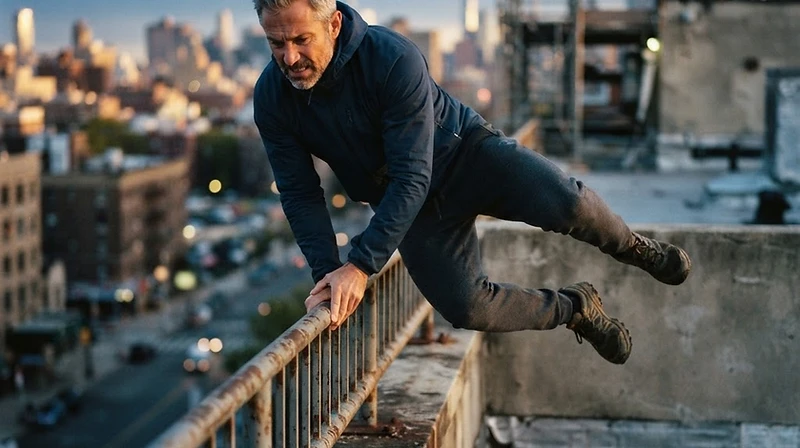
Parkour is the art of moving through an environment with maximum efficiency, treating concrete barriers and staircases not as hindrances, but as opportunities for physical expression. At its core, the practice demands a synthesis of mental focus and physical conditioning, requiring only a pair of sturdy shoes and the curiosity to view your city through a new lens. For the Gen X individual navigating the transition of an empty nest, parkour offers a profound reclamation of personal agency, emphasizing the longevity of the body rather than the high-impact acrobatics often associated with younger practitioners.
The roots of this discipline reach back to the early 1900s, anchored in the work of French naval officer Georges Hébert. While stationed in Africa, Hébert was struck by the fluid, effortless movement of indigenous tribespeople, prompting him to codify his 'Méthode Naturelle.' This system prioritized functional fitness through ten categories of movement, including running, climbing, and leaping. He famously declared his motto as 'Être fort pour être utile'—to be strong to be useful. This foundational philosophy remains the bedrock upon which all modern traceurs, the term for those who practice parkour, build their own movement patterns.
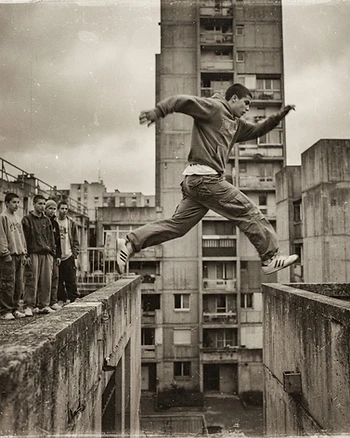
In the late 1980s and early 1990s, this legacy found a new manifestation in Lisses, a Paris suburb. David Belle, alongside a group known as the Yamakasi, began applying Hébert’s principles to the stark, functional architecture of their surroundings. By treating the environment as a continuous circuit, they turned mundane concrete walls, railings, and ledges into a sophisticated obstacle course. This period solidified the aesthetic of parkour: a seamless, rhythmic flow that prioritizes momentum and precision over theatricality. The documentary 'Jump London,' released in 2003, brought this burgeoning culture to a global audience, proving that the human body could interact with the urban grid in entirely unexpected ways.
For the modern practitioner, parkour has shifted from a rebellious urban subculture to a structured, accessible form of exercise. It is a discipline of gradual progression rather than immediate mastery. You do not need the athleticism of a stunt performer to begin; you only need the willingness to understand the geometry of your own reach and landing. Start by mastering the basic landing, a technique designed to dissipate force through the ball of the foot and the engagement of the leg muscles. This simple, controlled motion protects joints and builds the confidence required to approach more complex movements like the precision jump or the cat leap.
Equipment requirements are intentionally minimal, keeping the barrier to entry remarkably low. A pair of lightweight, flexible shoes with excellent grip is the only essential investment. Opt for footwear with a flat, rubber sole to maximize your surface contact with walls and rails. Beyond this, your own body weight provides the resistance necessary to build strength in the core, shoulders, and legs. Unlike traditional gym environments defined by static machines, parkour encourages a dynamic relationship with your surroundings, fostering a sense of play that is often missing from adult fitness regimens.
Engaging in parkour as an empty nester provides a unique intellectual and physical challenge. It forces the brain to solve spatial puzzles under the moderate pressure of movement, effectively sharpening cognitive agility alongside physical prowess. It is a meditative practice; when you focus entirely on the placement of a foot or the angle of a vault, the noise of daily life recedes. You are left with the immediate, visceral sensation of your own capacity, a reminder that the world remains a vast space for exploration regardless of your life stage.
Ultimately, this discipline is about longevity and self-knowledge. You are encouraged to move at your own pace, respecting the limits of your current physical condition while gently expanding them over time. By incorporating parkour into your weekly routine, you move beyond the concept of 'exercise' and enter a state of constant, rhythmic engagement with your environment. It is a lifetime commitment to the belief that you can always find a way over, under, or around the obstacles that present themselves, both on the street and in life.
“Movement is not just about the destination; it is about the grace with which you negotiate every barrier in your path.”
What to gather
A graded list of gear — from the first honest kit to the tools of a life in the craft. The Novice kit is free; the deeper tiers open with membership.
Novice
The first kit — enough to begin honestly.
From novice to proficient
A thirty-day passage. Each node is a day. The terracotta fill marks the ground you have already covered.
Understand the craft: the vault, the flow, the line, the calm. Tour the shoe and the city. Today is orientation; the move begins tomorrow.
YouTubeThe Craft and the City
Parkour GenerationsHow does the concept of 'the flow' change your perspective on moving through your local environment? Reflect on how you can find calm in a busy city space.
Saved locally to your device


How the cohort practices today
The pulse is quiet — for now.
Be the first to document your Parkour journey with #EmptyNexxter.