
Mountain Biking
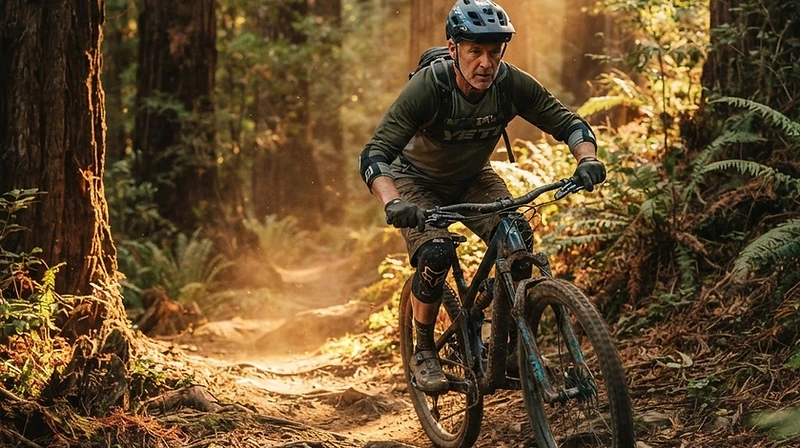
The youngest sport in the archive — a trail that goes where the road does not, a bike that goes where the car cannot, and a forest that is the place the trail leads.
But first, a little context and history...
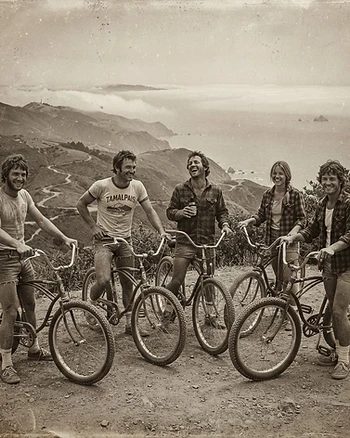
Mountain biking is the youngest sport in this archive that was invented in America, and it was invented on a mountain in California by a handful of riders who were, in the late 1970s, doing something no one had a name for. The mountain was Mount Tamalpais, in Marin County, just north of San Francisco, and the riders were a group of cyclists who had begun riding old paperboy cruisers — balloon-tire Schwinns from the 1940s and 1950s — down the fire roads and the hiking trails of the mountain for the simple thrill of going downhill fast on a bicycle where no bicycle was meant to go. They called the bikes 'klunkers,' from the sound the coaster brakes made when they burned out on the long descents, and they called themselves the Larkspur Creek Gang, and later the Repack riders, after the Repack race they organized in 1976 down a fire road so steep that the grease in the hub repacked itself — the hub had to be repacked with grease after every run.
The two riders who turned the klunker into the mountain bike were Joe Breeze and Gary Fisher. Breeze, a frame builder from Mill Valley, built the first purpose-made mountain bike frame in 1977 — the Breezer, a steel frame with a longer wheelbase, a lower bottom bracket, and clearance for wide tires, designed for the abuse of the Repack descent. Fisher, a racer and a mechanic, began building frames with Tom Ritchey in 1979 and founded MountainBikes, the first company with the name. The three of them — Breeze, Fisher, and Ritchey — are the parents of the mountain bike, and the Breezer is the first mountain bike in the sense that matters: a bicycle designed from the frame up to be ridden off road. The first mountain bike to be mass-produced was the Specialized Stumpjumper, introduced in 1981, which made the sport affordable to anyone who could not afford a hand-built frame and which is still in production. By 1985 the mountain bike was the best-selling bicycle in America, and the road bike, which had dominated the market since the 1970s bike boom, was in a decline it would not reverse for twenty years.
The technology of the mountain bike evolved quickly because the sport demanded it. The coaster brake of the klunker was replaced by cantilever brakes, which were stronger and which did not burn out on the descent; the cantilever was replaced by the V-brake in the 1990s, which was stronger still; and the V-brake was replaced by the disc brake, which was borrowed from motorcycles and which made the rim brake obsolete. The suspension fork was invented by Paul Turner, who founded RockShox in 1989, and the first full-suspension frame — a frame with both front and rear suspension — was introduced by Mert Lawwill, a former Harley-Davidson factory racer, in 1985. The number of gears grew from ten in the early 1980s to twenty-one by the 1990s, and the drivetrain that was the standard for thirty years — three chainrings in the front, seven to ten cogs in the back — was replaced in the 2010s by the one-by: a single chainring in the front and ten to twelve cogs in the back, which is simpler, lighter, and less prone to dropping the chain. The wheel that was the standard for a century — the 26-inch wheel — was replaced by the 29-inch wheel in the 2000s, which rolls over obstacles more easily and which is now the standard for cross-country and trail bikes.
The sport that the bike made possible divided into disciplines as it grew. Cross-country, the first discipline, is the race over a course of climbs and descents, and it was the first mountain bike event in the Olympics, in 1996. Downhill is the race against the clock down a steep, technical course, and it is the discipline that demands the most armor and the biggest suspension. Enduro is the discipline that combines the two: timed downhill stages linked by untimed transfers, which is the race that most resembles the way people actually ride. Freeride is the discipline of jumps, drops, and tricks, and it is the one that produced the slopestyle contest. The first mountain bike world championship was held in 1990 in Durango, Colorado; the first World Cup series in 1991. The sport's first Olympic appearance was in 1996 in Atlanta, and the first American gold was won by Susan DeMattei in the women's race.
For the empty nester, mountain biking is the rare sport that is as much an exploration as an exercise. The trail goes where the road does not, and the bike goes where the car cannot, and the forest is the place the trail leads. The bike that was a klunker on a mountain in 1977 is now a machine of extraordinary refinement, and the trail that was a fire road is now a network that covers the country. The lesson the empty nest is teaching you — that the next chapter is the one you make — is the lesson the Repack riders made on a mountain forty years ago.
“The trail goes where the road does not, and the bike goes where the car cannot, and the forest is the place the trail leads.”
What to gather
A graded list of gear — from the first honest kit to the tools of a life in the craft. The Novice kit is free; the deeper tiers open with membership.
Novice
The first kit — enough to begin honestly.
From novice to proficient
A thirty-day passage. Each node is a day. The terracotta fill marks the ground you have already covered.
The Repack race, the klunker, Joe Breeze, Gary Fisher, Tom Ritchey, the Stumpjumper. Know the lineage of the bike under you and the mountain that made it.
YouTubeWhat Mountain Biking Is
The Pro's ClosetHow does understanding the 'klunker' era and the DIY spirit of early pioneers change your perspective on the modern technology of your own bike?
Saved locally to your device


How the cohort practices today
The pulse is quiet — for now.
Be the first to document your Mountain Biking journey with #EmptyNexxter.