
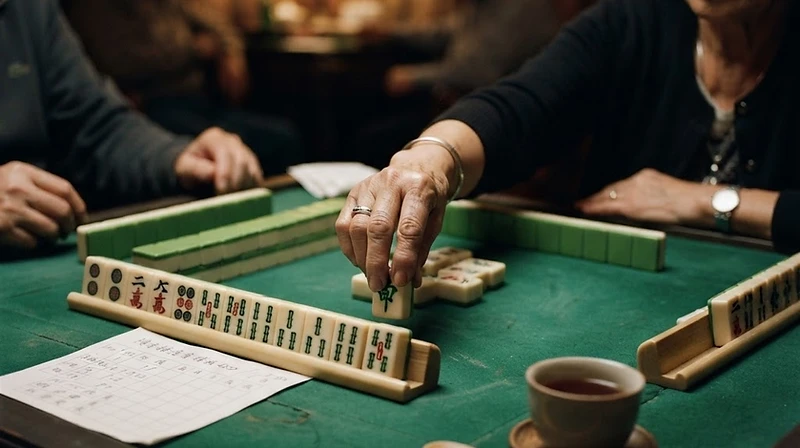
Mahjong
A symphony of tiles and chance, where the rhythm of the wall meets the precision of the focused mind.
But first, a little context and history...
At its heart, Mahjong is an elegant contest of strategy, memory, and spatial recognition. Played with 144 intricately carved tiles, the game asks participants to collect specific sets—pungs, kongs, and chows—to complete a winning hand. Beyond the mechanical assembly of these tiles, Mahjong functions as a social ritual. It demands a keen awareness of your opponents, where the discard pile becomes a narrative of their hidden intentions. For the Gen X practitioner navigating the newfound quiet of an empty nest, the game offers a meditative challenge that sharpens cognitive focus while providing a reliable framework for deep social connection.
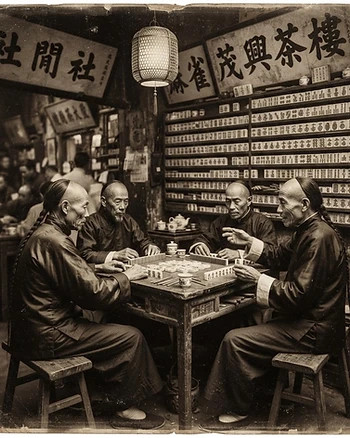
Historical records trace the roots of the game back to the mid-19th century in the coastal provinces of China, particularly Ningbo. Scholars suggest it evolved from older card games known as 'ya pei,' or leaf cards, transitioning into tiles to provide greater durability and tactile satisfaction. By the late Qing Dynasty, the game had permeated various strata of society, from the imperial courts to the flourishing merchant class. The imagery carved into the tiles—bamboos, characters, winds, and dragons—reflects a deep cultural inheritance, turning every match into a quiet encounter with history itself.
Global adoption arrived in the 1920s, spurred by individuals like Joseph Park Babcock, a Standard Oil representative who recognized the game’s universal appeal. Babcock simplified the scoring rules for Western audiences, fueling a nationwide craze that briefly rivaled the popularity of jazz and ballroom dancing. As the game settled into American life, it underwent localized transformations, leading to the formation of the National Mah Jongg League in 1937. This organization provided the necessary structure to standardize play, ensuring that the game remained both challenging and accessible for generations to come.
Today, Mahjong exists as a vibrant global hobby with countless regional variations, including the precise, high-speed Riichi rules of Japan and the strategic complexities of the American style. Modern players utilize sets crafted from bakelite, bone, or contemporary resins, each piece producing a satisfying 'click' when tapped against the table. Whether played in tournament halls or at a kitchen table with friends, the core experience remains unchanged: a meticulous process of building order from disorder. The learning curve is welcoming; one can grasp the basic rules within a few weeks, yet the pursuit of mastery provides a lifetime of intellectual reward.
For those of us transitioning into this new chapter of life, Mahjong offers a perfect balance of stimulation and serenity. It encourages a deliberate slowing down, requiring players to set aside the digital clamor of the modern world in favor of genuine face-to-face engagement. The game requires neither heavy physical exertion nor complex preparation, making it an ideal anchor for a weekly routine. It rewards patience, rewards the observant eye, and eventually, rewards the player with a deep, rhythmic intuition for the game's hidden patterns. In the quiet of an afternoon, a game of Mahjong transforms a simple table into a field of possibility, proving that some traditions are perfectly built to endure.
“To master Mahjong is to choreograph chaos, turning a handful of scattered symbols into a perfect, winning design.”
What to gather
A graded list of gear — from the first honest kit to the tools of a life in the craft. The Novice kit is free; the deeper tiers open with membership.
Novice
The first kit — enough to begin honestly.
From novice to proficient
A thirty-day passage. Each node is a day. The terracotta fill marks the ground you have already covered.
Understand the game: the tiles, the four players, the wind, the wall, the hand. Tour the table, the rack, the dice, the score. Today is orientation; the mahjong begins tomorrow.
YouTubeThe Game and the Table
napervillelibraryReflect on the complexity of the table setup. How does the physical arrangement of the tiles and racks influence the flow of the game?
Saved locally to your device


How the cohort practices today
The pulse is quiet — for now.
Be the first to document your Mahjong journey with #EmptyNexxter.