
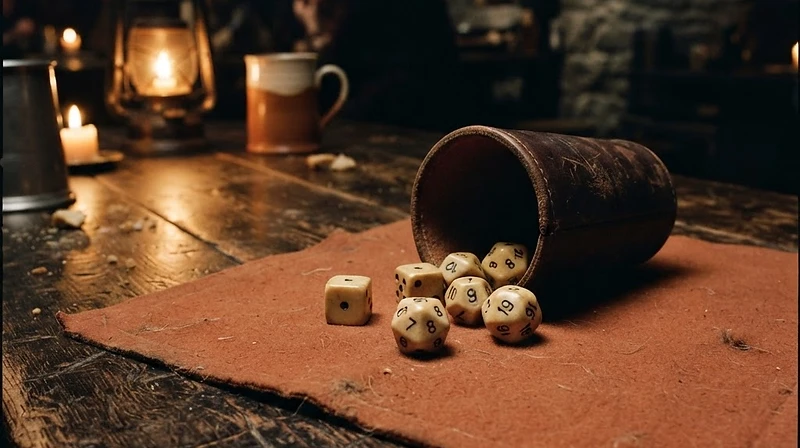
Liar's Dice
The ancient bluffing game of hidden dice and bold claims, where probability meets nerve.
But first, a little context and history...
Liar's Dice traces its roots to the sixteenth-century Spanish colonies of South America, where it was known as Perudo or Dudo. Spanish conquistadors and settlers carried the game north to California, where it became a staple of the gold-rush saloons and cattle camps of the nineteenth century. The game's elegance lies in its simplicity: each player shakes a cup of dice, slams it face-down, and peeks at what they have. Then the bidding begins, each claim escalating in boldness until someone calls the previous bidder a liar. The game is a study in incomplete information, probability under pressure, and the ancient human art of the bluff. It requires no board, no cards, and no equipment beyond five dice and a cup, which is why it has survived in barracks, ship galleys, and frontier saloons for four hundred years. Variants exist across the globe, from the open-hand Common Hand to the concealed-hand version popularized in modern bars, but the core tension is unchanged: you never know what the other player holds, and neither do they.
“In Liar's Dice, the dice are the least of what you are betting.”
What to gather
A graded list of gear — from the first honest kit to the tools of a life in the craft. The Novice kit is free; the deeper tiers open with membership.
Novice
The first kit — enough to begin honestly.
From novice to proficient
A thirty-day passage. Each node is a day. The terracotta fill marks the ground you have already covered.
Understanding the core objective and the physical setup of the game.
YouTubeThe Basics of the Cup
Practical Gaming CenterHow does the secrecy of the cup change your initial confidence in your own dice?
Saved locally to your device


How the cohort practices today
The pulse is quiet — for now.
Be the first to document your Liar's Dice journey with #EmptyNexxter.