
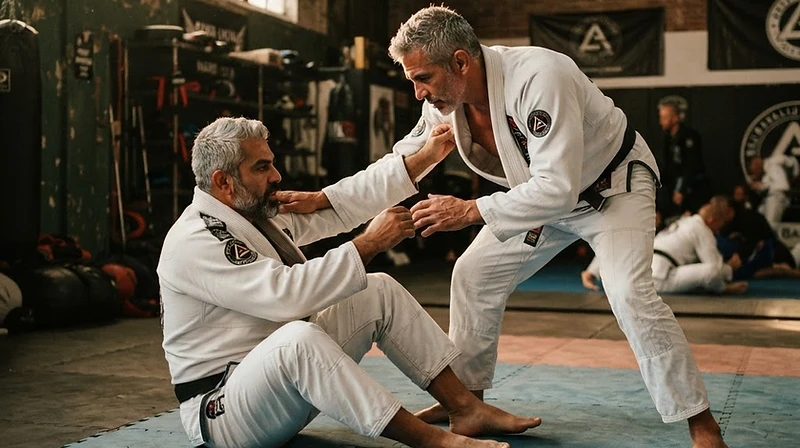
Jiu Jitsu
A chess game played with the whole body, where the smaller piece can take the larger one — if it understands leverage.
But first, a little context and history...
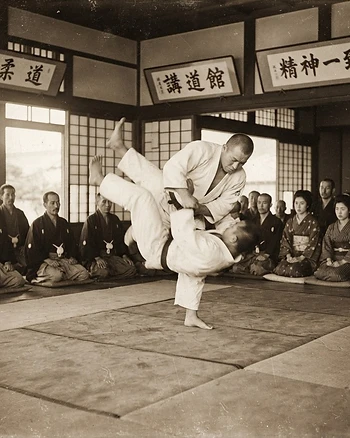
Jiu jitsu begins in the Japanese feudal era as a battlefield art for the unarmed. The samurai, stripped of sword and spear, needed a way to survive: to throw, joint-lock, and strangle an armored opponent who could not be punched or kicked to any effect. The schools that taught these methods — the koryu jujutsu ryuha — multiplied across the Edo period (1603–1868), each a family secret passed down through scrolls and bruises.
The art's modern turn came in the 1880s. A frail Tokyo student named Jigoro Kano distilled the surviving jujutsu schools into a safe, teachable curriculum he called Kodokan judo — the gentle way. Kano threw out the dangerous strikes and the secret techniques, kept the throws and the mat work, and made the art safe enough to practice at full speed. Judo spread: in 1904, Kano sent Mitsuyo Maeda, a champion judoka, abroad to demonstrate and teach. Maeda traveled the world as a professional fighter, settled in Brazil, and in 1917 took on a 15-year-old boy named Carlos Gracie as a student.
Carlos taught his younger brother Helio. Helio was sickly and small, and he could not make the throws of judo work against larger students. So he re-engineered the art around leverage, timing, and ground fighting — the guard, the sweep, the submission — and called it Gracie Jiu-Jitsu. In 1925 the Gracies opened their first academy in Rio de Janeiro and spent the next seventy years issuing open challenges to fighters of every discipline. Royce Gracie proved the art on the world stage at UFC 1 in 1993, winning three fights in one night against much larger men from boxing, wrestling, and karate.
What Brazilian jiu jitsu proved — and what every empty nester who steps on the mat learns — is that a smaller, older, weaker person can defeat a bigger, younger, stronger one, if they understand leverage and position better. It is a chess game played with the whole body, and it is one of the few physical disciplines that can be practiced at full resistance into one's sixties and beyond.
“The gentle way is the hardest discipline. The smaller person wins by knowing more, not by being more.”
What to gather
A graded list of gear — from the first honest kit to the tools of a life in the craft. The Novice kit is free; the deeper tiers open with membership.
Novice
The first kit — enough to begin honestly.
From novice to proficient
A thirty-day passage. Each node is a day. The terracotta fill marks the ground you have already covered.
The gi, the belt, the mat, the bow — the etiquette and equipment of a dojo, and the lineage from samurai to Gracie.
YouTubeThe Dojo & the Lineage
Gracie BarraReflect on why respect and hygiene are the foundations of a safe training environment. How does the culture of the dojo differ from other sports you have participated in?
Saved locally to your device


How the cohort practices today
The pulse is quiet — for now.
Be the first to document your Jiu Jitsu journey with #EmptyNexxter.