
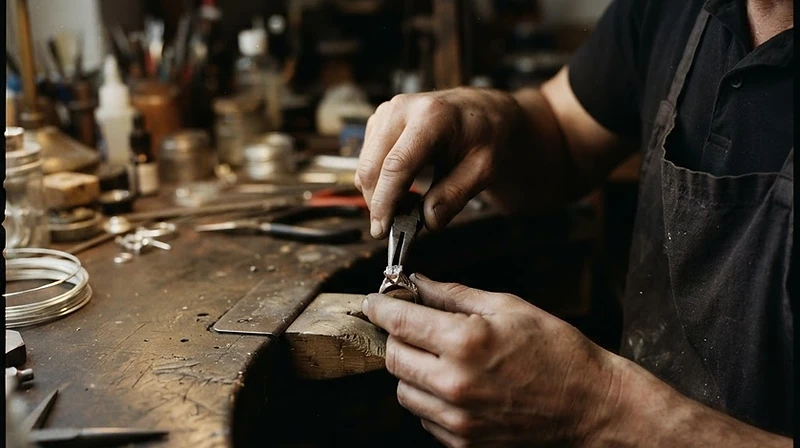
Jewelry Making
The oldest craft that fits in the hand — a wire, a flame, a stone, and the slow work of turning raw metal into something worn against the skin.
But first, a little context and history...
Jewelry making is the oldest craft that fits in the hand, and it is the craft that taught humans to work metal at all. The oldest jewelry ever found is a set of shell beads, pierced and strung, from the Skhul Cave in Israel and the Oued Djebbana in Algeria, dated to between 100,000 and 135,000 years ago. The beads were made from the shells of the sea snail Nassarius, and they were carried, sometimes for hundreds of kilometers, from the coast to the interior. They are the first evidence we have of a human being making something with no purpose but to be worn — the first evidence of the thing we call adornment — and they are the first evidence of a human being making something to last.
The craft that turned shells into gold began in the ancient Near East and Egypt, and the metal that defined it was gold. Gold is the metal that jewelry was built on because it is the metal that is found in its pure state — it does not have to be smelted from ore — and because it is soft enough to be worked cold, with a hammer and a stone. The first gold jewelry was beaten gold, made by hammering a nugget into a thin sheet and then cutting and folding it, and the technique is called chasing and repoussé: the sheet is worked from the front (chasing) and from the back (repoussé) to raise a design in relief. The goldsmiths of ancient Egypt, working from around 3000 BCE, made jewelry of a refinement that has never been surpassed, and the pieces in the tomb of Tutankhamun (c. 1323 BCE) — the gold pectoral, the gold mask, the gold coffin — are the work of masters who had every technique the modern jeweler has, except the torch.
The technique that separates the ancient jeweler from the modern one is soldering — the joining of two pieces of metal with a third, lower-melting metal — and the invention of soldering is the invention that made complex jewelry possible. Soldering was discovered in the ancient Near East, probably by accident, in the working of gold, and it was in regular use by 3000 BCE. The solder is an alloy of gold and a metal that lowers its melting point (silver, copper, or zinc), and the jeweler cuts a small chip of solder, places it at the join, and heats the whole piece until the solder melts and flows into the gap by capillary action. The join, done well, is invisible, and the piece that was made of many parts becomes one. The torch that the ancient jeweler used was a blowpipe fed by the breath, and the torch that the modern jeweler uses is a gas torch fed by a cylinder, but the principle is the same: the heat that melts the solder without melting the work.
The stone that jewelry is built around is the gemstone, and the setting that holds the stone is the setting, and the setting that every jeweler learns first is the bezel. The bezel is a band of metal that wraps the edge of the stone and is burnished over it to hold it in place, and it is the oldest and the simplest and the most secure of the settings. The more complex settings — the prong setting, the pavé setting, the channel setting — are the settings that the goldsmiths of the Renaissance developed to show more of the stone and to hold more stones in a smaller space, and the setting that the modern jeweler uses is the setting that the trade has refined over five hundred years. The gemstones that the jeweler sets are the stones that the lapidary cuts, and the cut of the stone — the facets that the lapidary grinds and polishes — is the cut that gives the stone its brilliance, and the cut that the modern jeweler takes for granted is the brilliant cut, developed by Marcel Tolkowsky in 1919 and the cut that every round diamond is now cut to.
The two forms of jewelry making that the modern maker chooses between are metalsmithing and wirework, and they are the two ends of the craft. Metalsmithing is the work of the bench: the saw, the file, the hammer, the torch, and the sheet and the wire, and the piece is built by cutting, forming, joining, and finishing. Wirework is the work of the pliers: the wire is bent, wrapped, and woven by hand, without heat, and the piece is built by the interlocking of the wire itself. Metalsmithing is the older and the more demanding craft, and it is the craft that the goldsmiths of Egypt and the Renaissance practiced. Wirework is the craft that the modern revival brought back, and it is the craft that the beginner can start with a pair of pliers and a spool of wire, and the craft that has made jewelry making a hobby that anyone can begin in an afternoon.
For the empty nester, jewelry making is the craft that rewards the patient hand and the quiet hour. The work is small — the piece fits in the palm — and the tools are few, and the bench is a corner of a table. The craft teaches the eye to see small things and the hand to do small things, and the patience it asks is the patience of the file and the torch, not the patience of the screen. The first piece is a simple ring of bent wire, and the last piece is a setting that holds a stone, and the distance between them is the distance of a hundred hours at the bench. The craft does not care how old you are, and the ring that is too fine today is the ring that is your warm-up next year. Jewelry making is the craft that keeps the hand and the eye sharp, and it is the craft that gives you, at the end, something you can wear or give that no one else has.
“The craft does not care how old you are, and the ring that is too fine today is the ring that is your warm-up next year.”
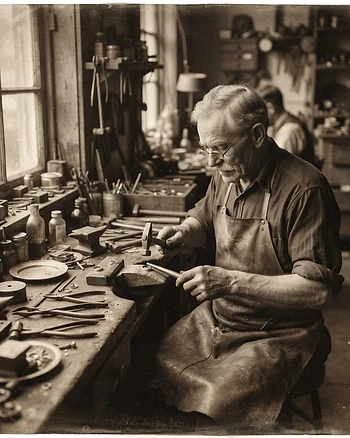
What to gather
A graded list of gear — from the first honest kit to the tools of a life in the craft. The Novice kit is free; the deeper tiers open with membership.
Novice
The first kit — enough to begin honestly.
Expert
The equipment of a life in the craft.
Coming soon
From novice to proficient
A thirty-day passage. Each node is a day. The terracotta fill marks the ground you have already covered.
Understand the two paths — metalsmithing (torch and bench) and wirework (pliers only). Tour the basic tools: pliers, cutters, saw, file, mandrel, torch. Today is orientation; the work begins tomorrow.
YouTubeThe Craft and the Tools
Jewel SchoolReflect on the two paths of jewelry making: do you feel more drawn to the precision of metalsmithing or the fluid creativity of wirework?
Saved locally to your device


How the cohort practices today
The pulse is quiet — for now.
Be the first to document your Jewelry Making journey with #EmptyNexxter.