

HIIT Training
The shortest, hardest workout in the world — bursts of all-out effort broken by brief rests, and the science that proved less can be more.
But first, a little context and history...
High-Intensity Interval Training — HIIT — is the workout that proved less can be more, and it is the most thoroughly studied exercise protocol in the history of physiology. The idea is simple: alternate short bursts of all-out effort with short periods of rest, and repeat. The science that made the idea famous is the work of a single Japanese physiologist, and the protocol that bears his name is the shortest workout ever shown to improve both aerobic and anaerobic fitness at the same time.
The man who gave HIIT its canonical form was Izumi Tabata, a researcher at the National Institute of Fitness and Sports in Tokyo, and the year was 1996. Tabata was working with the head coach of the Japanese speed skating team, Irisawa Koichi, who had devised an interval protocol of eight cycles of twenty seconds of all-out work followed by ten seconds of rest — four minutes of effort in total. Tabata ran a controlled study: one group of elite athletes trained with the Irisawa protocol four days a week plus one day of moderate-intensity training, and another group trained at moderate intensity for an hour a day, five days a week. After six weeks, the moderate group improved their aerobic capacity (VO2max) by about nine percent but gained nothing in their anaerobic capacity. The interval group improved their aerobic capacity by fourteen percent and their anaerobic capacity by twenty-eight percent. The four-minute workout, done hard enough, beat the hour-long workout. Tabata published the result in 1996 in the journal Medicine & Science in Sports & Exercise, and the protocol has been called the Tabata protocol ever since.
The idea that intervals could outperform steady work was not new even in 1996. Interval training had been used by track coaches since the early twentieth century — the Finnish runner Paavo Nurmi, who won nine Olympic golds in the 1920s, trained with intervals, and the German coach Woldemar Gerschler developed systematic interval training at the University of Freiburg in the 1930s. The difference was that Tabata and the physiologists who followed him measured what the coaches had only observed: they showed, with blood lactate and oxygen uptake, that the brief, maximal effort did something to the body that the long, moderate effort did not. The mechanism turned out to be twofold. The first is the oxygen debt: an all-out effort demands more energy than the heart and lungs can supply in the moment, and the body borrows the difference from its anaerobic stores and then spends the rest of the day (and the recovery interval) paying it back — a phenomenon called EPOC, or excess post-exercise oxygen consumption, which keeps the metabolism elevated for hours after the workout ends. The second is the mitochondrial adaptation: the repeated maximal stress forces the muscle cells to build more and larger mitochondria, the organelles that burn fuel for energy, and the increase in mitochondrial density is the cellular reason the interval-trained body becomes better at both aerobic and anaerobic work.
The decade after Tabata's study was the decade the protocol left the laboratory and entered the gym, and the people who carried it were the physiologists who showed that you did not need to be an elite athlete to benefit. The most influential of these was Martin Gibala, a physiologist at McMaster University in Ontario, who in 2010 and 2014 published studies showing that three sessions a week of one minute of all-out effort (broken into three twenty-second sprints within a ten-minute session, including warm-up and recovery) produced the same improvements in cardiovascular health as fifty minutes of steady cycling. Gibala's work brought the protocol out of the sports-science journal and into the popular press, and his 2017 book, The One-Minute Workout, made the case to the public that the barrier to fitness was not time but intensity. The science converged on a finding that the fitness industry had long resisted: the dose of exercise that matters is not the duration but the stress, and the body adapts to the hardest work it is asked to do.
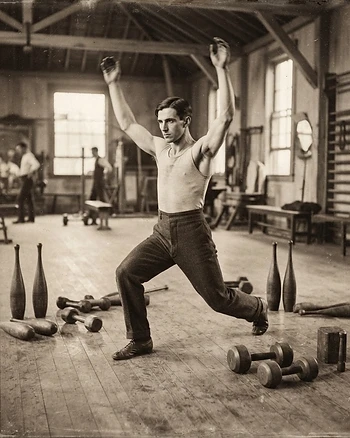
The form that HIIT took in the gym was the circuit, and the circuit was the form the boutique studio boom of the 2010s built on. The circuit — a sequence of bodyweight or weighted movements performed for time, with short rests between — was borrowed from the physical-culture gyms of the early twentieth century and from the CrossFit boxes that spread from the 2000s. The boutique studios (Barry's Bootcamp, Orangetheory, F45) wrapped the circuit in a brand, a heart-rate monitor, and a soundtrack, and they sold the same thing the Tabata protocol had proven: that a short, hard, supervised session could deliver the fitness that an hour on the treadmill could not. The smartwatch — the Apple Watch and its competitors, which arrived in 2015 and which put a heart-rate monitor and a interval timer on every wrist — completed the circuit, and the at-home HIIT workout, guided by a phone and timed by a watch, became one of the most common forms of exercise in the world.
For the empty nester, HIIT is the workout that solves the problem of time and the problem of aging at once. The loss of muscle and aerobic capacity that begins in the thirties and accelerates in the fifties is the loss that the long, moderate walk does not reverse — but the brief, hard interval does. The protocol demands nothing in equipment and little in time: a mat, a timer, and twenty minutes, three times a week. The first sessions are humbling, because the all-out effort is an effort most adults have not made since childhood, and the heart rate that a twenty-second sprint produces is a heart rate most adults have not felt in years. The body adapts fast — faster than it adapts to anything else in exercise — and the person who can do four Tabata intervals in week one can do eight in week four, and the person who could not run for a bus in January can sprint for one in March. HIIT is the workout that asks the most of the least time, and it is the workout that gives the most back the fastest.
“The dose of exercise that matters is not the duration but the stress, and the body adapts to the hardest work it is asked to do.”
What to gather
A graded list of gear — from the first honest kit to the tools of a life in the craft. The Novice kit is free; the deeper tiers open with membership.
Novice
The first kit — enough to begin honestly.
From novice to proficient
A thirty-day passage. Each node is a day. The terracotta fill marks the ground you have already covered.
Understand the protocol: short bursts of all-out effort (90%+ of max heart rate) broken by brief rests. HIIT is not 'hard cardio' — it is maximal. Today, learn to find your max effort and your recovery breath.
YouTubeWhat HIIT Is — and Is Not
The Body Coach TVHow did it feel to push your body to its limit for 20 seconds, and what did you notice about your breathing during the 10-second recovery?
Saved locally to your device


How the cohort practices today
The pulse is quiet — for now.
Be the first to document your HIIT Training journey with #EmptyNexxter.