

Harmonica
A pocket-sized orchestra — the instrument that taught America the blues, one bent note at a time.
But first, a little context and history...
The harmonica is the only instrument small enough to carry in your shirt pocket that can make a room full of strangers weep. Ten holes, twenty reeds, and a lifetime of breath — it is the instrument that taught America the blues, carried by soldiers in the Civil War, hobos on the railroads, and buskers on every street corner where someone needed to make a dollar and a point at the same time.
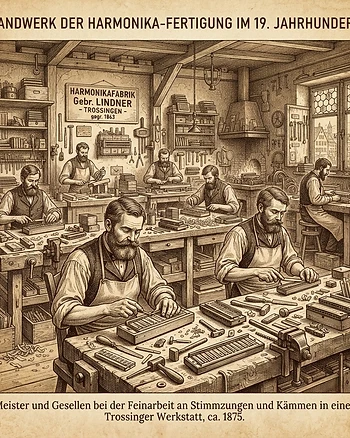
The free-reed principle that powers the harmonica is ancient — it appears in Chinese sheng mouth organs dating back three thousand years — but the instrument as we know it was born in the German workshops of the 1820s. Christian Friedrich Ludwig Buschmann patented the aura in 1821, a small reed instrument played with the mouth, and within a decade clockmakers in the town of Trossingen were producing harmonicas by the thousands. Matthias Hohner, a clockmaker who founded his harmonica company in 1857, built the instrument into a global industry, and by the turn of the century Hohner was producing millions of harmonicas a year and shipping them to America, where they cost less than a dollar and required no lessons, no sheet music, and no teacher.
The harmonica arrived in America as a toy and became a voice. During the Civil War, soldiers on both sides carried harmonicas in their pockets and played them in camp, and the instrument spread across the continent with the railroad. Hobos and itinerant workers learned to play the harmonica because it was the only instrument that survived a train ride in a coat pocket, and the blues harmonica tradition grew out of the Mississippi Delta, where players like Sonny Terry, Sonny Boy Williamson, and Little Walter developed techniques that turned a folk toy into an instrument capable of expressing the full range of human feeling.
Little Walter Jacobs was the figure who transformed the harmonica from a solo instrument into a band instrument. Playing with Muddy Waters in the Chicago blues scene of the 1950s, Walter held a microphone close to the harmonica and cupped his hands around it, creating a distorted, amplified sound that could cut through a full electric band. He was the first harmonica player to treat the instrument as an electric voice, and every blues harmonica player since has been working in his shadow. The techniques he invented — tongue blocking, hand vibrato, the warble, the overblow — are the vocabulary of modern harmonica playing.
The harmonica crossed into every American music form that followed. Bob Dylan used it as a folk instrument, strapping it in a rack around his neck so he could play guitar and harmonica at the same time. The Rolling Stones' early sound was built on Brian Jones's harmonica work. Country music adopted it for train songs and lonesome ballads. Stevie Wonder made the chromatic harmonica sing as a lead instrument in pop and soul. The instrument that cost a dollar in 1860 still costs a few dollars today, and the distance between a beginner's first wheeze and a master's bent note is the distance between picking up a sound and finding your own voice in it.
“You do not play the harmonica. You breathe it, and the reeds decide whether to weep or shout.”

What to gather
A graded list of gear — from the first honest kit to the tools of a life in the craft. The Novice kit is free; the deeper tiers open with membership.
Novice
The first kit — enough to begin honestly.
From novice to proficient
A thirty-day passage. Each node is a day. The terracotta fill marks the ground you have already covered.
Verify clean single-note production using the pucker embouchure.
Pucker Technique: Single Note Isolation
Which hole felt the most difficult to isolate, and how did adjusting your lip tension affect the clarity of the note?
Saved locally to your device


How the cohort practices today
The pulse is quiet — for now.
Be the first to document your Harmonica journey with #EmptyNexxter.