

Golf
The sport the Scots gave the world — a four-mile walk, a swing you can make at seventy, and a handicap that lets you play against your grandchildren.
But first, a little context and history...
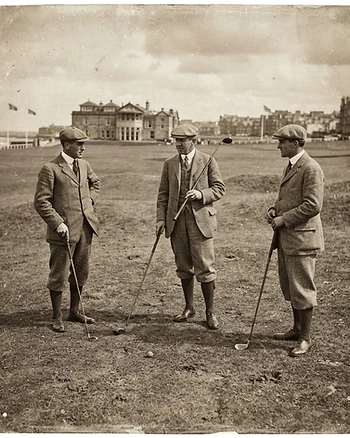
Golf is the sport the Scots gave the world, and they gave it on a stretch of coast east of St Andrews where the wind off the North Sea bent the gorse and the rabbits cropped the turf short. The first written record of the game is a 1457 Act of the Scottish Parliament, in which King James II banned golf because it was distracting his subjects from archery practice — which the realm needed for war with England. The ban was repeated in 1471 and 1491, which suggests it was not very effective. The earliest golf clubs we know of are the bishop's clubs that the Earl of Bothwell bought in 1502 from a bowmaker in Perth, and the first golf course is the Old Course at St Andrews, which was not designed but was shaped by the land and the sheep that grazed it into the shared common it still is.
The game the Scots played was played with a feathery — a ball stitched from leather and stuffed with boiled goose feathers, which cost as much as a day's wages and split open in the wet. The feathery was the ball for four hundred years, until the Reverend Adam Paterson of St Andrews demonstrated the gutta-percha ball in 1848, made from the dried latex of the Malaysian sapodilla tree, which was cheaper, more durable, and flew farther. The gutty, as it was called, democratized the game and made the modern sport possible. The next revolution was the Haskell ball, patented in 1898 by Coburn Haskell, a Cleveland dentist, who wound rubber thread around a solid core and covered it in gutta-percha: the wound ball flew farther still and held the green. The dimple pattern that every modern ball wears was added in 1908, by William Taylor, who found that a dimpled ball flew farther than a smooth one because the dimples created a turbulent boundary layer that reduced drag. The ball in your bag is the product of five hundred years of trial and error.
The club evolved in parallel. The first clubs were wooden — made of ash, thorn, or apple — and were used for every shot. The iron was a later invention, used first to escape trouble, and it was the forged steel heads of the late nineteenth century that made the iron a club for every shot. The first set of matched clubs was built by Robert Forgan of St Andrews in 1851, and the first steel shaft was patented in 1910, though it was not legal until 1924. The first sand wedge was invented by Gene Sarazen in 1931 after a lesson from Howard Hughes about how an airplane's flaps worked; the first modern putter was the center-shafted model built by Karsten Solheim in his garage in 1959, which became Ping. The driver, the wood that is now metal, is the club that has changed most: the first metal wood was introduced by TaylorMade in 1979, and the first oversized titanium driver was introduced by Callaway in 1995. The club that hits the ball the farthest is also the one that has changed the most.
The rules of the game are the oldest written rules in sport. The first code, drawn up in 1744 by the Honourable Company of Edinburgh Golfers for the playing at Leith, had thirteen rules; the modern Rules of Golf, administered jointly by the R&A and the USGA, has twenty-five. The handicap system, which lets players of different ability play against each other, was invented in the nineteenth century and is the reason golf is the rare sport you can play competitively for a lifetime. The first Open Championship was played at Prestwick in 1860 and was won by Willie Park Senior with a score of 174 for thirty-six holes; the first Masters was played at Augusta National in 1934 and was won by Horton Smith. The Ryder Cup, the team match between the United States and Europe, began in 1927. The sport's first Olympic appearance was in 1900; its second was in 2016, after a 116-year absence.
For the empty nester, golf is the rare hobby that rewards patience more than strength. The swing is a motion you can make at seventy as well as at thirty, and the handicap is the reason you can play against your children and your grandchildren and have a match. The course is a walk of four miles, which is the reason the sport is also the only one that is good for you. The lesson the empty nest is teaching you — that the long game is the one worth playing — is the lesson golf has been teaching for six hundred years.
“The swing is a motion you can make at seventy as well as at thirty, and the handicap is the reason you can play against your children and your grandchildren.”
What to gather
A graded list of gear — from the first honest kit to the tools of a life in the craft. The Novice kit is free; the deeper tiers open with membership.
Novice
The first kit — enough to begin honestly.
Expert
The equipment of a life in the craft.
Coming soon
From novice to proficient
A thirty-day passage. Each node is a day. The terracotta fill marks the ground you have already covered.
The 1457 ban, the feathery, the gutty, the Haskell, the dimple. The Old Course and the Honourable Company. Know the lineage of the ball and the club in your hands.
YouTubeWhat Golf Is
MeandmygolfReflect on the history of golf and how the evolution of equipment has changed the way the game is played today. How does understanding the origins of the sport change your perspective on the modern game?
Saved locally to your device


How the cohort practices today
The pulse is quiet — for now.
Be the first to document your Golf journey with #EmptyNexxter.