
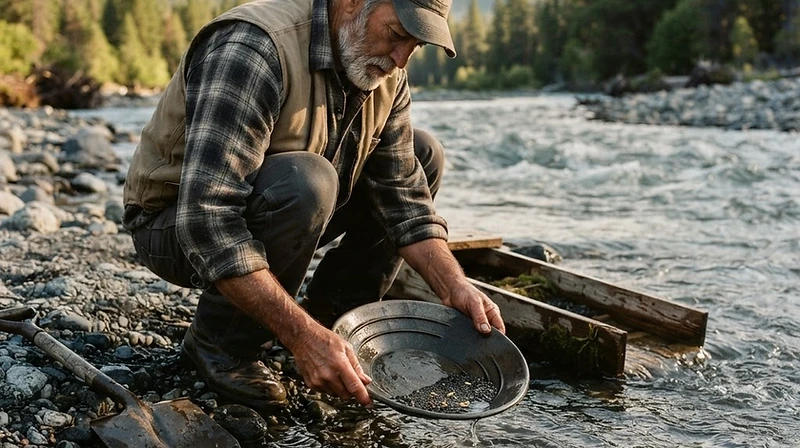
Gold Panning
Master the art of the river, where gravity and patience reveal the hidden weight of the earth.
But first, a little context and history...
Gold panning serves as the most accessible entry point into the world of prospecting, requiring only a keen eye and a basic understanding of geology. At its core, the practice relies on the high specific gravity of gold, which causes the precious metal to settle at the bottom of a pan while lighter sediment, known as overburden, is washed away by water. This fundamental physical principle has remained unchanged since the days of the Roman Empire, when hydraulic mining techniques were first documented to extract ore from riverbeds. Modern practitioners use lightweight plastic pans with riffled edges to catch fine flakes, making the process both efficient and portable for any weekend excursion. For the Gen X empty nester, this hobby offers a perfect blend of low-impact physical movement and intellectual engagement, transforming a simple walk along a mountain stream into a focused, rewarding archaeological pursuit. History took a dramatic turn on January 24, 1848, when James W. Marshall discovered gold flakes at Sutter's Mill in Coloma, California. This singular event triggered the California Gold Rush of 1849, drawing thousands of 'forty-niners' to the Sierra Nevada foothills. Prospectors arrived with little more than a galvanized steel pan, a shovel, and a dream of striking it rich. While the era of industrial dredging has long passed, the romantic appeal of the pan persists. It serves as a living connection to the pioneers who shaped the American West, turning the river into a classroom of earth science and historical persistence. The transition from the massive labor of 19th-century mining to today's recreational panning allows for a gentler pace. You no longer need to stake a claim or fight the elements for survival; instead, you can focus on the nuances of river flow and sediment distribution. Modern gear is vastly superior to the tools of 1849, with specialized 'snuffer bottles' for suctioning up flakes and magnetic tools to remove black sand. This hobby is particularly suited for those in their second prime who value autonomy, quiet reflection, and the satisfaction of uncovering something hidden in plain sight. Mastering the 'swirl' requires a rhythmic motion that centers the mind, offering a welcome respite from the digital noise of daily professional life. Whether you are searching for 'color' in the streams of the American River or exploring the historic sites of the Klondike, the act of panning is deeply meditative. It invites you to read the river’s path, identifying where gold settles behind large boulders or in the roots of submerged vegetation. You learn to interpret the landscape, recognizing how geological time has pushed precious minerals into the crevices of the earth. Beyond the physical act of finding gold, the community of modern prospectors provides a vibrant social scene for sharing tips, equipment reviews, and geological data. Joining a local club allows you to access private claims and benefit from the expertise of seasoned hobbyists. Ultimately, gold panning is not about the wealth you accumulate, but about the patience you cultivate. It is an invitation to step away from the clock and measure your day in the flow of clear water and the promise of the next scoop.
“Gold panning is a quiet conversation between the prospector and the current—a meditation in mud and silt.”

What to gather
A graded list of gear — from the first honest kit to the tools of a life in the craft. The Novice kit is free; the deeper tiers open with membership.
From novice to proficient
A thirty-day passage. Each node is a day. The terracotta fill marks the ground you have already covered.
Understand the craft: the pan, the swirl, the read, the gold. Tour the gear and the river. Today is orientation; the panning begins tomorrow.
YouTubeThe Craft and the River
Gold ProspectingReflect on the history of the river you plan to visit. How does understanding the landscape's past change your perspective on the potential for finding gold?
Saved locally to your device


How the cohort practices today
The pulse is quiet — for now.
Be the first to document your Gold Panning journey with #EmptyNexxter.