
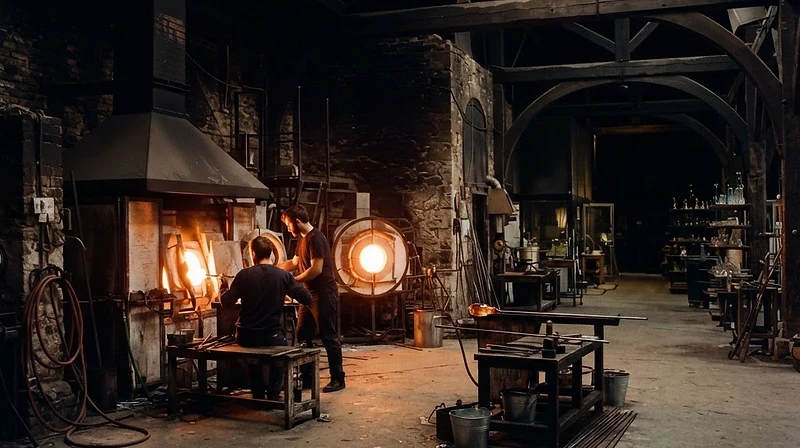
Glassblowing
Breathing glass into being — the oldest craft that still happens in real time, at 1,000 degrees and a slow, perfect rotation.
But first, a little context and history...
Glass was once treated as a gem — cast, cold-worked, precious. Then, somewhere along the Syrian coast around the middle of the first century BCE, a glassworker discovered that a gather of molten glass on the end of a hollow iron pipe could be inflated like a bubble. That single insight — glass is not carved, it is breathed — turned a luxury stone into a vessel anyone could own. Within a generation, glassblowing had spread across the Roman world, and the ribbed, prismatic mould-blown cups made in Syrian and Judean workshops were travelling further than Roman legions did.
For over a thousand years after Rome fell, the craft's centre drifted north and west. By 1291 the Venetian Republic had moved its glassmakers to the island of Murano — officially a fire precaution, effectively a way to keep the technology and its secrets on one island. Murano's families invented cristallo, the near-colourless glass that let Renaissance Europe see its wine; they held their knowledge so tightly that a glassblower leaving the Republic risked punishment. When Angelo Barovier's clear glass reached northern Europe, it reset what the material could be used for: optics, mirrors, science, spectacle.
Industrialisation split the craft from the factory — pressed glass and machine bottles took the tableware market — but it did not kill the hand. In 1962, at a Toledo workshop, Harvey Littleton and Dominick Labino demonstrated a small furnace a single artist could afford to run, and the American studio glass movement began. Today glassblowing exists in three overlapping worlds: the factory, the artist's studio, and the pay-to-play studio where a beginner rents a bench, a furnace and a few hours of heat. That last one is where this lab begins — with a full sharp breath, one turn of the pipe, and a shape that only exists because you were there.
“Glass is not carved. It is breathed, and it is always one second away from a different shape.”
What to gather
A graded list of gear — from the first honest kit to the tools of a life in the craft. The Novice kit is free; the deeper tiers open with membership.
Novice
The first kit — enough to begin honestly.
From novice to proficient
A thirty-day passage. Each node is a day. The terracotta fill marks the ground you have already covered.
Understanding the studio environment, safety protocols, and the physical properties of molten glass.
YouTubeIntroduction to the Hot Shop
Corning Museum of GlassWhat was the most surprising thing about the heat and scale of the hot shop?
Saved locally to your device


How the cohort practices today
The pulse is quiet — for now.
Be the first to document your Glassblowing journey with #EmptyNexxter.