
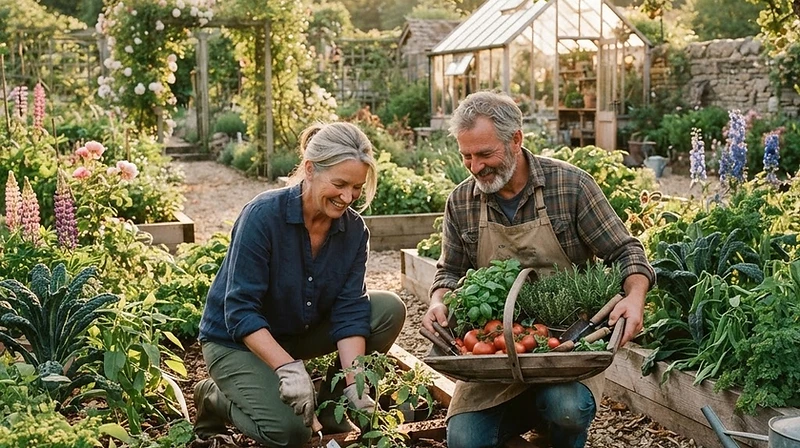
Gardening
The oldest conversation between a human and the ground — and the one that pays in tomatoes.
But first, a little context and history...
Gardening is older than the city. When the last ice age ended around 11,000 years ago, the people of the Fertile Crescent — in what is now Iraq, Syria, and Lebanon — began to save the seeds of the wild grasses they gathered. Rye, einkorn, and emmer became wheat and barley; wild legumes became lentils and peas. The first gardens were not ornamental but survival: a patch of saved seed beside a settlement, a hedge against famine. By 7000 BCE, the first walled gardens of Mesopotamia were irrigated by hand-dug canals from the Tigris and Euphrates.
The ornamental garden came later, and it came as a luxury. The Hanging Gardens of Babylon — one of the Seven Wonders, whether they existed or not — fixed the idea of the garden as a paradise, a man-made Eden. The Persians called it pairidaeza, a walled enclosure, and the Greeks borrowed the word as paradeisos. The garden as paradise entered every Abrahamic religion through that Persian wall.
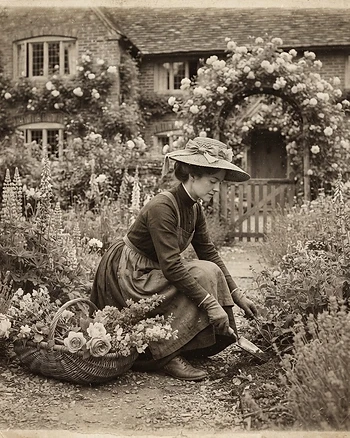
Every civilization built its own garden. The Romans had the peristyle, a courtyard of columns around a pool and flowers. The medieval monastery garden grew physic herbs for medicine and salvation in equal measure. The Islamic garden — the charbagh, four quadrants divided by water — spread from Spain to India and reached its summit in the Taj Mahal. The English cottage garden, a jostle of flower, herb, and vegetable, grew from the peasant's yard and became, by the 19th century, a national art form. The Japanese garden, a thousand years older than the English, made a religion of stone, water, and moss.
The American garden is younger and more democratic. Thomas Jefferson's vegetable garden at Monticello, begun in the 1770s, was an experiment in what the new country could grow; his neighbor and rival George Washington designed the gardens at Mount Vernon as a statement of the new republic's taste. The victory garden of the two world wars turned 20 million Americans into vegetable gardeners almost overnight. For the empty nester, the garden is the rare hobby that gives back exactly what you put in — patience, attention, and time — and that pays in tomatoes.
“The garden is the only hobby that gives back exactly what you put in — patience, attention, and time.”
What to gather
A graded list of gear — from the first honest kit to the tools of a life in the craft. The Novice kit is free; the deeper tiers open with membership.
Novice
The first kit — enough to begin honestly.
From novice to proficient
A thirty-day passage. Each node is a day. The terracotta fill marks the ground you have already covered.
Full sun, partial shade, clay, sand, loam. Read your plot before you plant — the ground decides what will grow.
YouTubeReading Your Plot
Epic GardeningAfter observing your garden for a day, which areas receive the most intense afternoon sun, and how might that change your planting plan?
Saved locally to your device


How the cohort practices today
The pulse is quiet — for now.
Be the first to document your Gardening journey with #EmptyNexxter.