
Food Truck Business
A commercial kitchen you can park in front of your customers, and the business behind it.
But first, a little context and history...
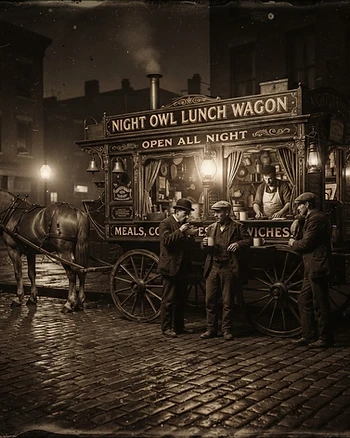
In 1872 a Rhode Island man named Walter Scott cut a serving window into a horse-drawn wagon, parked it outside the Providence Journal, and sold sandwiches and coffee to the men coming off the night press. He is generally credited with the first lunch wagon, and the shape of the business has barely changed since: a small kitchen, a piece of pavement, and a crowd that is already there. By the 1890s lunch wagons were a fixture of factory districts and rail yards, built by firms like Buckley Wagon Works in Worcester, Massachusetts, painted in scrollwork and gaslit, feeding the night shift what the boarding house could not.
As the wagons motorised, the trade split. Ice cream went first: in 1920 Harry Burt of Youngstown, Ohio fitted a truck with a chime and a freezer and put his Chocolate Dipped Ice Cream Sucker on the street, and the Good Humor fleet that followed is the reason a certain generation hears a jingle and reaches for a wallet. On the industrial side the catering truck, cheerfully nicknamed the roach coach, made the round of construction sites, plants and offices on a fixed schedule.
The next shift began in East Los Angeles in 1974, when Raul and Albina Martinez cut the sides out of an ice cream truck and started serving tacos from it. The taco truck became a city institution, then a regional one, and it proved something the industry had not quite believed: a truck was not a lesser restaurant. It was a restaurant that could follow its customers.
In 2008 Roy Choi parked a truck called Kogi in Los Angeles and sold Korean-Mexican tacos, announcing locations on Twitter, and a line formed. The gourmet food truck boom that followed was part cuisine, part recession economics: in the collapse of that year, a truck was the only honest way many cooks could afford to own a kitchen. Cities rewrote their vending codes, food truck pods and parks appeared, and chefs began treating a truck as a legitimate first restaurant rather than a fallback.
What remains today is a business with the worst and best margins in food service. There is no dining room and no landlord, but there is a truck payment, a commissary fee, a permit for every jurisdiction, weather that cancels a day's revenue, and a health inspection that can park you. The economics are unforgiving and completely knowable, which is why the last thirty days of this lab are about numbers rather than recipes. The romance of the truck is real. It is also a spreadsheet.
“The first food truck parked where the hungry already were, and that is still the entire strategy.”
What to gather
A graded list of gear — from the first honest kit to the tools of a life in the craft. The Novice kit is free; the deeper tiers open with membership.
Novice
The first kit — enough to begin honestly.
From novice to proficient
A thirty-day passage. Each node is a day. The terracotta fill marks the ground you have already covered.
A tour of everything a food truck actually requires, from concept to first service.
YouTubeThe Whole Business in Twenty Minutes
Wilson K LeeList the five things that surprised you about what this business requires.
Saved locally to your device


How the cohort practices today
The pulse is quiet — for now.
Be the first to document your Food Truck Business journey with #EmptyNexxter.