
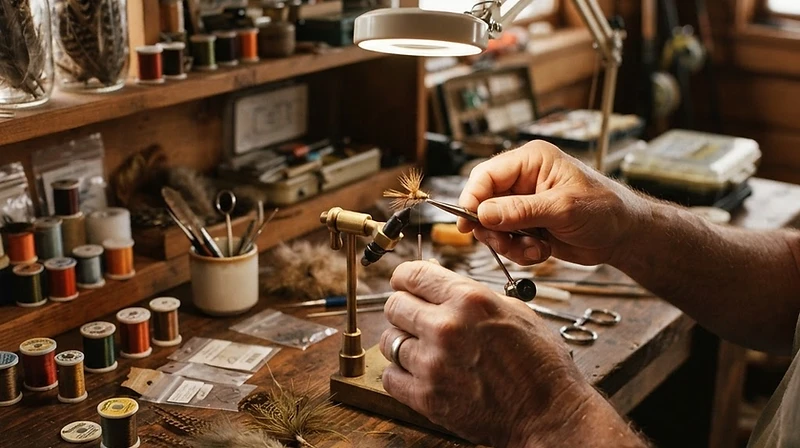
Fly Tying
Feather, thread, and hook — the sculpture of a lie, tied small enough to fool a fish into believing it is real.
But first, a little context and history...
Fly tying is the craft of dressing a fishhook with feather, fur, thread, and wire to create an artificial fly — an imitation of an insect, a crustacean, or a small baitfish designed to fool a fish into striking. You sit at a vise, hold a hook in the jaws, and wrap materials around the shank one turn at a time until the fly takes shape. The fly is small — often smaller than a fingernail — and the materials are delicate. The craft is in the proportion, the color, and the movement of the finished fly in the water.
The first written record of fly tying comes from the 2nd-century Roman author Claudius Aelianus, who described Macedonian anglers dressing hooks with red wool and feathers to imitate the insects that speckled fish fed on. The technique was already old. For centuries, fly tying was a practical skill — anglers tied their own flies because there was no one else to do it. The patterns were local, passed from father to son, and the materials were whatever the region provided: feathers from local game birds, fur from local mammals, silk thread from the merchant.
The craft became an art form in 19th-century England, where the chalk-stream gentry turned fly tying into a refined pursuit. The Victorian fly tiers developed the classic patterns — the Gold-Ribbed Hare's Ear, the Pheasant Tail, the Partridge and Orange — that are still tied today. They also developed the tools: the rotary vise, the hackle pliers, the whip finish tool. The materials trade grew: hackle capes from specially bred chickens, dubbing from fur farms, hooks from Sheffield steel.
The American tradition brought its own patterns and its own philosophy. The Catskill school — Theodore Gordon, Art Flick, and Harry and Elsie Darbee — tied sparse, elegant flies for the clear, pressured streams of the East. The Western school — tied bigger, bushier flies for the fast, turbid rivers of the Rockies. The Atlantic salmon fly — the most elaborate of all fly-tying traditions — became an art form in itself, with fully dressed salmon flies displayed in glass cases like jewelry.
The modern era brought a revolution in materials. Synthetic dubbing, flash, foam, and epoxy expanded the fly tier's palette beyond natural materials. The tube fly, the articulated streamer, and the saltwater fly all emerged as new forms. YouTube and online forums made the craft accessible to anyone — a tier in Montana can now learn from a tier in Scandinavia in real time. The fly-tying community is one of the most generous in any craft — tiers share patterns, techniques, and materials freely, because the craft is not about secrecy but about the fish.
The equipment is modest. A vise to hold the hook, a bobbin to hold the thread, scissors, hackle pliers, and a whip finish tool. A starter kit of materials — hooks, thread, hackle, dubbing — costs under $50. The materials accumulate over a lifetime: a hackle cape can cost $100, a pelt of deer hair $15, a bottle of UV resin $20. The fly itself costs nothing once you have the materials — a few cents of feather and thread on a ten-cent hook.
The craft rewards proportion above all else. A well-tied fly is not about beauty but about behavior — how it sits on the water, how it moves in the current, how it looks to a fish that has seen ten thousand real insects. The first fly is a lumpy mess. The hundredth is a pattern you can tie in three minutes that catches fish consistently. The distance between them is the distance of a thousand wraps of thread.
For the empty nester, fly tying is a craft you can do at a desk, in the evening, while the light fades. It does not demand a river or a season. It gives you something to make in the winter, something to fish in the spring, and something to give to a friend who fishes. The vise does not care how old your eyes are. It only cares how steadily you can wrap the thread.
“The tie is sculpture. The fish is the only honest critic.”
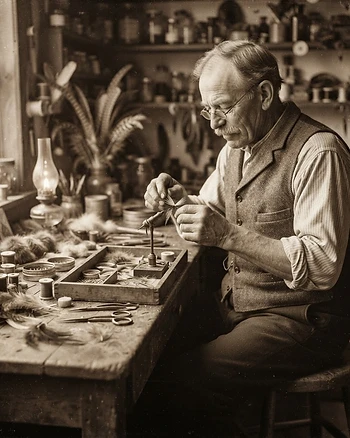
What to gather
A graded list of gear — from the first honest kit to the tools of a life in the craft. The Novice kit is free; the deeper tiers open with membership.
Novice
The first kit — enough to begin honestly.
From novice to proficient
A thirty-day passage. Each node is a day. The terracotta fill marks the ground you have already covered.
Learn what fly tying is — the dressing of a hook with feather, fur, and thread to imitate an insect or baitfish. Understand the vise, the bobbin, and the whip finish. These are the tools of a craft that began in the 2nd century.
YouTubeThe Hook and the Vise
Tightline ProductionsReflect on the history of fly tying; how does it feel to participate in a craft that has been practiced for centuries?
Saved locally to your device


How the cohort practices today
The pulse is quiet — for now.
Be the first to document your Fly Tying journey with #EmptyNexxter.