
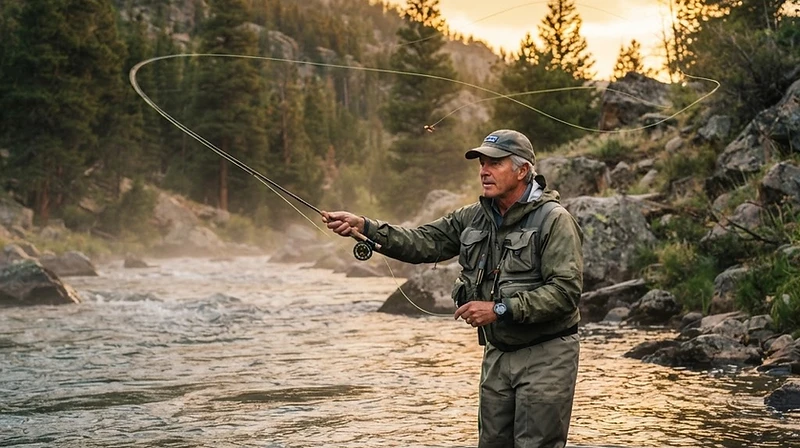
Fly Fishing
Reading water, casting a line, and waiting for a fish to believe the lie you throw across the current.
But first, a little context and history...
Fly fishing is the art of catching fish with an artificial fly — a hook dressed in feather, fur, and thread to imitate an insect or a small baitfish. You cast not with the weight of a lure but with the weight of the line itself, unrolling it in a loop that lays the fly on the water with a touch lighter than the real thing. The cast is geometry. The read of the water is science. The fish is the only honest critic.
The first written record of fly fishing comes from the 2nd-century Roman author Claudius Aelianus, who described Macedonian anglers casting hooks dressed with red wool and feathers to catch speckled fish that fed on insects on the surface. The technique was already old when he wrote about it. Fly fishing matured on the chalk streams of southern England, where the gentry and the clergy turned it into a refined pursuit. Izaak Walton's "The Compleat Angler" (1653) codified the philosophy of the sport — that fishing was not just a means to catch fish but a way of life, a meditation on nature and patience.
The 19th century brought the technical revolution. The split-cane rod, the silk line, and the modern reel transformed the equipment. Frederick Halford, fishing the chalk streams of the Test and the Itchen in the 1880s, codified dry-fly fishing — presenting a floating fly to a rising trout with a precision that bordered on obsession. His rival, G.E.M. Skues, championed the nymph — a sunken fly fished below the surface — and the debate between dry-fly purists and nymph fishermen became one of the great arguments in angling.
The American tradition was forged on the wild rivers of the West and the Catskills. Theodore Gordon, fishing the Beaverkill in the early 1900s, adapted the English dry fly to American waters and American trout. Lee Wulff, a mid-century iconoclast, championed catch-and-release fishing, light tackle, and the idea that a fish was too valuable to be caught only once. Norman Maclean's novella "A River Runs Through It" (1976) made fly fishing a metaphor for family, faith, and the unbridgeable distance between people who love each other.
The modern era brought graphite rods, floating and sinking lines for every condition, and a global expansion of the sport. Fly fishing spread from trout to bass, pike, bonefish, tarpon, and even saltwater big game. The equipment diversified: a 3-weight rod for small streams, a 5-weight for general trout fishing, an 8-weight for bass and steelhead, a 12-weight for tarpon. The flies multiplied from a few classic patterns to thousands, each tied for a specific insect, a specific fish, and a specific water.
The craft rewards patience above all else. You learn to read water — the seam where the current meets the slow water, the riffle where the insects live, the pool where the fish hold. You learn to cast — the overhead, the roll, the reach, the stack — each a tool for a different problem. You learn to set the hook with a gentle lift, not a jerk, because a fly holds by a single point in a soft mouth. And you learn to release the fish you catch, because the sport is not about the taking but about the meeting.
For the empty nester, fly fishing is a hobby that puts you in the river. It is physical, meditative, and endlessly variable. It does not demand the arm it once did — modern rods are light and fast. It rewards a smooth, repeatable cast and a calm read of the water. The first day is a tangle and a splash. The hundredth is a drift that lands a fly on a dime and a fish that takes it without a sound. The river does not care how old you are. It only cares how quietly you can wade.
“The cast is geometry. The fish is the only honest critic.”

What to gather
A graded list of gear — from the first honest kit to the tools of a life in the craft. The Novice kit is free; the deeper tiers open with membership.
Novice
The first kit — enough to begin honestly.
- PLUSINNO Fly Fishing Rod and Reel Combo Kit — 5/6 Wt 9' Starter Package with Carrying BagAmazon$63.97
- SF Fly Fishing Rod Combo Starter Kit — 24T Carbon Fiber Trout Travel Fly Rod with Reel, Case, Fly Box, Flies, Leader, Knot ToolsAmazon$79.99
- Aventik Practice Fly Rod with Line — 4ft Practice Rod for Beginners Casting PracticeAmazon$40.99
- SF Hand Tied Loop Fly Fishing Tapered Leader — Nylon, Freshwater Trout, 9FT 5XAmazon$6.99
- HOOK-EZE Fishing Knot Tying Tool — Protect from Hooks, Nail Knot Tool for Beginner AnglersAmazon$14.99
From novice to proficient
A thirty-day passage. Each node is a day. The terracotta fill marks the ground you have already covered.
Learn what fly fishing actually is — casting not the weight of a lure but the weight of the line itself, unrolling in a loop to lay a fly on the water. Understand the rod, the reel, and the line as a single system.
YouTubeThe Line and the Rod
Ventures Fly Co.How does the concept of casting the weight of the line, rather than the weight of a lure, change your perspective on how a fly rod functions?
Saved locally to your device


How the cohort practices today
Tied my first woolly bugger. Ugly, but the river did not care. #EmptyNexxter