
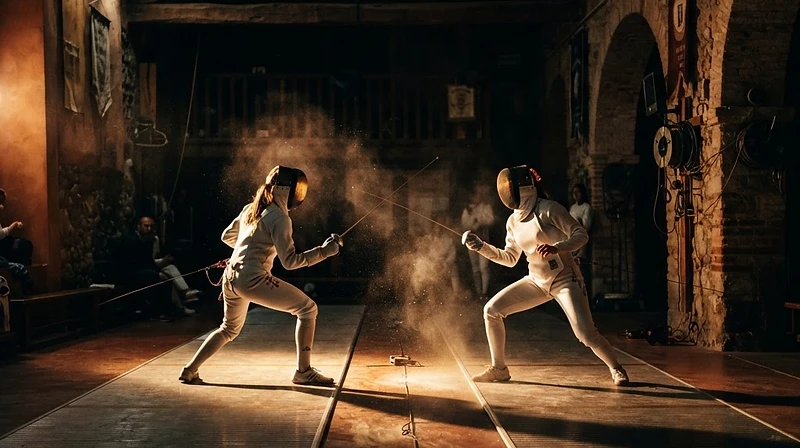
Fencing
The original physical chess — a conversation of blades where measure, timing, and the line that opens decide the point before the thought completes.
But first, a little context and history...
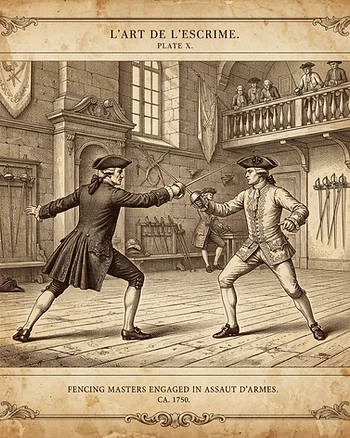
Fencing is the duel made safe, the sword made sport. It descends from a lineage older than the gun: the rapier play of the sixteenth century, when a gentleman's education was incomplete until he could defend his name on the field of honor. The Italian masters — Marozzo, Agrippa, Capoferro — were the first to reduce combat to geometry, teaching that the sword was governed not by strength but by angles, time, and measure. The French, in the next century, added the foil: a practice weapon whose tip was blunted and whose target was the chest, so that a man could learn to kill without first dying.
What fencing preserves, alone among modern sports, is the grammar of the duel. Every phrase begins with a salute and ends with a handshake; every touch is a sentence with a subject, a verb, and a period. There are three weapons — foil, épée, and sabre — and each is a different language. The foil is a school of right-of-way, a convention that teaches the fencer to attack with priority and defend with intention. The épée is the honest descendant of the dueling sword: the whole body is target, and the first to land wins, even by a fraction of a second. The sabre, fastest of the three, is cavalry-descended, cut and thrust, where the bout is decided before the fencer has time to think.
What makes fencing singular is that it is a physical chess played at the speed of reaction. The blade travels faster than the eye can follow; the point arrives in the space between two heartbeats. And yet the art is not speed but preparation — the small feints and changes of distance that open the line before the attack is launched. A beginner learns to hit; a master learns to make the opponent believe the hit was their own idea.
“Fencing is thinking with your hand; the blade arrives where the mind has already gone, and the point is won in the inch between intention and action.”
What to gather
A graded list of gear — from the first honest kit to the tools of a life in the craft. The Novice kit is free; the deeper tiers open with membership.
Novice
The first kit — enough to begin honestly.
From novice to proficient
A thirty-day passage. Each node is a day. The terracotta fill marks the ground you have already covered.
Mastering the foundational en garde position, focusing on weight distribution and balance.
YouTubeThe En Garde Stance
Fencing4YouHow does your center of gravity feel when you hold the en garde position for 60 seconds?
Saved locally to your device


How the cohort practices today
The pulse is quiet — for now.
Be the first to document your Fencing journey with #EmptyNexxter.