

Fasting
The oldest health practice in human history — learning to sit with hunger and discover what your body is built to do.
But first, a little context and history...
Fasting is the oldest health practice in human history and the only one that costs nothing. Every religion that has ever existed has prescribed it, every physician from Hippocrates to the present has studied it, and every human body is already built for it — we evolved in a world where food was not guaranteed, and the mechanisms that store energy and release it are the mechanisms that keep us alive between meals. To fast is to use the biology you already have, on purpose, for the first time.
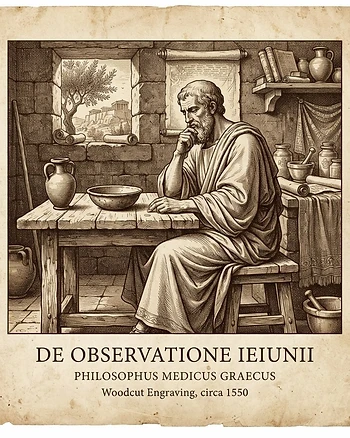
The deliberate practice of fasting is older than written language. Hunter-gatherer societies lived in cycles of feast and famine by necessity, and the human body adapted to perform at its best in the fasted state — heightened alertness, sharp cognition, efficient fat burning, and the cellular repair processes that modern science calls autophagy. The first written records of fasting as a deliberate discipline come from ancient Greece, where Pythagoras fasted for forty days before examinations and Hippocrates prescribed fasting for digestive complaints, arguing that to feed a sick man was to feed his sickness. The Greek word for fasting, nestia, gave us the medical term for the baseline blood sugar level that every modern lab measures: the fasting glucose.
Every major religion adopted fasting as a spiritual technology. Hinduism, Buddhism, and Jainism prescribed upavasa for purification and self-discipline. Judaism established Yom Kippur as a day of complete fast. Christianity developed Lent as a forty-day fast modeled on Christ's time in the wilderness. Islam made Ramadan a month of daily fasting from dawn to sunset, a practice observed by nearly two billion people today. The shared insight across all of these traditions is that hunger is not an emergency — it is a signal, and learning to sit with it rather than immediately answering it is a skill that changes your relationship with everything else you consume.
Modern fasting research began in the twentieth century with studies of calorie restriction and longevity, but the form that transformed public understanding was intermittent fasting — the practice of compressing your daily eating into a window of eight hours or less and fasting for the remaining sixteen. Research from the 2010s onward showed that time-restricted eating produces measurable benefits in insulin sensitivity, blood pressure, inflammatory markers, and cellular repair, and that many of these benefits are triggered by the fasting state itself rather than by weight loss. The mechanism is evolutionarily simple: when the body has no incoming food, it stops storing and starts repairing, and the repair processes — autophagy, in which cells clean out damaged components — only activate after the insulin from your last meal has fully cleared.
The practice of fasting is not complicated, but it is not easy. The first fast is uncomfortable because the body has never been asked to wait, and the mind interprets the discomfort as danger. By the third or fourth day of a time-restricted eating practice, the body switches from running on glucose to running on fat, and the discomfort disappears. By the second week, most people report that their thinking is clearer, their energy is more stable, and their relationship with food has changed from compulsion to choice. The reward is not weight loss, though that often follows — it is the discovery that your body is not a machine that breaks when you skip a meal, but a system that thrives when you give it room to rest.
“Hunger is not an emergency. It is a signal, and learning to sit with it is a skill that changes your relationship with everything else you consume.”
What to gather
A graded list of gear — from the first honest kit to the tools of a life in the craft. The Novice kit is free; the deeper tiers open with membership.
Novice
The first kit — enough to begin honestly.
From novice to proficient
A thirty-day passage. Each node is a day. The terracotta fill marks the ground you have already covered.
Verifying your ability to stay committed to your fast in environments designed for eating.
Social Fasting Practice: Navigating External Environments
How did it feel to be the only person not eating, and what specific social cues were the hardest to navigate?
Saved locally to your device


How the cohort practices today
The pulse is quiet — for now.
Be the first to document your Fasting journey with #EmptyNexxter.