
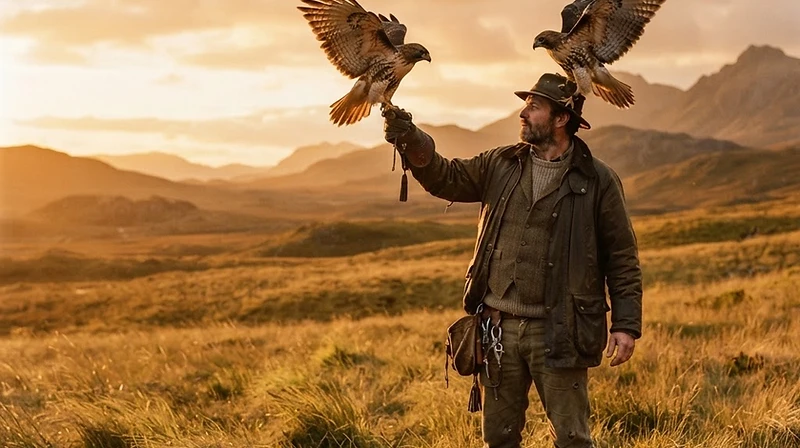
Falconry
The oldest partnership between human and predator — training a wild raptor to hunt from your fist, as kings and nomads have done for four thousand years.
But first, a little context and history...
Falconry is the oldest sport in which the human is not the hunter but the partner. The earliest evidence — stone carvings from Mesopotamia depicting a man on horseback with a raptor on his fist — dates to roughly 2000 BCE, though the practice is almost certainly older, born among the nomadic horsemen of the Central Asian steppe who discovered that a trained hawk could catch game a man alone never could. From the steppe, falconry spread west to Persia, Arabia, and eventually Europe, and east to China and Japan, carried by traders and conquerors along the same routes that moved silk and spice.
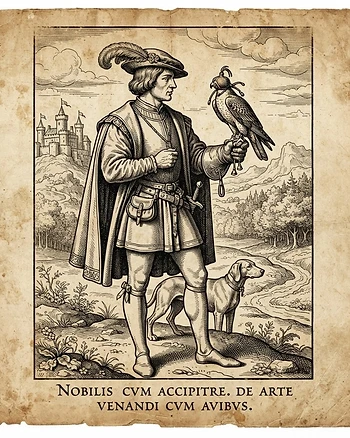
In medieval Europe, falconry became the defining sport of the aristocracy. The laws were precise and merciless: an emperor could fly a gyrfalcon, an earl a peregrine, a yeoman a goshawk, and a priest a sparrowhawk — each bird matched to a rank, and poaching another man's hawk was a crime punishable by death. The Bayeux Tapestry shows King Harold with a hawk on his fist; Frederick II of Sicily wrote a six-volume treatise on the art in the 1240s that remains, eight centuries later, one of the most thorough falconry manuals ever produced. To fly a hawk was to be civilized.
The sport nearly died with the old aristocracy. The invention of firearms made the bow obsolete for hunting, and the enclosure of the English countryside destroyed the open land falconry required. By 1900, falconry was a curiosity practiced by a few hundred people worldwide. What saved it was, paradoxically, the pesticide crisis. When DDT pushed the peregrine falcon to the brink of extinction in the 1960s, the falconers — the only people who knew how to breed and handle raptors in captivity — became the foundation of the captive breeding program that brought the species back. The same knowledge that once served kings now serves conservation.
Modern falconry is licensed and regulated in every country where it is legal. In the United States, an apprentice must serve two years under a sponsor, trap and train a wild bird, build a facility that passes inspection, and pass a written exam before receiving a permit. The commitment is not casual: a raptor must be flown, fed, weighed, and monitored every day. But the reward is a partnership no other sport offers — a wild creature that could disappear over the horizon at any moment, and chooses, every day, to come back to your fist.
“The hawk does not belong to you. You belong to the hawk — and the day it decides otherwise, it is gone.”
What to gather
A graded list of gear — from the first honest kit to the tools of a life in the craft. The Novice kit is free; the deeper tiers open with membership.
Novice
The first kit — enough to begin honestly.
From novice to proficient
A thirty-day passage. Each node is a day. The terracotta fill marks the ground you have already covered.
Ensuring full compliance with regulatory and ethical standards.
Legal Readiness Audit
Which specific legal requirement surprised you most, and how do you plan to remain compliant?
Saved locally to your device


How the cohort practices today
The pulse is quiet — for now.
Be the first to document your Falconry journey with #EmptyNexxter.